Species → Canada Lynx
Canada Lynx
Lynx canadensis
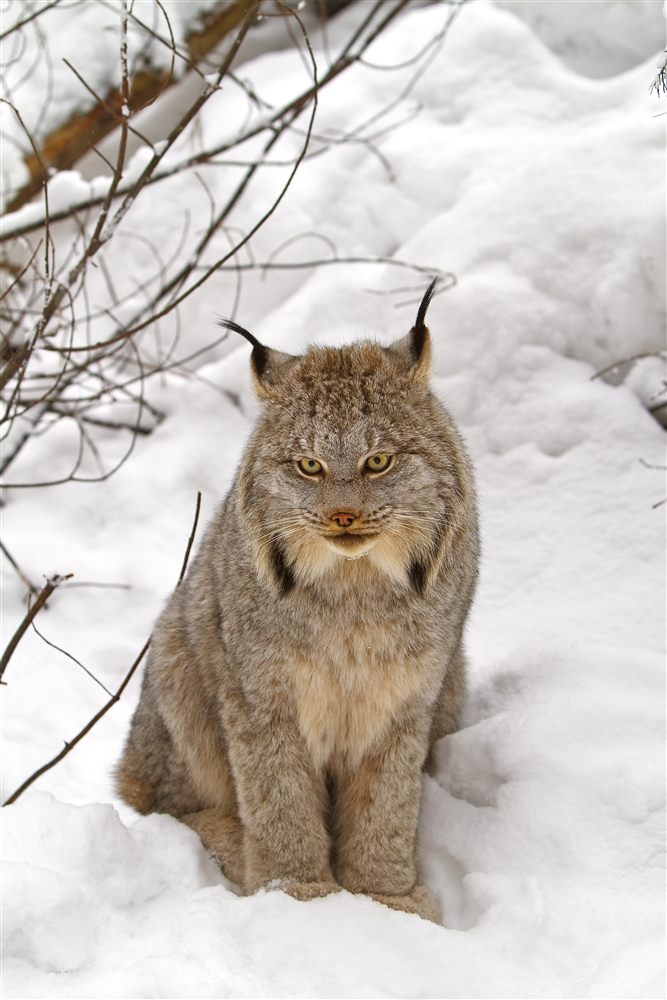
What if it disappeared?
Impact HighWithout the lynx to hunt it, one of the snowshoe hare's main sources of predation pressure vanishes at once: a field experiment showed that excluding mammalian predators, including the lynx, doubles hare density compared to control plots.
DocumentedDetail
Krebs, C.J., Boutin, S., Boonstra, R. et al. (1995). Impact of Food and Predation on the Snowshoe Hare Cycle. Science, 269(5227), 1112–1115.
A factorial experiment on one-square-kilometer plots in southwestern Yukon compared control plots to plots where mammalian predators — including the lynx — were fenced out. Predator exclusion alone doubled hare density; combined with supplemental food, it pushed density up to 11 times the control level, proof that predation alone carries substantial weight in hare population size.
But removing the lynx specifically likely isn't the same as removing every predator: unlike the coyote, which can fall back on other prey, the lynx hunts almost nothing but hare — losing the lynx would likely dampen the hare cycle's swings without erasing them entirely.
ExtrapolatedDetail
Extrapolation à partir de O'Donoghue, Boutin, Krebs et al. (1998). Functional responses of coyotes and lynx to the snowshoe hare cycle. Ecology, 79(4), 1193–1208, qui compare le comportement de chasse des deux prédateurs sans mesurer l'effet du retrait du seul lynx.
The study shows that the lynx and coyote, predators of comparable size, differ sharply in their ability to catch replacement prey when hares become scarce: the coyote shifts its diet, the lynx much less so. This asymmetry suggests the lynx's role in the cycle's troughs is not interchangeable with the coyote's.
What's missing to confirm it: No field experiment has excluded the lynx alone, leaving other predators in place, to directly measure how much the hare cycle would persist without it specifically.
Over a century, the roughly 9.6-year cycle that shaped hare and lynx populations across two centuries of fur records would likely blur: generalists like the coyote would take over part of the vacated role, but without recreating the tight link that once bound the hare to its former specialist predator.
HypothesisOver a thousand years, a permanently weakened predator-prey cycle would eventually feed through to the browsing of willow, birch and poplar in the boreal forest, whose regrowth depends on the hare population's own highs and lows — a forest whose regeneration rhythm would never quite settle back into the same cadence.
HypothesisDocumentation
-
IUCN Red List — Lynx canadensis, statut et lacunes de données sur la population mondiale
Accessed August 7, 2026
-
Elton & Nicholson (1942) — The Ten-Year Cycle in Numbers of the Lynx in Canada, Journal of Animal Ecology
Accessed August 7, 2026
-
Krebs, Boutin, Boonstra et al. (1995) — Impact of Food and Predation on the Snowshoe Hare Cycle, Science
Accessed August 7, 2026
-
O'Donoghue, Boutin, Krebs et al. (1998) — Functional Responses of Coyotes and Lynx to the Snowshoe Hare Cycle, Ecology
Accessed August 7, 2026
Last verified: August 16, 2026