Species → Coyote
Coyote
Canis latrans
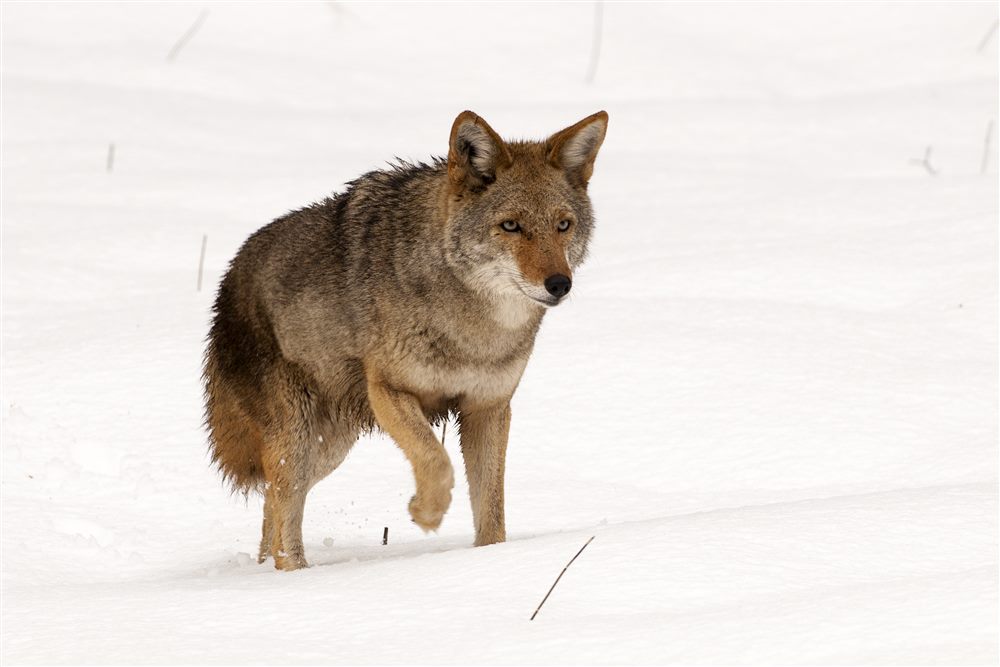
What if it disappeared?
Impact HighIn the chaparral fragments of Southern California where coyotes disappear due to habitat fragmentation, the mesopredators they once kept at bay — feral house cats, gray foxes, raccoons, skunks — almost immediately stop avoiding those areas and become markedly more active.
DocumentedDetail
Crooks, K.R. et Soulé, M.E. (1999). Mesopredator release and avifaunal extinctions in a fragmented system. Nature, 400, 563–566.
The study tracked 37 fragments of urban chaparral around San Diego, ranging from 0.4 to 104 hectares. Fragment size and time since isolation predicted coyote presence; in its absence, mesopredator activity — led by the house cat — rose sharply and quickly, a sign of an immediate behavioral release rather than an effect that takes years to set in.
That sustained rise in mesopredator activity eventually empties the fragments of their ground-nesting birds: several species go locally extinct there, an effect that builds up the longer the coyote stays absent rather than leveling off after the initial shock.
DocumentedDetail
Crooks, K.R. et Soulé, M.E. (1999). Mesopredator release and avifaunal extinctions in a fragmented system. Nature, 400, 563–566.
Ground-nesting bird species richness fell as coyote absence persisted, with several local extinctions documented directly in the fragments most lacking coyotes. The dominant driver was increased predation by the house cat, once freed from the pressure the coyote had exerted on it.
Over a century, these same fragments would likely have lost nearly all of their ground-nesting birds, with a mesopredator population settled into a lasting equilibrium rather than still expanding: the trend the study measured worsens with the length of coyote absence, with no sign of leveling off within the observed window.
ExtrapolatedDetail
Extrapolation à partir de Crooks & Soulé (1999), qui mesurent une aggravation de l'effet avec la durée d'isolement des fragments (jusqu'à quelques décennies dans l'échantillon étudié), projetée ici sur un horizon d'un siècle.
The study documents a correlation between how long a fragment has been isolated and the intensity of mesopredator release, though no sampled fragment had reached a full century of isolation — the extrapolation takes this trend, observed over a few decades, and projects it out to a hundred years, rather than relying on a direct measurement at that horizon.
What's missing to confirm it: No fragment tracked by the study has reached a full century of isolation; nothing directly confirms that bird loss keeps worsening beyond a few decades rather than leveling off.
Over a thousand years without coyotes across the continent, other medium-sized predators — bobcats, red foxes — would likely take on part of its mesopredator-suppression role, and some other canid might fill in the fawn predation it now provides in the east, where wolves are gone. But no single successor would combine both roles at once: a patchwork of partial replacements, never one clean substitute.
HypothesisDocumentation
-
Canis latrans — The IUCN Red List of Threatened Species
Accessed August 10, 2026
-
Crooks & Soulé (1999) — Mesopredator release and avifaunal extinctions in a fragmented system, Nature 400
Accessed August 7, 2026
-
Benson et al. (2017) — Ungulate predation and ecological roles of wolves and coyotes in eastern North America, Ecological Applications
Accessed August 7, 2026
-
IUCN Red List — Canis latrans, statut et tendance de population
Accessed August 7, 2026
Last verified: August 16, 2026