Species → African Wild Dog
African Wild Dog
Lycaon pictus
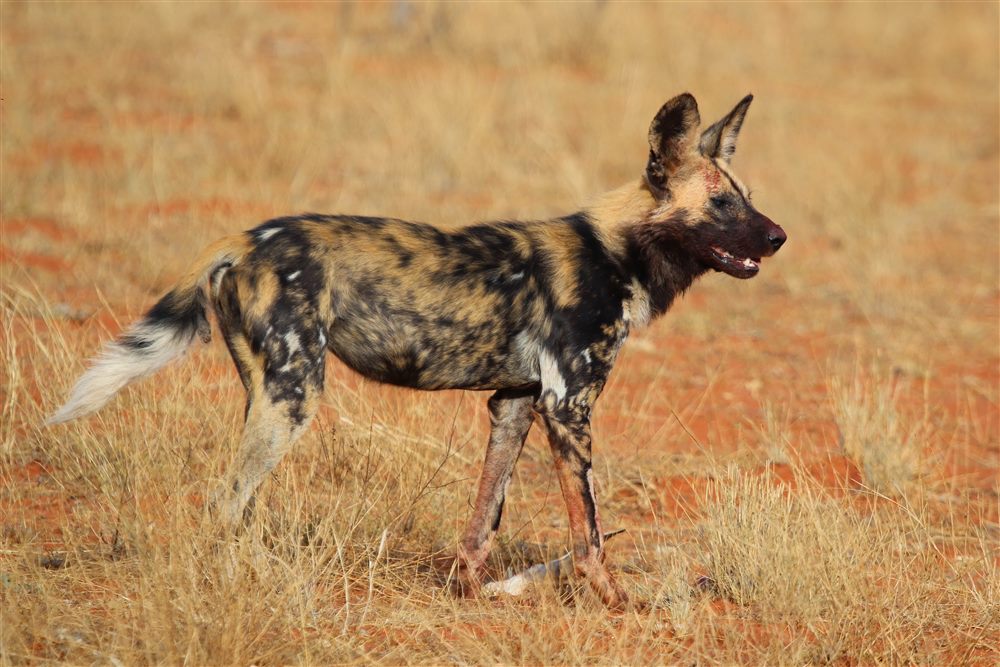
What if it disappeared?
Impact LowWithout the wild dog, the small and medium-sized antelope it already falls back on during lean periods — up to 30% more often according to accelerometer-collar data — would suddenly lose a predator that increases its hunting effort rather than reducing its kills when prey grows scarce: a predation pressure that stayed active even in the worst conditions would vanish almost at once.
HypothesisThat relief would reach several size classes of antelope at once rather than a single population exploding: the wild dog specifically broadens its diet to small antelope when larger prey is scarce, so its prolonged absence would leave these different prey without the one predator that hunted them in every condition — a diffuse pressure across the whole savanna antelope guild rather than one lock giving way.
HypothesisOn the Serengeti plains, where the wild dog genuinely went locally extinct in the early 1990s after sixteen years of decline, that constant predation pressure on small and medium-sized antelope would likely have given way to the other predators of the same guild — lion, hyena, cheetah — none of which reproduces the same long-distance, coordinated pack-hunting strategy.
HypothesisThe gap left by this specific hunting strategy — coordinated long-distance pack pursuit, able to sustain its kill rate even as prey grows scarce — would likely never be fully filled by the savanna's other carnivores, each of which hunts its own way: a lastingly different predation network, rather than a simple swap of one species for another.
HypothesisDocumentation
-
IUCN Red List — Lycaon pictus, évaluation 2020 (Woodroffe & Sillero-Zubiri)
Accessed August 7, 2026
-
Burrows, Hofer & East (1994) — Demography, extinction and intervention in a small population: the Serengeti wild dogs, Proceedings of the Royal Society B
Accessed August 7, 2026
-
Creel, Redcliffe, Goodheart et al. (2025) — Prey depletion, interspecific competition, and the energetics of hunting in endangered African wild dogs, PNAS
Accessed August 7, 2026
Last verified: August 16, 2026