Species → African Lion
African Lion
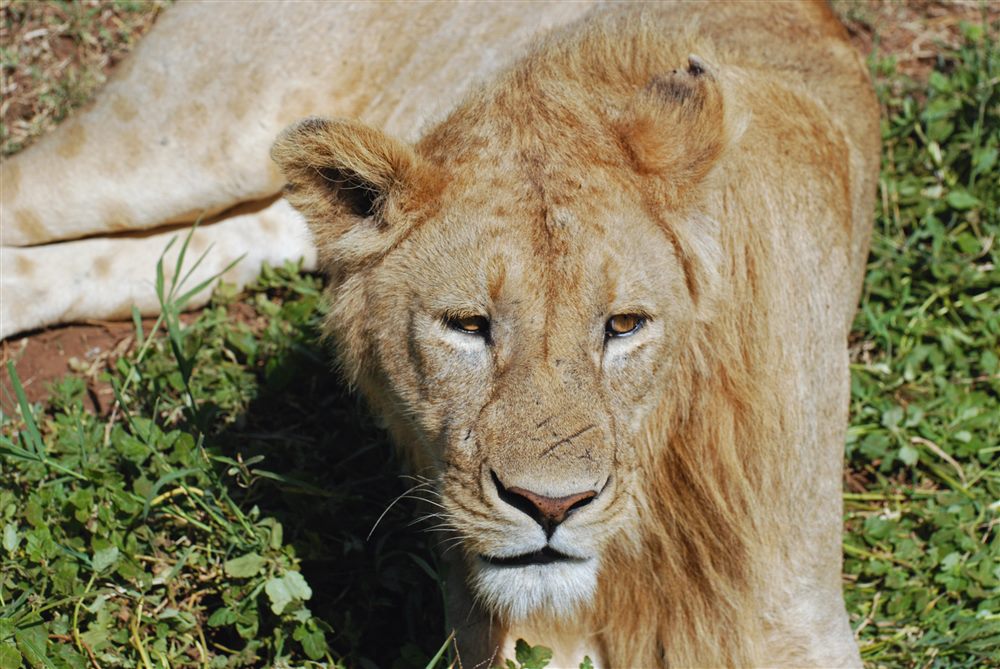
Panthera leo
What if it disappeared?
Impact HighThe lion hunts by ambush, and that alone changes its prey's behavior: impala, warthog, waterbuck, and kudu actively avoid the areas it frequents, unlike areas frequented by cheetahs or African wild dogs, which hunt by chase. Without lions, that avoidance would likely stop almost immediately, with large herbivores fearlessly recolonizing the areas they used to avoid.
ExtrapolatedDetail
Extrapolation à partir de Thaker, Vanak, Owen et al. (2011), qui mesure l'évitement spatial des grands herbivores en présence du lion dans la réserve de Karongwe, sans tester directement ce qui se passe une fois le lion disparu du territoire.
Study conducted in the fenced Karongwe Reserve (South Africa) on seven ungulate species in the presence of five large predators. Small-bodied species avoid all predators, while larger ones (wildebeest, zebra, giraffe) avoid only areas with heavy lion and leopard presence — proof that the lion's effect on prey spatial distribution is measurable and specific to its hunting style. The study compares areas where the lion is present to varying degrees at the same point in time; inferring what would happen if the lion vanished from the territory entirely remains an inference, not a direct measurement.
What's missing to confirm it: A study comparing the same herds' behavior before and after an actual lion disappearance on the same territory, rather than a comparison between areas where it is present to varying degrees.
Where lions, leopards, and spotted hyenas disappeared from three Ghanaian national parks, olive baboons — their former occasional prey and competitor — exploded in number: a 365% increase in sightings and a 500% increase in their range over the period.
DocumentedDetail
Taylor, R.A., Ryan, S.J., Brashares, J.S. et Johnson, L.R. (2016). Hunting, food subsidies, and mesopredator release: the dynamics of crop-raiding baboons in a managed landscape. Ecology, 97(4), 951–960 — citant les données de suivi du Ghana Wildlife Division (1968-2004).
Across the six national parks studied by Ghana's wildlife services, large predators (lion, leopard, spotted hyena) went locally extinct in three of them between 1968 and 2004. In these parks without an apex predator, the olive baboon shifted from a largely herbivorous and frugivorous diet to an omnivorous one including small vertebrates, and considerably expanded its territory — a classic case of mesopredator release documented over a span of decades rather than as a single snapshot.
If the baboon explosion observed in Ghana repeats elsewhere as lions decline across the continent, a century would be enough to turn these local conflicts into a structural problem: multiplied incursions outside park boundaries and ravaged crops along the edges of several protected areas at once, not just the three Ghanaian parks studied.
ExtrapolatedDetail
Extrapolation à partir de Taylor et al. (2016), dont le modèle mathématique s'appuie sur les données ghanéennes pour projeter la dynamique de maraudage des babouins, sans confirmer empiriquement que ce schéma se généralise à l'échelle du continent sur le long terme.
Taylor et al.'s model explicitly links the loss of apex predators to increased crop-raiding by baboons in areas peripheral to parks, with economic consequences and heightened risk of human-wildlife conflict. This is a plausible mechanism consistent with the documented Ghanaian case, but its extension across a century and multiple countries hasn't been measured elsewhere in the same way.
What's missing to confirm it: Replicating the Ghana study, followed over several decades, in other East or southern African parks where lions are declining would confirm whether baboon release — and the resulting human-wildlife conflict — is a general pattern rather than a local case.
Over a thousand years, other predators like the spotted hyena or the leopard would likely take up part of the space the lion left behind, but none hunt very large prey in groups the way it did: buffalo and wildebeest would probably remain less regulated in the long run, and the baboon, having become largely omnivorous without a lion to keep it in check, would have lastingly reshaped the local food chain.
HypothesisDocumentation
-
IUCN SSC Cat Specialist Group (2023) — Panthera leo, The IUCN Red List of Threatened Species
Accessed August 7, 2026
-
Thaker, Vanak, Owen et al. (2011) — Minimizing predation risk in a landscape of multiple predators, Ecology
Accessed August 7, 2026
-
Taylor, Ryan, Brashares & Johnson (2016) — Hunting, food subsidies, and mesopredator release: crop-raiding baboons, Ecology
Accessed August 7, 2026
Last verified: August 16, 2026