Species → Cheetah
Cheetah
Acinonyx jubatus
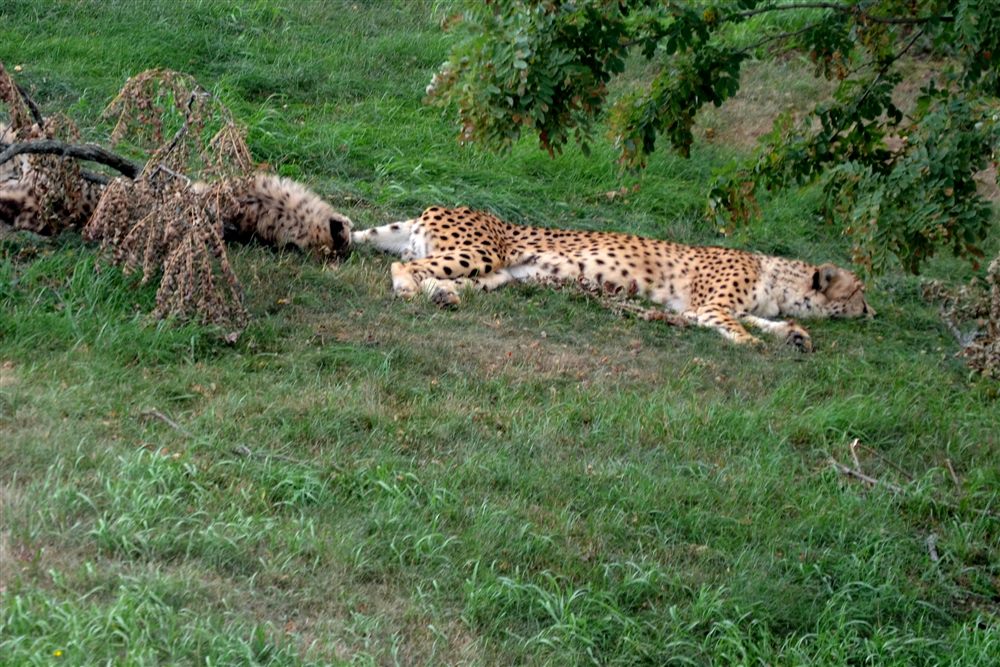
The cheetah is a predator specialized in daytime hunting, with residual, fragmented populations declining across sub-Saharan Africa — its IUCN status is Vulnerable. Its disappearance would change little in the short term: lions and hyenas already hunt its prey. What is at stake is a specific niche — daytime hunting, which nocturnal predators do not fill — and how its prey would reorganize around that gap.
What if it disappeared?
Impact LowLittle change: the cheetah's prey — gazelles, impalas — remain actively hunted by lions and hyenas, which already steal 10 to 12% of its kills today.
ExtrapolatedDetail
Extrapolation à partir de Durant (2000), qui documente le vol de proies par les hyènes chez le guépard vivant, pas la conséquence de sa disparition.
Durant (2000) shows that 10 to 12% of kills made by a cheetah in the Serengeti are stolen before it can feed on them, mainly by hyenas — meaning a share of the predation pressure on the same prey already comes from elsewhere. Its disappearance would remove only one predation source among several already active on the same species.
What's missing to confirm it: No study directly measures the effect of removing the cheetah on its prey at one year — the reasoning starts from its role as a hunter already partly redundant with lions and hyenas.
Cheetahs hunt mostly by day, a time when lions and hyenas, more active at night, hunt little. Ten years after its disappearance, this window would likely stay underused while another predator adapts to fill it.
ExtrapolatedDetail
Extrapolation à partir de Durant (2000), qui documente l'évitement comportemental du guépard envers lions et hyènes du vivant de l'espèce, pas le devenir de son créneau de chasse après sa disparition.
The study establishes that the cheetah actively avoids areas and times where lions and hyenas are present, implying a partial specialization in a less contested daytime window. Nothing directly measures how long that window would stay underused once the cheetah is gone.
What's missing to confirm it: No study tracks a real site after the cheetah's disappearance to measure the delay before another predator occupies that daytime window.
The cheetah went extinct in India in the 1950s. A century later, the gazelles and antelope it once hunted there would plausibly have come under the regulation of other predators already present, such as the wolf or the leopard.
HypothesisOver a thousand years, other predators already present — lions, hyenas, leopards — would likely have taken over the daytime hunting the cheetah once handled, without its disappearance leaving a lasting gap.
HypothesisDocumentation
-
IUCN Red List — Acinonyx jubatus, évaluation 2022
Accessed August 7, 2026
-
Durant (2000) — Living with the enemy: avoidance of hyenas and lions by cheetahs in the Serengeti, Behavioral Ecology
Accessed August 7, 2026
-
Laurenson (1994) — High juvenile mortality in cheetahs and its consequences for maternal care, Journal of Zoology
Accessed August 7, 2026
-
Swanson, Caro, Davies-Mostert et al. (2014) — Cheetahs and wild dogs show contrasting patterns of suppression by lions, Journal of Animal Ecology
Accessed August 7, 2026
Last verified: August 16, 2026