Species → Sea Otter
Sea Otter
Enhydra lutris
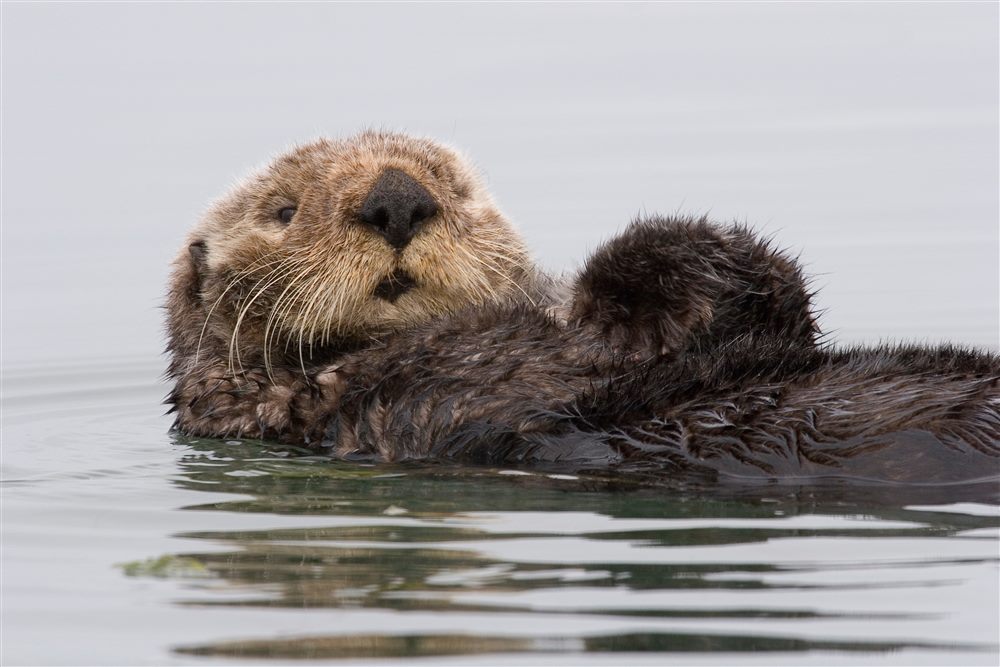
What if it disappeared?
Impact MajorWithout otters, nothing keeps sea urchins in check anymore: their population starts growing right away, with no predator left to slow it down.
DocumentedDetail
Estes, J.A. et Palmisano, J.F. (1974). Sea otters: Their role in structuring nearshore communities. Science, 185(4156), 1058–1060.
By comparing Aleutian islands where otters had been eliminated by commercial hunting to islands where they remained present, Estes and Palmisano established that its role as an urchin predator drives the whole system: once that control disappears, the urchin population has nothing left to hold it back.
Within a few years to a few decades, these unchecked urchins graze the kelp forest down to its holdfast, turning the seafloor into an 'urchin barren' that persists as long as the otter stays gone.
DocumentedDetail
Estes, J.A. et Palmisano, J.F. (1974). Sea otters: Their role in structuring nearshore communities. Science, 185(4156), 1058–1060.
The same study shows that once triggered, this transformation is fast on an ecological timescale — observed across several islands within a span of a few years to roughly three decades depending on the site — and the effect has since been reproduced in other North Pacific archipelagos.
Commercial hunting had already wiped out otters from several Aleutian islands decades before Estes and Palmisano studied them in 1974 — for some, an absence approaching a century. That lasting urchin barren would then have taken the kelp forest, and the carbon it captures, down with it across the whole region.
ExtrapolatedDetail
Extrapolation à partir du fait historique de l'élimination de la loutre par la chasse commerciale sur plusieurs îles des Aléoutiennes bien avant l'étude d'Estes et Palmisano (1974), combiné à Wilmers, Estes, Edwards, Laidre et Konar (2012), qui modélisent la perte de stockage carbone associée à l'état de désert d'oursins.
Estes and Palmisano explicitly note that otters had been eliminated by commercial hunting on some of the islands they studied before their own survey — hunting that ran from the 18th century until it largely ended around 1911. Wilmers et al. (2012) quantify, from forty years of data, the extra carbon captured by dense kelp compared to an urchin-barren area; applied to an absence approaching a century on these islands, that model implies a cumulative capture loss on a comparable timescale.
What's missing to confirm it: No direct measurement of the carbon actually lost on these specific islands during their century without otters was found — only the Wilmers et al. model allows the order of magnitude to be estimated.
Over a thousand years, even if otters came back, the kelp forest might not simply resume growing on its own: an urchin barren that lasts long enough can become a stable state in its own right, with urchins resisting kelp's return rather than making room for it.
HypothesisDocumentation
-
IUCN SSC Otter Specialist Group — Enhydra lutris, statut et population
Accessed August 6, 2026
-
Estes & Palmisano (1974) — Sea otters: Their role in structuring nearshore communities, Science
Accessed August 6, 2026
-
Wilmers et al. (2012) — Do trophic cascades affect the storage and flux of atmospheric carbon?, Frontiers in Ecology and the Environment
Accessed August 6, 2026
Last verified: August 16, 2026