Species → Killer whale
Killer whale
Orcinus orca
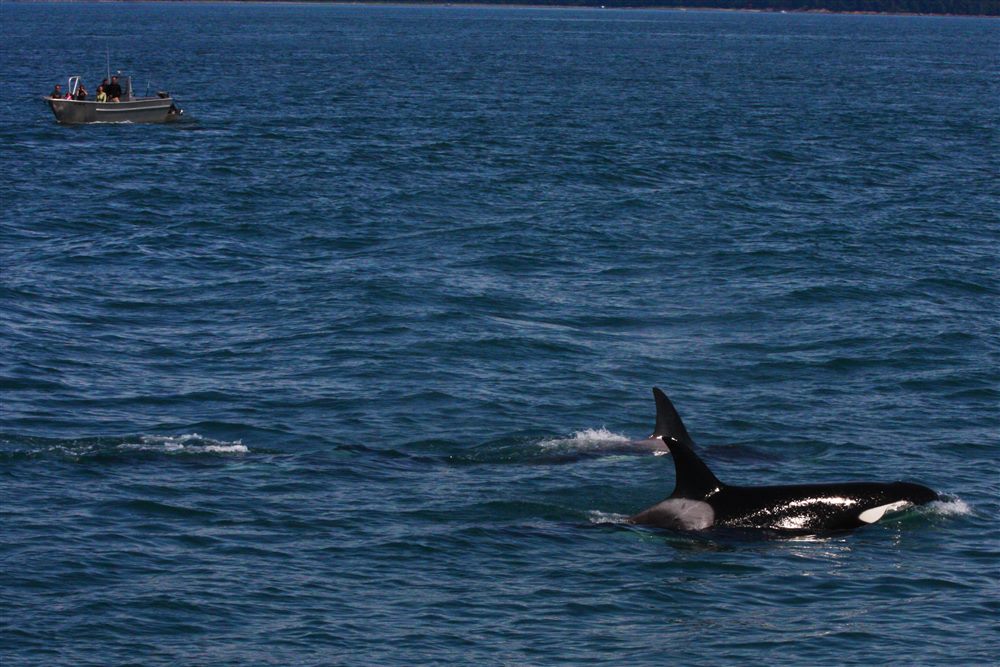
What if it disappeared?
Impact HighWithout killer whales to hunt it, the sea otter stops being preyed upon: its population, which was declining by about 25% a year across much of western Alaska during the 1990s, would stop falling within the first year — the same stability already seen where killer whales have never had access.
DocumentedDetail
Estes, J.A., Tinker, M.T., Williams, T.M. & Doak, D.F. (1998). Killer whale predation on sea otters linking oceanic and nearshore ecosystems. Science, 282(5388), 473–476.
Sea otters were declining by about 25% per year across much of western Alaska during the 1990s, with no local cause (disease, contamination) sufficient to explain it. Comparing a lagoon on Adak Island inaccessible to killer whales, where the otter population stayed stable, to a nearby bay open to killer whales, where it dropped 76%, made it possible to isolate predation as the direct cause — and so to predict that in its complete absence, this decline would stop.
Ten years after killer whales disappeared, the now-recovered otter population would have had time to resume its role controlling the urchins it feeds on, limiting their grazing on kelp forests — a link well established for otters elsewhere, but one Estes et al. (1998) do not measure themselves beyond the otter's own population recovery.
ExtrapolatedDetail
Extrapolation à partir d'Estes et al. (1998), qui mesure le rétablissement de la loutre libérée de la prédation de l'épaulard, combinée au rôle bien documenté ailleurs de la loutre dans le contrôle des oursins et la santé des forêts de varech.
Sea otters are a recognized regulator of urchin populations, whose excessive grazing can reduce kelp forests to bare patches. Estes et al. (1998) demonstrate otter recovery once killer whale predation is removed, but do not themselves track the cascading effect on urchins and kelp — that logical next step remains to be confirmed directly for this specific case.
What's missing to confirm it: No study tracks the full otter-urchin-kelp chain specifically following a killer whale disappearance; the otter's role in controlling urchins is established elsewhere, not in this specific context.
Over a century, the kelp forests the otter indirectly sustains would probably have had time to regain an extent close to their historical maximum in the region — but no real site has gone without killer whales long enough to verify it, and other factors like warming waters could limit that recovery.
HypothesisOver a thousand years, the otter would have had ample time to fully resume its role regulating urchins, but other pressures unrelated to killer whales — warming waters, diseases directly affecting otters or urchins — would likely have reshaped the final balance into something different from what existed before its disappearance.
HypothesisDocumentation
-
Estes et al. (1998) — Killer whale predation on sea otters linking oceanic and nearshore ecosystems, Science
Accessed August 7, 2026
-
Springer et al. (2003) — Sequential megafaunal collapse in the North Pacific Ocean, PNAS
Accessed August 7, 2026
-
NOAA Fisheries — Killer Whale, populations et statut
Accessed August 7, 2026
Last verified: August 16, 2026