Species → North American Beaver
North American Beaver
Castor canadensis
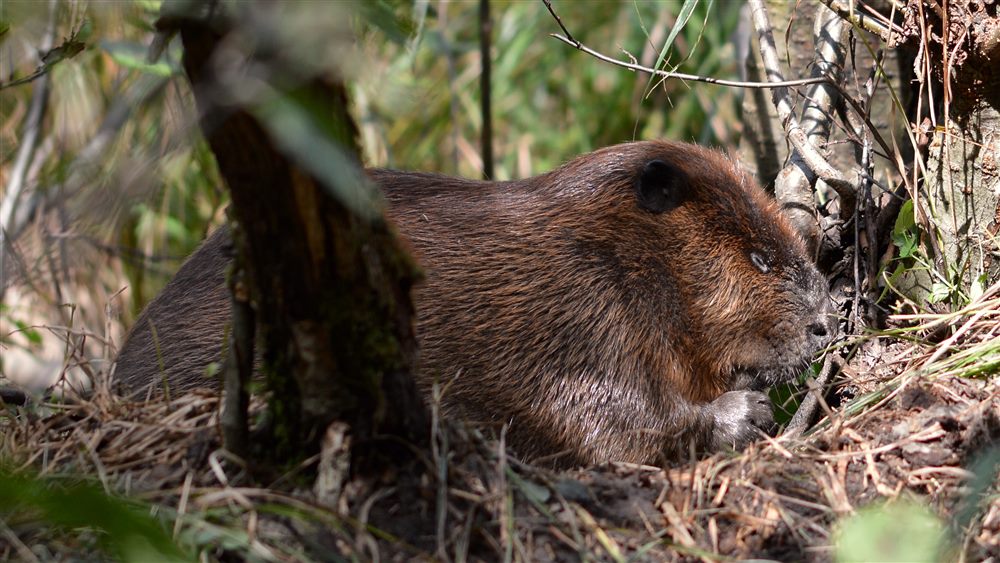
The North American beaver is an ecosystem engineer: its dams raise the water table, create ponds, and keep riparian corridors green and wet. Its IUCN status is Least Concern and its population has been increasing since the early 20th-century low — but it remains far below historical levels. Its local disappearance costs more than wetlands: it also removes a fire buffer, and reshapes the river itself over decades.
What if it disappeared?
Impact MajorWithout beavers to maintain their dams, a riparian corridor quickly loses the high water table, ponds, and vegetation they sustained.
DocumentedDetail
Naiman, R.J., Johnston, C.A. et Kelley, J.C. (1988). Alteration of North American Streams by Beaver. BioScience, 38(11), 753–762.
The authors show that beaver activity affects the physical structure of streams (channel morphology, vegetation), the diversity of habitats and species that depend on them, and functions such as stream productivity and resistance to disturbance — making the beaver the textbook example of the 'ecosystem engineer' concept. These effects depend on ongoing dam maintenance; without it, the structure they create quickly breaks down.
After ten years without beavers, a riparian corridor loses its wildfire buffer: during a forest fire, it no longer stays green and wet the way it did when its dams were still maintained.
DocumentedDetail
Fairfax, E. et Whittle, A. (2020). Smokey the Beaver: beaver-dammed riparian corridors stay green during wildfire throughout the western USA. Ecological Applications, 30(8), e02225.
By comparing, across many real wildfires, beaver-dammed riparian corridors to comparable corridors without beavers, the authors show that dammed areas stay green and wet while neighboring areas burn. The wetlands that produce this effect take years to form and to break down — a timescale consistent with the ten-year horizon.
A century after its disappearance from a region, the landscape has not regained its resistance to fire: in the Sierra Nevada, streams' water-retention capacity remains at about half its level from before the beaver was lost.
ExtrapolatedDetail
Modélisation à l'échelle de la Sierra Nevada (2025) évoquée dans la littérature sur la restauration du castor, comparant la capacité de barrage actuelle à son niveau historique après plus d'un siècle de piégeage intensif.
Current damming capacity in the Sierra Nevada is only about 51% of its historical level, with a modeled potential of 120 million m³ of water storage and 2,200 km² of fire resilience if beaver populations regained a much larger share of their capacity from before the intensive 19th- and early-20th-century trapping era. This measures what is still missing, not what has already been restored.
What's missing to confirm it: The actual pace of beaver recolonization in the coming decades — and thus the time before a significant share of this potential materializes — remains uncertain.
Over a thousand years without beavers, a river ends up cutting a single narrow path instead of the network of ponds and wetlands its dams once created — and even if beavers returned after all that time, this landscape would not easily re-form.
HypothesisDocumentation
-
IUCN Red List — Castor canadensis, statut de conservation
Accessed August 6, 2026
-
Naiman, Johnston & Kelley (1988) — Alteration of North American Streams by Beaver, BioScience
Accessed August 6, 2026
-
Fairfax & Whittle (2020) — Smokey the Beaver, Ecological Applications
Accessed August 6, 2026
-
Defenders of Wildlife — The Original Ecosystem Engineers: Beavers
Accessed August 6, 2026
Last verified: August 16, 2026