Species → Leatherback Sea Turtle
Leatherback Sea Turtle
Dermochelys coriacea
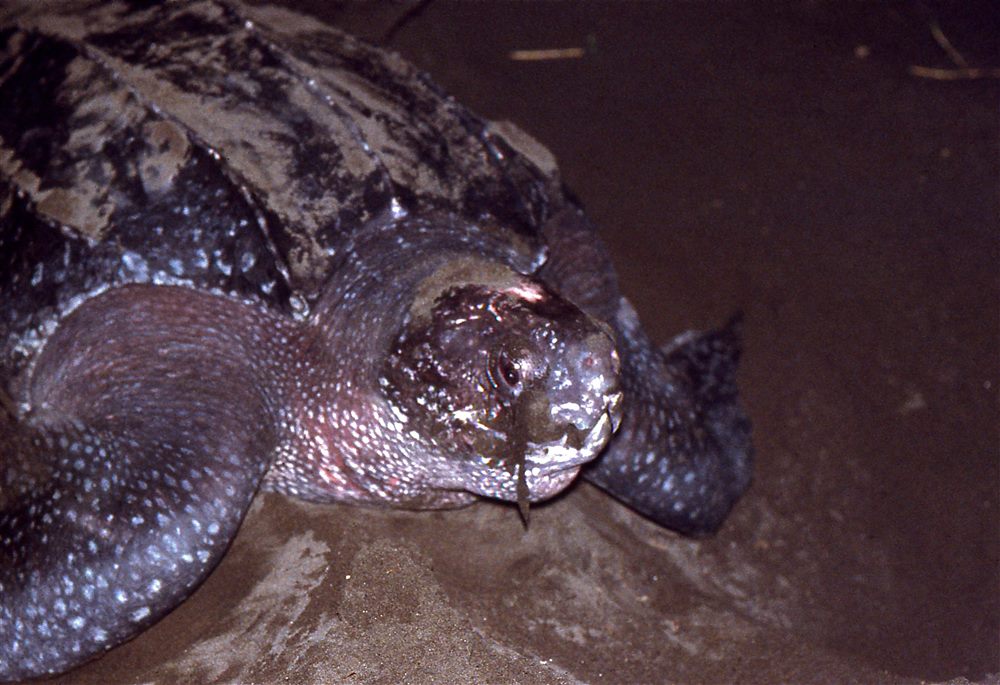
What if it disappeared?
Impact LowWithout the leatherback, a good share of the jellyfish eaten every day in certain waters no longer are: a single adult swallows an average of 330 kg per day, up to 840 kg on some days, and used to return year after year to the same areas where jellyfish gather.
ExtrapolatedDetail
Extrapolation à partir de Heaslip, Iverson, Bowen et James (2012) et de Houghton et al. (2006), qui documentent la consommation de méduses par la tortue luth vivante et sa fidélité à des zones d'agrégation précises, pas la conséquence de sa disparition sur ces zones.
Heaslip et al. (2012) used animal-borne cameras to measure an average consumption of 330 kg of jellyfish per day (up to 840 kg on some days), or 73% of the animal's body weight. Houghton et al. (2006) used aerial surveys to show that jellyfish aggregation zones in the Celtic Sea stay stable year after year, and that turtles return to them faithfully. The turtle's disappearance would remove this precise, recurring predation from these zones.
What's missing to confirm it: No study measures what happens to the jellyfish in these zones once this predation is removed — the reasoning starts from the documented regularity of the hunting behavior, not from a real site observed after disappearance.
Ten years after its disappearance, jellyfish would likely not simply have boomed in response, despite a popular assumption: a scientific review judges this link largely unproven, with most cited studies showing only that jellyfish have predators — not that a decline in those predators actually makes them proliferate.
ExtrapolatedDetail
Extrapolation à partir de Pitt, Lucas, Condon, Duarte et Stewart-Koster (2018), qui évaluent ce mécanisme prédateur-méduses à l'échelle de multiples espèces et jugent la preuve largement indirecte — l'étude ne teste pas spécifiquement la tortue luth.
Of the 11 articles most directly supporting the 'loss of jellyfish predators leads to jellyfish blooms' mechanism, the authors judge that 9 rely on inference rather than a direct demonstration. None of these articles specifically concern the leatherback turtle — extrapolating the finding to this species therefore remains to be confirmed.
What's missing to confirm it: Direct monitoring of jellyfish populations in an area after the leatherback's actual disappearance would make it possible to test the link rather than rely on a general review covering other species.
A century after its disappearance, other big jellyfish eaters already living in the same waters — ocean sunfish, certain other sea turtles — would likely have taken over part of that hunting, without leaving a lasting gap in the jellyfish population.
HypothesisOver a thousand years, jellyfish hunting would long since have reorganized around the species still around, with the leatherback's disappearance leaving no recognizable trace in how the oceans work.
HypothesisDocumentation
-
IUCN Red List — Dermochelys coriacea, statut mondial et régional (Pacifique / Atlantique Nord-Ouest)
Accessed August 7, 2026
-
Heaslip, Iverson, Bowen & James (2012) — Jellyfish Support High Energy Intake of Leatherback Sea Turtles, PLoS ONE
Accessed August 7, 2026
-
Houghton, Doyle, Wilson, Davenport & Hays (2006) — Jellyfish aggregations and leatherback turtle foraging patterns, Ecology
Accessed August 7, 2026
-
Pitt, Lucas, Condon, Duarte & Stewart-Koster (2018) — Claims That Anthropogenic Stressors Facilitate Jellyfish Blooms Have Been Amplified Beyond the Available Evidence, Frontiers in Marine Science
Accessed August 7, 2026
Last verified: August 16, 2026