Species → Green Sea Turtle
Green Sea Turtle
Chelonia mydas
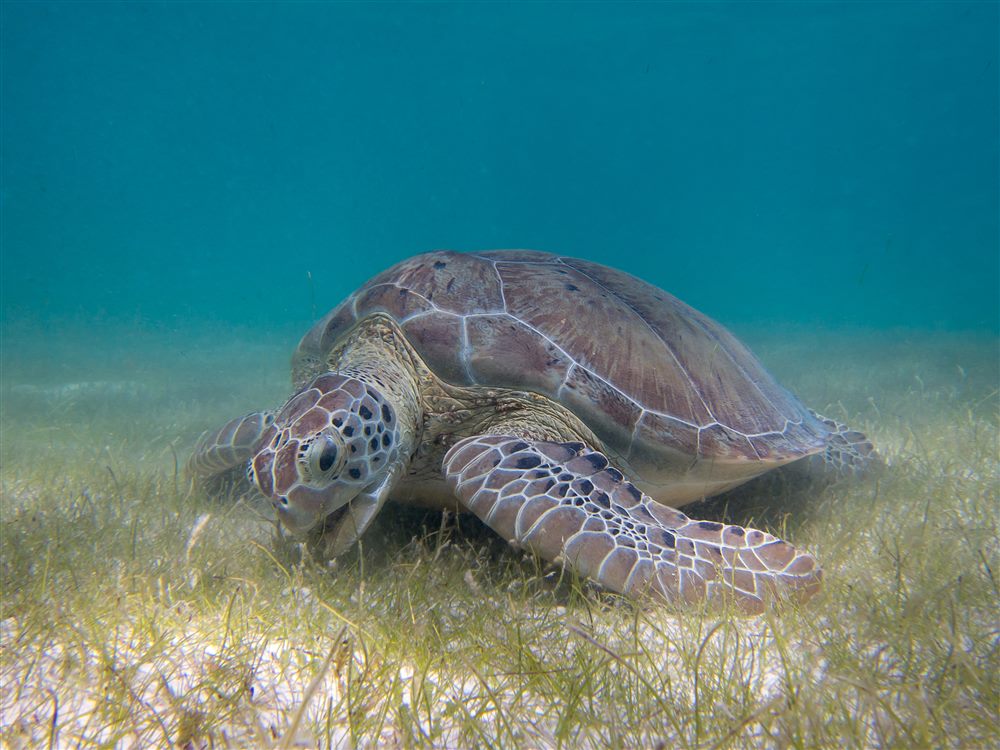
What if it disappeared?
Impact HighWithout the green turtle, the grazing pressure that shapes seagrass meadow structure today where turtles concentrate (Lakshadweep, India) disappears almost immediately: a meadow left without that influence develops a taller canopy, longer and denser shoots, and different flowering than the one the turtle maintained through its grazing.
DocumentedDetail
Lal, A., Arthur, R., Marbà, N., Lill, A.W.T. & Alcoverro, T. (2010). Implications of conserving an ecosystem modifier: Increasing green turtle (Chelonia mydas) densities substantially alters seagrass meadows. Biological Conservation, 143(11), 2730–2738.
The study draws on a lagoon in the Lakshadweep Islands (Indian Ocean) where a stable, high-density turtle aggregation serves as a natural laboratory: by comparing grazed to ungrazed zones, it directly shows what the meadow would look like if the turtle disappeared from it.
A decade without green turtles also averts a risk documented elsewhere: at five atolls monitored since 2005, every high-density turtle aggregation had eventually stripped the meadow to bare sand within 2 to 6 years — a collapse made possible by the absence of sharks to limit turtle density. Without any turtles at all, that specific risk disappears, but so does the low, dense structure its grazing maintained elsewhere.
ExtrapolatedDetail
Gangal, M. et al. (2021). Sequential overgrazing by green turtles causes archipelago-wide functional extinctions of seagrass meadows, Biological Conservation ; Heithaus, M.R., Alcoverro, T. et al. (2014). Seagrasses in the age of sea turtle conservation and shark overfishing, Frontiers in Marine Science — extrapolé ici à un scénario de disparition complète de la tortue plutôt qu'au déclin de la prédation par les requins.
Gangal et al. show that turtle grazing unchecked by predation can destroy a meadow rather than maintain it; Heithaus et al. show that it's shark predation pressure, through a "landscape of fear" comparable to the wolf's in Yellowstone, that normally prevents this scenario. A complete turtle disappearance removes both the overgrazing risk and the structuring service moderate grazing provided to the meadow — two opposing effects no study compares directly within a single total-disappearance scenario.
What's missing to confirm it: No study directly measures the net balance, over ten years, between the overgrazing risk averted and the structuring service lost, in a scenario of complete green turtle disappearance rather than a simple decline in predation.
Over a century without the green turtle, meadows that had never again experienced its grazing would likely settle into a permanently different state — taller, denser, and probably dominated by slower-growing seagrass species than those repeated grazing once favored, a compositional shift that takes generations to set in.
HypothesisOver a thousand years, even if the green turtle returned, the meadow would struggle to regain its original structure: the slow-growing species that had established in its absence would already dominate the space, and grazing resumed so late would take a long time to replace them with the lower, denser mosaic the turtle once maintained.
HypothesisDocumentation
-
Oceanic Society — Global Conservation Efforts Lift Green Turtle from Endangered Status (2025)
Accessed August 7, 2026
-
Lal et al. (2010) — Implications of conserving an ecosystem modifier, Biological Conservation
Accessed August 7, 2026
-
Gangal et al. (2021) — Sequential overgrazing by green turtles causes archipelago-wide functional extinctions of seagrass meadows, Biological Conservation
Accessed August 7, 2026
-
Heithaus et al. (2014) — Seagrasses in the age of sea turtle conservation and shark overfishing, Frontiers in Marine Science
Accessed August 7, 2026
Last verified: August 16, 2026