Species → Pink salmon
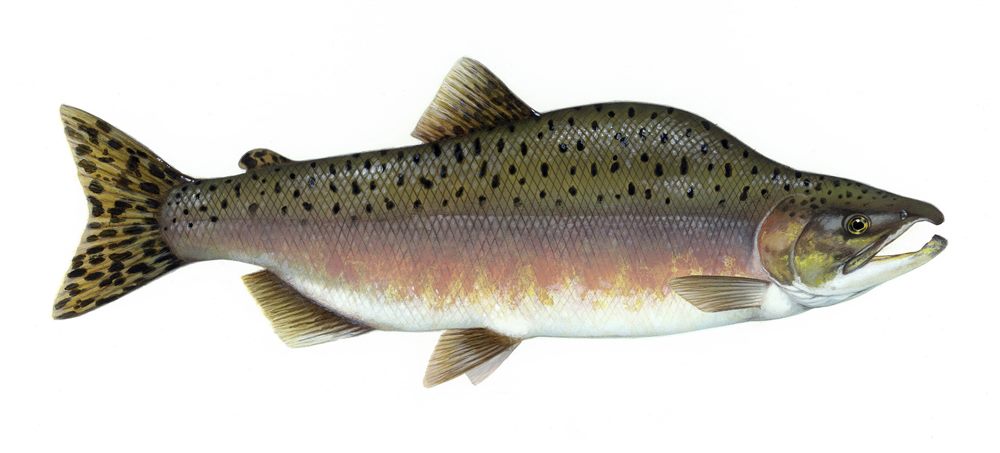
Pink salmon
Oncorhynchus gorbuscha
What if it disappeared?
Impact HighWithout salmon to carry marine-derived nitrogen into the rivers where they spawn and then die, leaves of trees near spawning streams would lose, from the very first season without them, up to 22 to 24% of the nitrogen that today comes directly from them.
DocumentedDetail
Helfield, J.M. et Naiman, R.J. (2001). Effects of Salmon-Derived Nitrogen on Riparian Forest Growth and Implications for Stream Productivity. Ecology, 82(9), 2403–2409.
Using isotopic analysis, the authors trace the marine-derived nitrogen that salmon carry back into the streams where they were born and then die after spawning. Sitka spruce trees near salmon-bearing streams grow significantly faster than those near comparable streams without salmon.
Over a decade without this yearly influx, the growth gap measured today between spruce near salmon streams and those near comparable salmon-free streams would gradually close — all the faster because bears, with no more carcasses to drag away from the water, would stop fertilizing the wide band of riparian forest they currently reach by feeding under cover.
DocumentedDetail
Helfield, J.M. et Naiman, R.J. (2001). Effects of Salmon-Derived Nitrogen on Riparian Forest Growth and Implications for Stream Productivity. Ecology, 82(9), 2403–2409 ; Helfield, J.M. et Naiman, R.J. (2006). Keystone Interactions: Salmon and Bear in Riparian Forests of Alaska. Ecosystems, 9(2), 167–180.
Sitka spruce near salmon-frequented streams grow significantly faster than those near comparable salmon-free streams (Helfield & Naiman 2001) — a gap that builds season after season. Bears amplify this effect by dragging carcasses away from the water to eat them under cover, fertilizing a much wider band of forest than dead salmon alone would reach in the water: nitrogen input is markedly higher where bears and salmon are present together than where either species is absent (Helfield & Naiman 2006).
Over the lifespan of a forest stand — a century rather than a decade — this sustained nitrogen input could durably alter the composition and structure of the riparian forest itself, not just the growth rate of a few trees: a plausible link, but one never tracked as a complete forest-scale phenomenon over such a long timeframe.
ExtrapolatedDetail
Extrapolation à partir de Helfield & Naiman (2001, 2006) : le raisonnement combine deux effets mesurés séparément à l'échelle de quelques années à quelques décennies, sans étude de suivi forestier sur l'échelle de vie complète d'un peuplement (environ un siècle).
If the extra growth and fertilization measured over a few years to a few decades persists over the full lifespan of a forest stand, it could change the composition and structure of the riparian forest itself — but no study has tracked a forest over such a long horizon to confirm this.
What's missing to confirm it: No one has tracked a riparian forest over the full lifespan of a stand to confirm that the extra growth measured in the short and medium term translates into a lasting structural change to the forest itself.
Over a thousand years, this riparian forest would likely have had time to adjust to the absence of that annual marine-nitrogen input: tree species less dependent on that seasonal fertilizer would probably come to dominate over the ones that benefited most from it, and even a return of the salmon would not recreate exactly the same forest, since the composition that took hold in the meantime would have its own momentum.
HypothesisDocumentation
-
Numbers and Biomass of Natural- and Hatchery-Origin Pink Salmon... in the North Pacific Ocean, 1925–2015 (Ruggerone & Irvine 2018, Marine and Coastal Fisheries)
Accessed August 10, 2026
-
IUCN Red List — Oncorhynchus gorbuscha, statut de conservation
Accessed August 7, 2026
-
Helfield & Naiman (2001) — Effects of Salmon-Derived Nitrogen on Riparian Forest Growth, Ecology
Accessed August 7, 2026
-
Helfield & Naiman (2006) — Keystone Interactions: Salmon and Bear in Riparian Forests of Alaska, Ecosystems
Accessed August 7, 2026
Last verified: August 16, 2026