Species → Brown Bear
Brown Bear
Ursus arctos
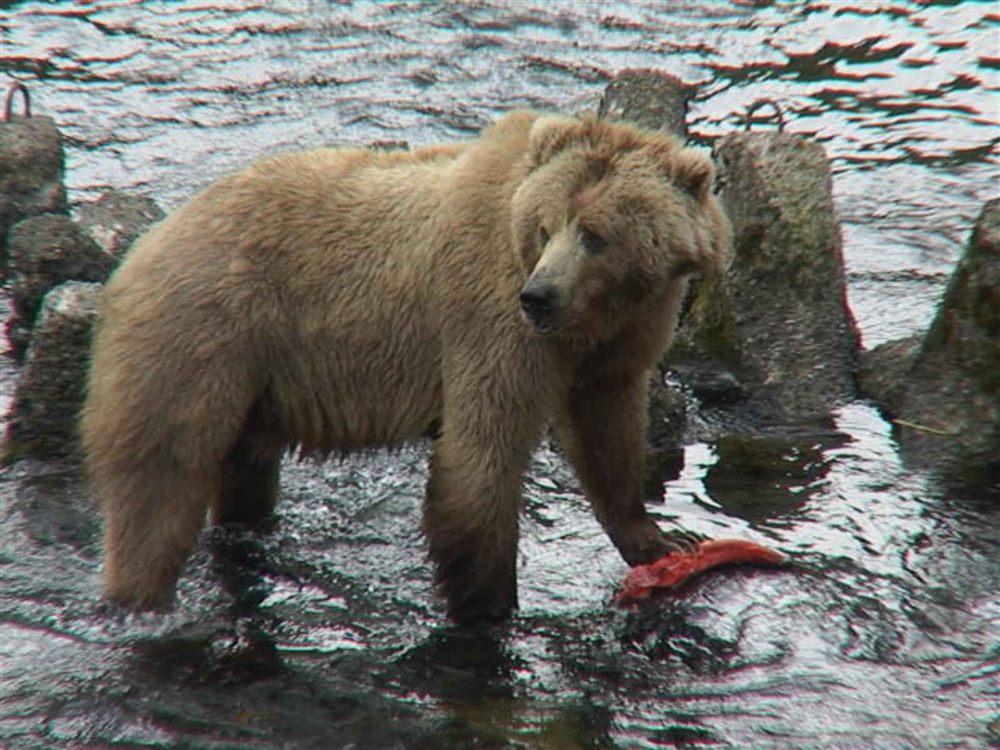
What if it disappeared?
Impact ModerateWithout bears to catch salmon and drag carcasses out of the water, the riparian forest would not receive the 37.2 kg of marine-derived nitrogen an adult female bear redistributes there on average each year — the marine nitrogen input only rises when salmon and bears are present together, never with salmon alone.
DocumentedDetail
Hilderbrand, G.V., Hanley, T.A., Robbins, C.T. & Schwartz, C.C. (1999). Role of brown bears (Ursus arctos) in the flow of marine nitrogen into a terrestrial ecosystem. Oecologia, 121, 546–550.
96% of this nitrogen is excreted directly through the bear's urine, well away from the bank where it fishes — it is this physical transport by the bear, not the salmon's presence alone, that explains the measured rise in foliar nitrogen of nearby spruce along salmon streams. Helfield & Naiman (2006, Ecosystems, 9, 167–180) estimate this salmon-bear interaction can supply up to 24% of the riparian nitrogen budget.
Over a decade, marine nitrogen would keep entering the ecosystem through other pathways, but it would concentrate near the bank rather than spreading deep into the riparian forest — the fertilized zone would shrink, without disappearing entirely.
ExtrapolatedDetail
Extrapolation à partir du modèle de bilan de masse de Hilderbrand et al. 1999 et de Helfield & Naiman 2006 : aucune de ces études ne compare directement un cours d'eau à saumons avec et sans ours, faute d'un tel site naturel.
Both studies measure what bears actually carry inland, but neither has a bear-free control site to isolate their specific effect from that of other vectors (wolves, eagles, human harvest). The shrinking of the fertilized zone follows logically from the documented mechanism, without having been measured as such in the field.
What's missing to confirm it: A direct comparison between salmon streams with and without bears, controlling for other marine-nitrogen transport vectors, would confirm the true scale of the shrinkage rather than inferring it from a mass-balance model.
Over a century, the fertilized strip of forest would likely stay confined to the immediate banks: spruce farther from the water, permanently deprived of this input, would grow more slowly than those on the shore — a contrast that would mark the very structure of the riparian forest.
HypothesisOver a thousand years, other vectors like wolves or eagles might carry some of that marine nitrogen into the forest, but in far smaller amounts and over a shorter range than the bear: the wide reach it once provided would likely never be quite rebuilt.
HypothesisDocumentation
-
Hilderbrand et al. (1999) — Role of brown bears (Ursus arctos) in the flow of marine nitrogen into a terrestrial ecosystem, Oecologia 121
Accessed August 7, 2026
-
Helfield & Naiman (2006) — Keystone Interactions: Salmon and Bear in Riparian Forests of Alaska, Ecosystems 9
Accessed August 7, 2026
-
IUCN Red List — Brown Bear (Ursus arctos), statut et estimation mondiale
Accessed August 7, 2026
Last verified: August 16, 2026