Species → Banner-tailed kangaroo rat
Banner-tailed kangaroo rat
Dipodomys spectabilis
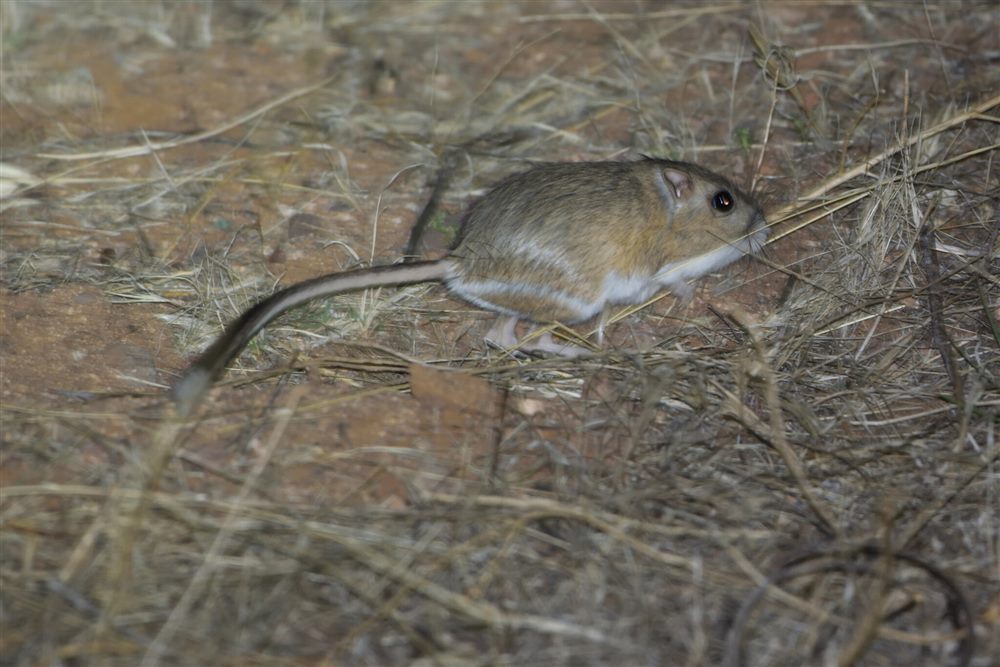
What if it disappeared?
Impact MajorAs soon as they stop harvesting large seeds and disturbing the soil through their burrows, young prairie grasses stop being grazed down or dug up — the same twin mechanism that, sustained over time, tripled their density within twelve years at the Portal, Arizona experimental site.
ExtrapolatedDetail
Extrapolation à partir de Brown, J.H. et Heske, E.J. (1990). Control of a desert-grassland transition by a keystone rodent guild. Science, 250(4988), 1705–1707 — l'étude mesure l'effet cumulé sur douze ans, pas l'état après une seule année.
The Portal experiment establishes that seed predation and soil disturbance by kangaroo rats actively limit the establishment of prairie grasses; both mechanisms necessarily stop as soon as the rats are excluded. What the study doesn't report is an intermediate one-year state — only the cumulative twelve-year result (tripled grass density) is measured.
What's missing to confirm it: No measurement of vegetation state in the first year after exclusion was found in the sources gathered here — only the cumulative twelve-year result is reported.
Excluding kangaroo rats from experimental plots tripled the density of tall grasses within twelve years, and rodents typical of arid grassland moved in — proof that this small rodent, through seed predation and soil disturbance, actively holds back the boundary between shrub desert and grassland.
DocumentedDetail
Brown, J.H. et Heske, E.J. (1990). Control of a desert-grassland transition by a keystone rodent guild. Science, 250(4988), 1705–1707.
Long-term experiment near Portal, Arizona, at a site located precisely at the natural transition between shrub desert and grassland. By harvesting large seeds and disturbing the soil through their burrows, kangaroo rats limit the establishment of grassland grasses; their exclusion allowed these grasses to triple in abundance over twelve years and opened the way for other rodent species typical of the grassland.
After a century without kangaroo rats to hold grasses back, the line between shrub desert and grassland would likely have shifted deep into former desert territory, gradually replacing creosote and mesquite shrubs with continuous grass cover — the opposite of the semi-bare desert the rat once maintained through seed predation and soil disturbance.
HypothesisEven if kangaroo rats eventually recolonized these grasslands born of their absence, the return would be slow: on plots where grassland had become well established without them, recolonization took about two years, versus only three months on bare soil — a sign that a desert turned to grassland over a thousand years might never quite become again the landscape they once shaped.
ExtrapolatedDetail
Extrapolation à partir de Christensen, E.M., Simpson, G.L. et Ernest, S.K.M. (2019). Established rodent community delays recovery of dominant competitor following experimental disturbance. Proceedings of the Royal Society B, 286(1917), 20192269 — l'étude mesure une asymétrie de recolonisation sur quelques années à l'échelle de parcelles, pas la persistance d'un tel effet à l'échelle du paysage sur un millénaire.
This recolonization asymmetry is a typical signal of what ecology calls a priority effect or the onset of bistability: once an alternative plant community establishes itself in the kangaroo rat's absence, it resists the rat's return more than bare soil alone would. Nothing confirms whether this mechanism, measured at plot scale over a few years, holds at the scale of an entire landscape over a millennium — but nothing suggests it fades with time either.
What's missing to confirm it: No landscape-scale or multi-decade-to-century monitoring confirms whether the recolonization asymmetry measured on plots holds at that larger scale of time and space.
Documentation
-
IUCN Red List — Dipodomys spectabilis, statut et tendance de population
Accessed August 7, 2026
-
Brown & Heske (1990) — Control of a desert-grassland transition by a keystone rodent guild, Science
Accessed August 7, 2026
-
Chew & Whitford (1992) — A long-term positive effect of kangaroo rats on creosotebushes, Journal of Arid Environments
Accessed August 7, 2026
-
Christensen, Simpson & Ernest (2019) — Established rodent community delays recovery of dominant competitor, Proceedings of the Royal Society B
Accessed August 7, 2026
Last verified: August 16, 2026