Species → Black-tailed Prairie Dog
Black-tailed Prairie Dog
Cynomys ludovicianus
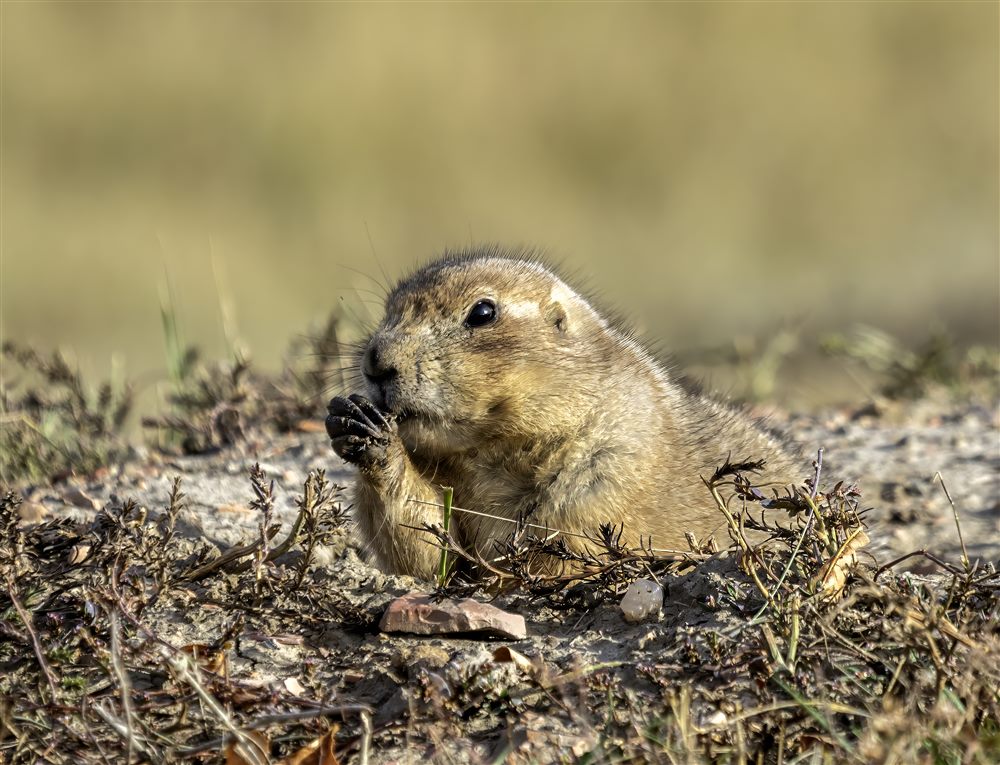
What if it disappeared?
Impact ModerateAs soon as a colony disappears, its burrow network stops being maintained: the species that relied on it for shelter — the black-footed ferret, the burrowing owl — lose that access overnight.
ExtrapolatedDetail
Extrapolation à partir de Miller, Ceballos & Reading (1994), qui documentent le réseau de terriers utilisé par des dizaines d'espèces du vivant de la colonie, pas le devenir de ce réseau après sa disparition.
Miller, Ceballos and Reading (1994) show that prairie dog burrows form a network of habitats used by dozens of species, from the black-footed ferret to the burrowing owl, which rely on it for shelter or food. That network exists thanks to ongoing maintenance by the colony; without it to dig and clear, access to that habitat would degrade quickly.
What's missing to confirm it: No study directly measures how quickly a burrow network stops being usable once the colony is gone.
Ten years without recolonization, the species most dependent on that network — chief among them the black-footed ferret, which uses it both as a pantry and as shelter — begin to decline locally, though the size of this effect on the prairie community as a whole is not settled science.
ExtrapolatedDetail
Extrapolation prudente à partir de Miller, Ceballos & Reading (1994) sur la dépendance du putois à pieds noirs et de la chevêche des terriers envers la colonie ; une revue critique de 1999 (Kotliar et al.) conteste l'ampleur de cet effet pour l'ensemble de la communauté de la prairie.
The effect is solidly documented for a small number of highly specialized species (black-footed ferret, burrowing owl), but according to some authors is overstated for the prairie animal community as a whole — an example where the literature itself is divided on the exact magnitude of the effect, not just its existence.
What's missing to confirm it: A consensus on the actual magnitude (as opposed to the mere existence) of the prairie dog's keystone effect on the prairie community as a whole, beyond the few well-documented specialist species.
The prairie dog's more than 95% decline since the early 20th century, driven by large-scale poisoning campaigns, took its closest dependent down with it: the black-footed ferret, which feeds almost exclusively on prairie dogs and lives in their burrows, was declared extinct in the wild in 1979, only to be rediscovered by chance in a single surviving colony in Wyoming in 1981.
ExtrapolatedDetail
Extrapolation à partir du déclin de 95 à 98 % du chien de prairie depuis le début du 20e siècle (déjà documenté dans cette fiche) et du fait historique bien établi de la quasi-extinction du putois à pieds noirs, combiné à Miller, Ceballos & Reading (1994) sur sa dépendance directe à la colonie.
The prairie dog's decline across most of the 20th century, mainly driven by poisoning campaigns, is already documented in this fiche (95 to 98% below historical levels). The black-footed ferret, which depends almost entirely on the colony for food and shelter according to Miller, Ceballos and Reading (1994), followed that decline down to near-disappearance: declared extinct in the wild in 1979, it survived only thanks to a forgotten colony near Meeteetse, Wyoming, discovered in 1981. The coincidence between the two timelines is the best-established historical fact here; the precise mechanism remains a reasonable extrapolation rather than a study isolating the prairie dog as the sole cause.
What's missing to confirm it: No study breaks down the share of the prairie dog's decline, relative to other causes (sylvatic plague, land conversion to farming), in the black-footed ferret's near-extinction at this historical scale.
Over a thousand years, even if the prairie dog regained ground, the vast interconnected colonies of the early 20th century — now cut apart by roads and farmland — would likely take a very long time to re-form at that scale, and the most demanding species, like the black-footed ferret, might never fully regain the range it once occupied.
HypothesisDocumentation
-
IUCN Red List — Cynomys ludovicianus, statut de conservation
Accessed August 7, 2026
-
Miller, Ceballos & Reading (1994) — The prairie dog and biotic diversity, Conservation Biology
Accessed August 7, 2026
-
Kotliar et al. — A critical review of assumptions about the prairie dog as a keystone species
Accessed August 7, 2026
Last verified: August 16, 2026