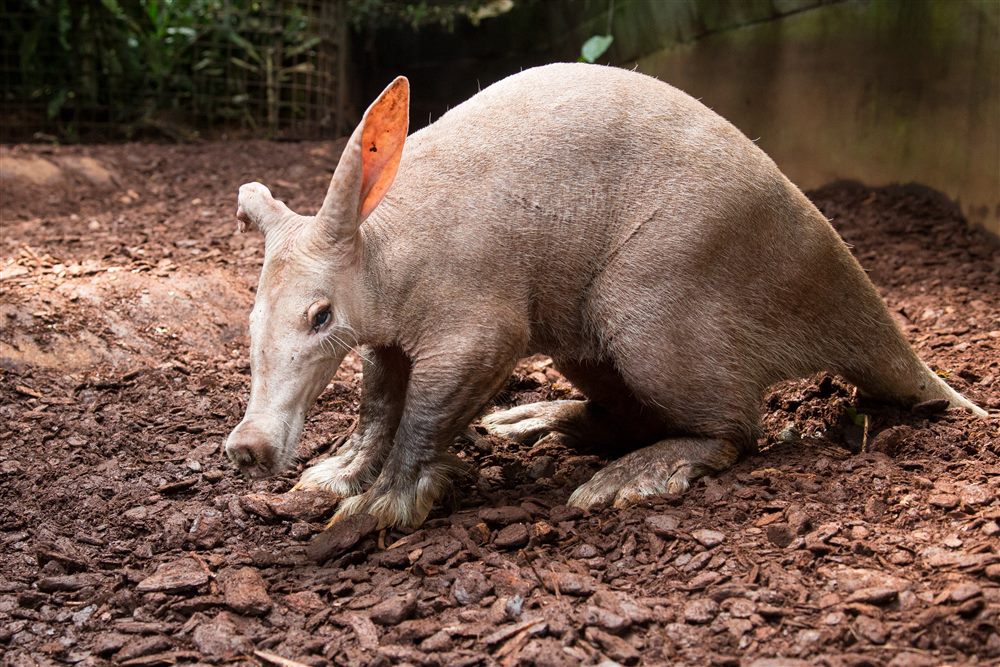
Species → Aardvark
Aardvark
Orycteropus afer
What if it disappeared?
Impact ModerateThe moment it disappears, no new burrow gets dug: African wild dog packs, critically endangered, which typically choose old aardvark burrows over rock crevices to give birth and shelter their most vulnerable pups, are now left to rely on a stock of burrows that will never be replenished.
DocumentedDetail
Jackson, C.R., Power, R.J., Groom, R.J. et al. (2014). Heading for the Hills: Risk Avoidance Drives Den Site Selection in African Wild Dogs. PLOS ONE, 9(6), e99686.
The study, covering packs monitored across several southern and eastern African countries, confirms that wild dog packs typically use burrows excavated by the aardvark or by other partly fossorial mammals, or caves and crevices in rugged terrain — without quantifying the exact proportion of dens housed in former aardvark burrows, nor whether a rock crevice can genuinely substitute at the same scale.
Over the years, it would no longer be just the wild dog affected: a long list of species — from the ground pangolin to the brown hyena, along with reptiles and insects — would also lose, burrow by burrow, a shelter they occupy today without ever digging one themselves.
ExtrapolatedDetail
Extrapolation à partir de Whittington-Jones, G.M., Bernard, R.T.F. et Parker, D.M. (2011). Aardvark Burrows: A Potential Resource for Animals in Arid and Semi-Arid Environments. African Zoology, 46(2), 362–370 — l'étude documente la réutilisation actuelle des terriers par d'autres espèces sans mesurer ce qui leur arriverait si ces terriers cessaient d'être renouvelés.
The authors record, through direct observation and camera traps, a range of species using former aardvark burrows in arid and semi-arid zones, without a systematic count of the number of species or frequency of use. An unmaintained burrow collapses and fills in within a few years; without the aardvark digging new ones, the number of burrows available to all these species would decline over time as a result.
What's missing to confirm it: No study measures the actual rate at which abandoned burrows fill in, nor to what extent the species that use them would find substitute shelter rather than being directly affected.
Over a century without new burrows, the noticeably less compacted soil researchers measure today around burrows in mesic grassland and semi-arid savanna would likely revert to the compaction of the surrounding control sites — taking with it the plant diversity associated with them, up to 166 species recorded in mesic grassland versus 32 in savanna; in arid scrubland, where this soil effect is already not measurable today, the change would probably go unnoticed.
ExtrapolatedDetail
Extrapolation à partir de Louw, M.A., Haussmann, N.S. et le Roux, P.C. (2019). Testing for consistency in the impacts of a burrowing ecosystem engineer on soil and vegetation characteristics across biomes. Scientific Reports, 9, 19355 — l'étude compare des terriers existants à des sites témoins à un instant donné, sans suivre ce qui arrive au sol après la disparition de l'espèce.
The authors sampled 60 burrows in mesic grassland, 71 in semi-arid savanna and 10 in arid scrubland. Soil compaction was significantly lower than at control sites in mesic grassland and savanna (p < 0.001), but showed no measurable difference in arid scrubland (p > 0.1); 166 plant species were recorded in mesic grassland, 32 in semi-arid savanna and 30 in arid scrubland. Extrapolating this snapshot to a century without aardvarks assumes the burrow's soil effect fades progressively once it is no longer maintained or renewed — something the study, built as a point-in-time comparison, does not directly measure.
What's missing to confirm it: No longitudinal study measures how fast an abandoned burrow loses its effect on soil compaction and plant diversity, or whether that effect fades completely or only partially over a century.
Over a thousand years, the already critically endangered wild dog would likely have become confined to the few areas offering natural rock crevices; other burrowers like porcupines or warthogs would probably dig some of the missing burrows, but rarely to the same depth or with the same effect on the soil, leaving a landscape lastingly different from the one the aardvark used to shape.
HypothesisDocumentation
-
IUCN Red List — Orycteropus afer, statut de conservation
Accessed August 14, 2026
-
Louw, Haussmann & le Roux (2019) — Testing for consistency in the impacts of a burrowing ecosystem engineer on soil and vegetation characteristics across biomes, Scientific Reports
Accessed August 14, 2026
-
Jackson et al. (2014) — Heading for the Hills: Risk Avoidance Drives Den Site Selection in African Wild Dogs, PLOS ONE
Accessed August 14, 2026
-
Whittington-Jones, Bernard & Parker (2011) — Aardvark Burrows: A Potential Resource for Animals in Arid and Semi-Arid Environments, African Zoology
Accessed August 14, 2026
Last verified: August 16, 2026