Species → Jaguar
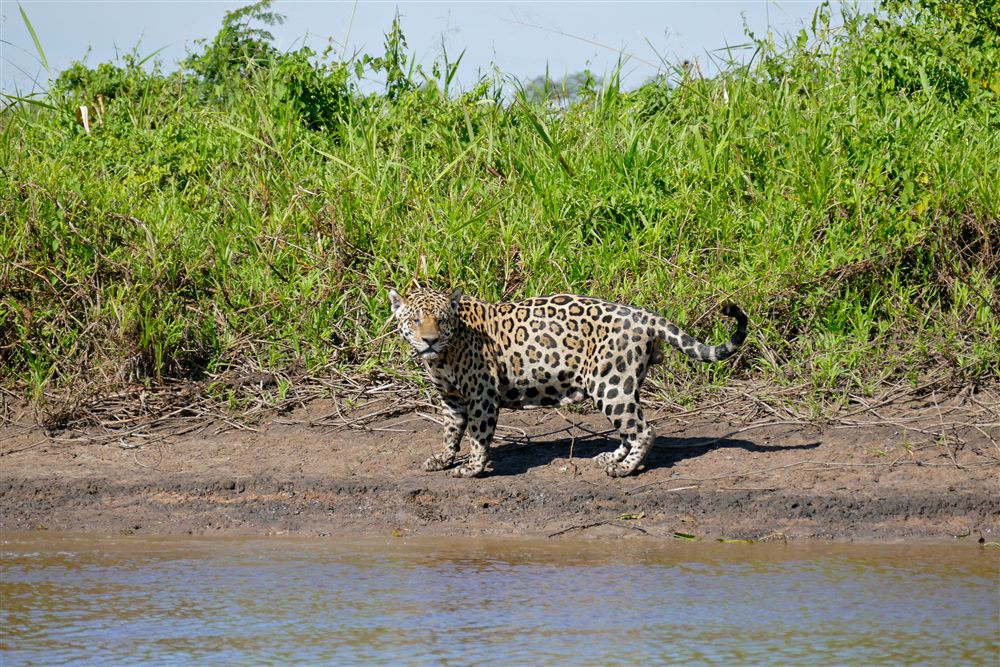
Jaguar
Panthera onca
What if it disappeared?
Impact HighOn small forested islands cut off from the mainland by the flooding of a dam — and thus inaccessible to large cats like the jaguar and puma — densities of howler monkeys, iguanas, leaf-cutter ants, and rodents climbed to 10 to 100 times their level on the neighboring mainland.
DocumentedDetail
Terborgh, J., Lopez, L., Nuñez, P. et al. (2001). Ecological Meltdown in Predator-Free Forest Fragments. Science, 294(5548), 1923–1926.
The 1986 flooding of the Guri Dam turned hilltops into isolated forest islands, too small for large cats and other vertebrate predators to persist on. Freed from this control, herbivores and small generalist predators proliferated to densities the authors describe as "hyperabundant."
This herbivore explosion eventually rippled through the forest itself: on the most affected islands, recruitment of young canopy trees dropped by roughly 80% relative to normal.
DocumentedDetail
Terborgh, J., Feeley, K., Silman, M., Asner, G. et Diaz, S. (2006). Vegetation dynamics of predator-free land-bridge islands. Journal of Ecology, 94(2), 253–263.
Longer-term vegetation monitoring confirms that the cascade triggered by the absence of predators does not stop at herbivore populations: it propagates all the way to the regeneration of the forest canopy itself, with a collapse in young tree recruitment on the islands most densely populated with howler monkeys and leaf-cutter ants.
Over a century without jaguars anywhere on the mainland — not just on small isolated islands like at Lake Guri — medium-sized predators such as the puma would likely take over part of its role, softening the extreme explosion seen on the islands; but across such a vast territory, canopy regeneration would probably still lag in places, without ever matching the total-isolation conditions that produced the collapse measured at Lake Guri.
HypothesisOver a thousand years, it would no longer be just the number of young trees that suffered, but their mix: tree species most sought after by howler monkeys and rodents would consistently have less chance of establishing than less-favored ones, gradually reshaping the canopy's species composition — a forest that likely would never quite return to the same mix, even if the jaguar came back.
HypothesisDocumentation
-
IUCN Red List — Panthera onca, statut et estimation de population 2024
Accessed August 7, 2026
-
Terborgh, Lopez, Nuñez et al. (2001) — Ecological Meltdown in Predator-Free Forest Fragments, Science
Accessed August 7, 2026
-
Terborgh, Feeley, Silman, Asner & Diaz (2006) — Vegetation dynamics of predator-free land-bridge islands, Journal of Ecology
Accessed August 7, 2026
Last verified: August 16, 2026