Species → Puma
Puma
Puma concolor
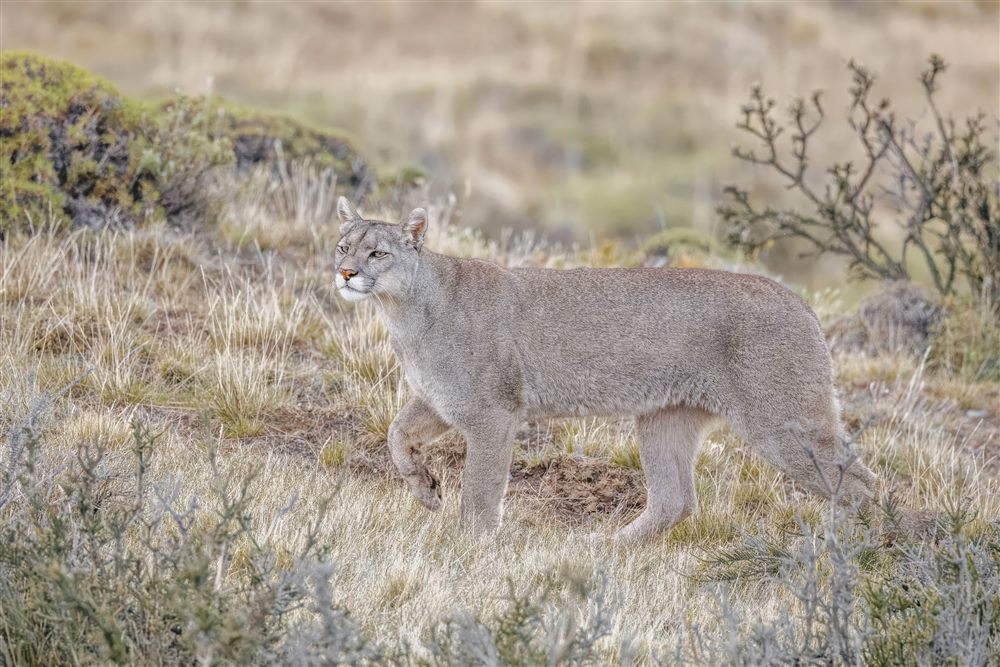
What if it disappeared?
Impact HighIn the very first year without a puma in a canyon, the mule deer living there would likely lose much of their vigilance toward risky terrain — the same relaxation documented elsewhere once a big cat stops using a territory — and start browsing longer in the same spots.
ExtrapolatedDetail
Extrapolation à partir de Ripple, W.J. & Beschta, R.L. (2006), qui mesurent un broutage plus intense du cerf mulet là où le puma a disparu de Zion Canyon, sans dater précisément à quelle vitesse ce changement de comportement s'installe une fois le puma parti.
The Zion study compares a stable state with puma to a stable state without puma after years of the canyon being abandoned, without measuring how quickly deer behavior changed at the outset. The behavioral shift (less vigilance, more sustained browsing) is a well-established mechanism in other apex cats and canids and logically precedes the vegetation effects measured at Zion, but its precise timeline for the puma isn't documented here.
What's missing to confirm it: No direct measurement of mule deer vigilance in the year following the puma's disappearance from a given site — only the end state, after years of absence, is measured at Zion.
Over the years, in canyons the puma abandoned under mounting human visitation, mule deer grew more abundant and browsed more intensively, driving down recruitment of riparian cottonwoods, increasing streambank erosion, and reducing the butterflies, frogs, lizards, and wildflowers tied to those wooded banks — compared with a neighboring canyon where the puma remained.
DocumentedDetail
Ripple, W.J. & Beschta, R.L. (2006). Linking a cougar decline, trophic cascade, and catastrophic regime shift in Zion National Park. Biological Conservation, 133(4), 397–408.
The authors compare two canyons in the same park: Zion Canyon, heavily visited and practically puma-free, and a neighboring, lightly visited canyon where the puma remains present. The canyon with pumas shows markedly higher cottonwood recruitment, more stable banks, and more butterflies, frogs, lizards, and wildflowers — a paired comparison rather than a simple temporal correlation.
The puma declined under human pressure in Yosemite Valley starting in the early 20th century, and oak recruitment there has been sharply reduced since the 1920s — nearly a century later, a dynamic similar to Zion's is proposed, but suppression of natural fires over the same period complicates attributing a single cause.
ExtrapolatedDetail
Ripple, W.J. & Beschta, R.L. (2008). Trophic cascades involving cougar, mule deer, and black oaks in Yosemite National Park. Biological Conservation, 141(5), 1249–1256.
Unlike the paired comparison at Zion, the Yosemite study relies on a single valley tracked over time, without an equivalent control canyon. The authors themselves present this link as a potential rather than an established cascade, because the fire-suppression policy applied over the same period also independently affects oak recruitment.
What's missing to confirm it: A controlled comparison between valleys with and without pumas, comparable to the one at Zion, would help disentangle the puma's effect from that of fire suppression on oak recruitment in Yosemite.
Over a thousand years, other predators such as coyotes or bears would likely fill part of the gap the puma left, but without ever recreating the same caution deer showed toward open valley floors where the puma's ambush made them vulnerable. The cottonwood galleries and oak groves that take centuries to establish would probably remain sparser, even if the puma eventually returned.
HypothesisDocumentation
-
Ripple & Beschta (2006) — Linking a cougar decline, trophic cascade, and catastrophic regime shift in Zion National Park, Biological Conservation
Accessed August 7, 2026
-
Ripple & Beschta (2008) — Trophic Cascades Involving Cougar, Mule Deer and Black Oaks in Yosemite National Park, Biological Conservation
Accessed August 7, 2026
-
IUCN Red List — Puma concolor, statut et estimation de population
Accessed August 7, 2026
Last verified: August 16, 2026