Species → Nile Crocodile
Nile Crocodile
Crocodylus niloticus
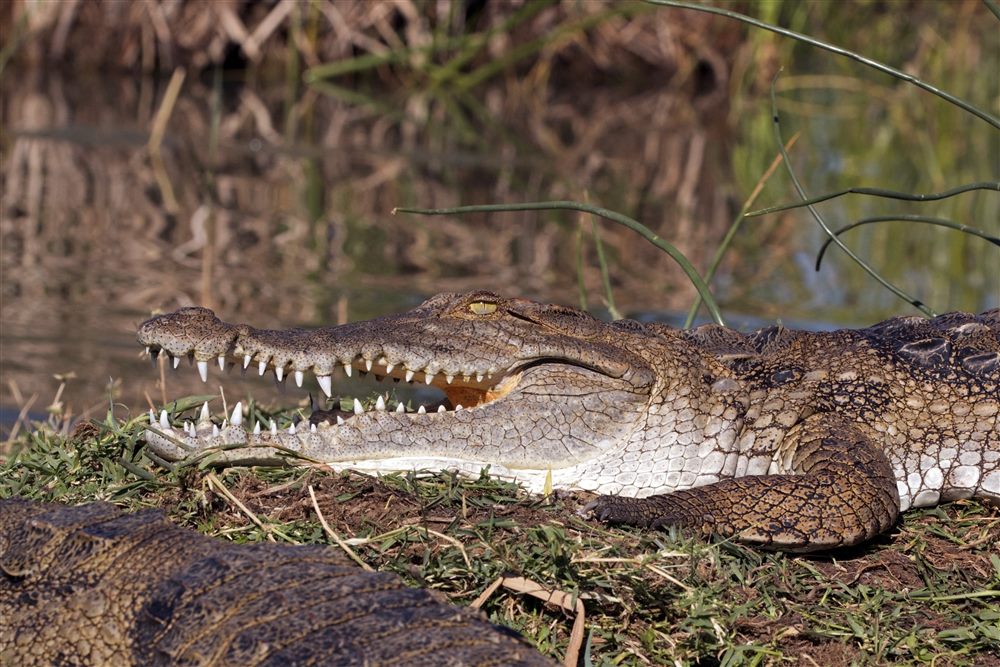
What if it disappeared?
Impact ModerateWithout the selective predation the crocodile normally exerts — removing the weakest or sickest fish first — fish populations in these waterways would no longer face the same culling: within the very first year, the least vigorous individuals would have just as good a chance of surviving and breeding as everyone else.
ExtrapolatedDetail
Extrapolation à partir du rôle de prédateur sélectif documenté par Ferreira, S.M. et Pienaar, D. (2011). Degradation of the crocodile population in the Olifants River Gorge of Kruger National Park, South Africa. Aquatic Conservation: Marine and Freshwater Ecosystems, 21(2), 155–164 — aucune étude ne mesure directement ce basculement dans l'année suivant une disparition du crocodile.
Ferreira & Pienaar identify the Nile crocodile as a keystone species of southern African aquatic ecosystems, notably through the selective predation it exerts on fish. This point assumes the reverse effect of a disappearance, though no study directly measures fish population composition within the year following such an event.
What's missing to confirm it: A direct measurement of fish population composition within the year following an actual crocodile disappearance, rather than an inference from its selective predator role documented while it is still present.
A decade later, it wouldn't just be prey selection that was missing: the crocodile also recycles nutrients by consuming large carcasses that few other scavengers in these waterways can handle — without it, they would pile up and decompose in place instead of being redistributed through the system.
ExtrapolatedDetail
Extrapolation à partir du rôle de recyclage de nutriments documenté par Ferreira & Pienaar (2011) parmi les fonctions clés de voûte du crocodile du Nil.
Alongside selective predation, Ferreira & Pienaar list nutrient recycling and the maintenance of drought-season water refuges among the crocodile's keystone functions. No study directly measures the accumulation of unconsumed carcasses following its disappearance; this point extrapolates that documented function through to its complete absence.
What's missing to confirm it: A direct measurement of unconsumed carcass accumulation following an actual crocodile disappearance, rather than an inference from its general role as a nutrient recycler.
A century without crocodiles, and both the culling of weaker fish and the recycling of carcasses would have been absent for so long that slower processes — bacterial decomposition, small scavengers — would have had time to take over, without ever matching the same speed or scale: a system that processes its dead fish and carcasses far more slowly than before.
HypothesisOver a thousand years, it would no longer just be a matter of speed: the deep pools the crocodile helped maintain as drought-season water refuges would have had time to fill with sediment and shrink without its activity, leaving other species without these reserves during the driest periods — a landscape that holds less water, not just fewer crocodiles.
HypothesisDocumentation
-
IUCN Red List — Crocodylus niloticus, statut et estimation de population
Accessed August 7, 2026
-
Ferreira & Pienaar (2011) — Degradation of the crocodile population in the Olifants River Gorge, Aquatic Conservation
Accessed August 7, 2026
-
Woodborne, Huchzermeyer, Govender et al. (2012) — Ecosystem change and the Olifants River crocodile mass mortality events, Ecosphere
Accessed August 7, 2026
Last verified: August 16, 2026