Species → Common hippopotamus
Common hippopotamus
Hippopotamus amphibius
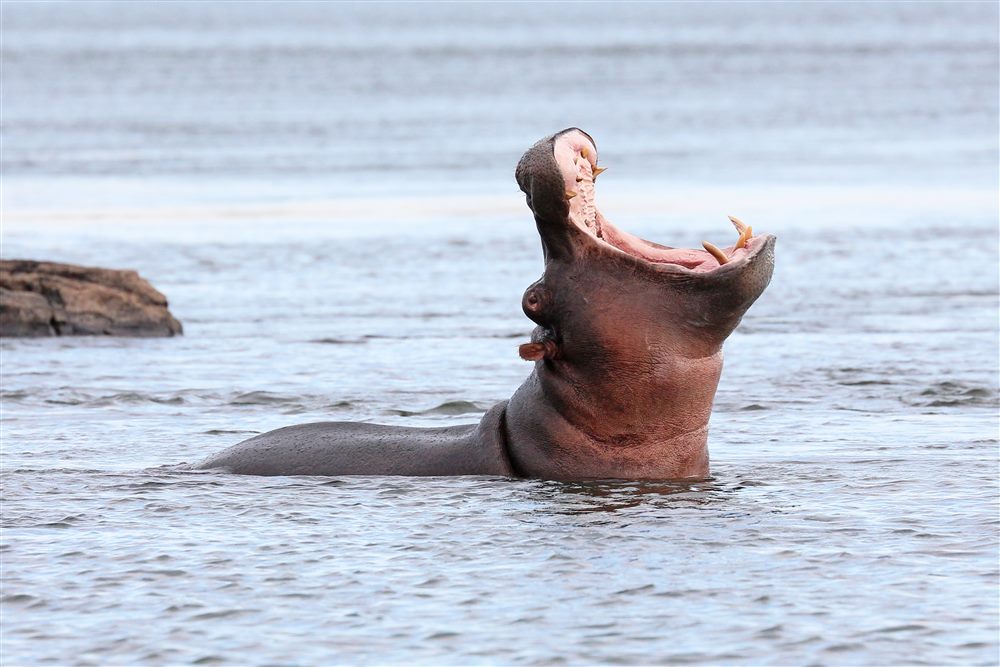
What if it disappeared?
Impact HighThe silicon flow the hippo carries daily from grassland to water — up to 76% of the total input in certain East African rivers — stops cold. At the same time, without its dung building up in pools, floods no longer trigger the oxygen crashes that used to kill fish downstream.
DocumentedDetail
Extrapolation directe à partir de Schoelynck et al. (2019), qui quantifie le flux de silicium entièrement porté par l'hippopotame vivant, et de Dutton et al. (2018), qui lie les hécatombes de poissons à l'accumulation de matière organique dans les mares à hippopotames — l'arrêt de ces deux processus suit directement de la disparition de l'animal qui les produit.
Schoelynck et al. (2019) show the hippo carries about 0.4 tonnes of silicon a day from terrestrial grassland into the water, bypassing the slow retention processes of the soil — an input that stops as soon as the animal is gone. Dutton et al. (2018) separately show that 13 of 49 floods monitored over three years triggered a marked drop in dissolved oxygen from organic matter built up in hippo pools, with nine documented fish kills over five years — a mechanism that disappears along with the animal that feeds it.
Deprived of that daily silicon supply, the base of the aquatic food chain would start to thin out: diatoms — tiny algae that need silicon to build their shells — would gradually become scarcer, leaving less food for everything that feeds on them.
ExtrapolatedDetail
Extrapolation à partir de Schoelynck et al. (2019), qui établit l'ampleur du flux de silicium porté par l'hippopotame et son rôle essentiel pour les diatomées, sans mesurer directement l'évolution de leur population dans les dix ans suivant l'arrêt de cet apport.
The study establishes that the silicon the hippo carries supports diatom production, at the base of the aquatic food chain. What it doesn't directly measure is how fast that production declines once the input is cut — the reasoning starts from silicon's documented role for diatoms, not from an actual ten-year record without hippos.
What's missing to confirm it: No study tracks a diatom population for ten years after the hippo's silicon input actually stops.
A century later, that shortfall wouldn't have closed: Schoelynck and colleagues note the hippo bypassed the slow soil-retention processes that are, in its absence, the only remaining way any silicon reaches the water — far slower than its daily transport was. Diatom production would stay durably below its pre-disappearance level.
ExtrapolatedDetail
Extrapolation à partir de Schoelynck et al. (2019), qui documente le contraste entre le transport rapide assuré par l'hippopotame et les processus de rétention lents du sol qui subsisteraient seuls en son absence, sans mesurer directement l'état du système à cent ans.
The study doesn't measure what happens a century after the hippo disappears — it only establishes that its silicon transport is fast compared with the soil's natural processes, which would keep delivering some, just slowly. No real site where the hippo has been gone for a century was found in the sources gathered here to directly confirm this prolonged shortfall.
What's missing to confirm it: No real site where the hippo has been gone for about a century was found in the sources gathered here to confirm this shortfall at that timescale.
Over a thousand years, the aquatic food chain would plausibly have reorganized around that scarcer silicon — a durably lower baseline productivity, not a simple return to the old balance even if another source eventually made up the gap, since nothing else replaces it at the pace the hippo once did.
HypothesisDocumentation
-
IUCN Red List — Hippopotamus amphibius, évaluation 2017 (Lewison & Pluháček)
Accessed August 7, 2026
-
Schoelynck, Subalusky, Struyf et al. (2019) — Hippos: The animal silicon pump, Science Advances
Accessed August 7, 2026
-
Dutton, Subalusky, Hamilton, Rosi & Post (2018) — Organic matter loading by hippopotami causes subsidy overload, Nature Communications
Accessed August 7, 2026
Last verified: August 16, 2026