Species → Western honey bee (wild colonies)
Western honey bee (wild colonies)
Apis mellifera
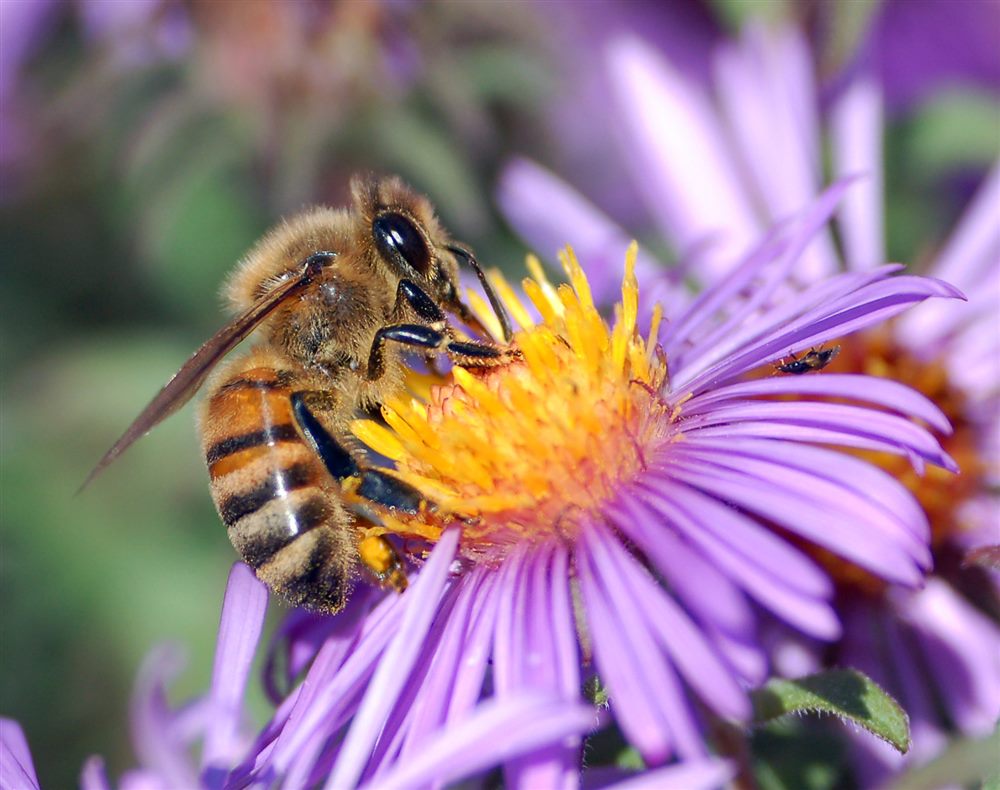
The western honey bee is the best-known pollinator, but this entry covers only its wild colonies — those that depend on no beekeeper and are declining by roughly 56% per decade in Europe. Its IUCN status is Endangered, established at the European Union level only. Their disappearance would remove a share of a pollination service valued at €153 billion per year worldwide, without a complete collapse: managed hives would keep providing part of it.
What if it disappeared?
Impact HighWild colonies are only part of the insect pollinator community, but their disappearance removes a share of a service currently valued at €153 billion per year worldwide, or 9.5% of the value of agricultural production intended for human food — hives managed by beekeepers continue supplying part of that service.
DocumentedDetail
Gallai, N., Salles, J.M., Settele, J. et Vaissière, B.E. (2009). Economic Valuation of the Vulnerability of World Agriculture Confronted with Pollinator Decline. Ecological Economics, 68(3), 810–821.
The authors quantify the economic contribution of insect pollination to global agriculture, isolating crops most dependent on animal pollination (fruits, vegetables, oilseeds) from those that do not depend on it (staple cereals). The study covers all pollinators, managed and wild combined; this point situates the scale of the service a share of which would disappear along with wild colonies.
Without wild colonies, yields for the crops most dependent on insect pollination would likely decline, without a complete collapse: managed beekeeping can absorb part of the lost service, but not for crops and wild plants that depend on specific pollinator species a domestic hive cannot replace.
ExtrapolatedDetail
Extrapolation à partir de Gallai et al. (2009) : les auteurs chiffrent une vulnérabilité économique à la dépendance envers les pollinisateurs, pas une projection de l'effet d'une disparition complète des colonies sauvages sur dix ans.
The extent to which managed beekeeping colonies can substitute for wild pollinators varies widely by crop and region — some crops and wild plants depend on specific pollinator species that a domestic hive cannot replace.
What's missing to confirm it: How much managed beekeeping can actually substitute for wild colonies in the crops and wild plants that depend on them most remains debated.
Over a century without wild colonies, wild plants that depend on a particular pollination behavior — one that managed hives, bred for agriculture, do not necessarily reproduce — would likely see their reproduction decline over the long term, even as major crops continue to be pollinated by managed beekeeping.
HypothesisOver a thousand years, pollination would rest almost entirely on other wild pollinators already present — bumblebees, solitary bees — and on managed beekeeping; since the honey bee is a generalist pollinator rather than one tied to specific plants, this shift would likely be more complete than it would be for a species that some plants depended on closely.
HypothesisDocumentation
-
Density of wild honey bee, Apis mellifera, colonies worldwide (Visick et al. 2023, Ecology and Evolution)
Accessed August 10, 2026
-
IUCN — Wild Apis mellifera classée En danger dans l'UE, Data Deficient au niveau paneuropéen
Accessed August 7, 2026
-
Gallai et al. (2009) — Economic Valuation of the Vulnerability of World Agriculture Confronted with Pollinator Decline, Ecological Economics
Accessed August 7, 2026
Last verified: August 16, 2026