Species → Rusty Patched Bumble Bee
Rusty Patched Bumble Bee
Bombus affinis
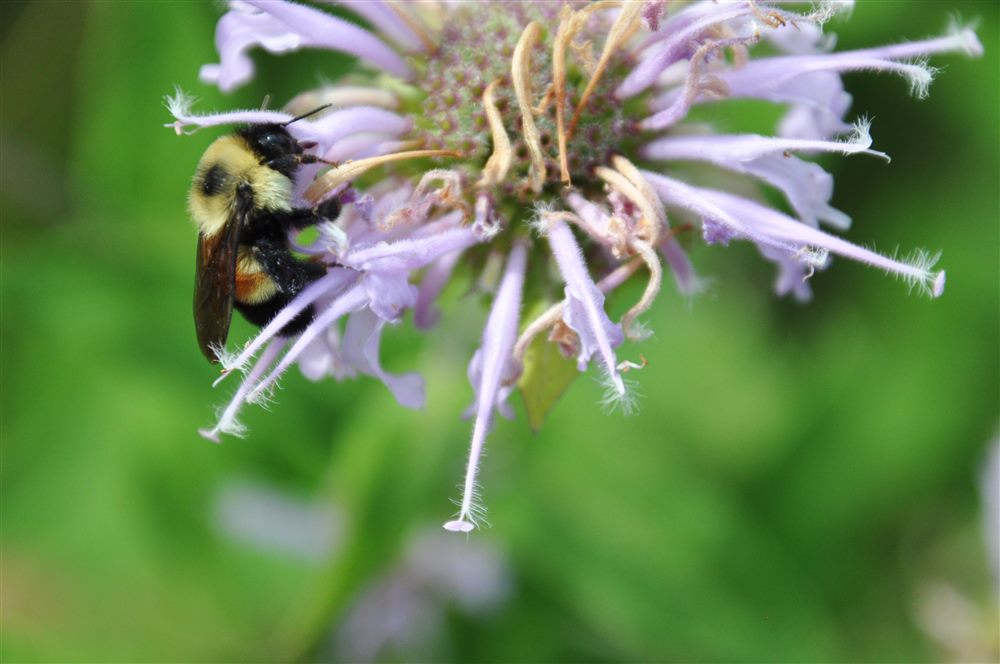
What if it disappeared?
Impact LowWithout the rusty patched bumble bee visiting buzz-pollinated flowers — tomato, blueberry, cranberry, eggplant — those flowers immediately lose a technique that neither honey bees nor most other pollinators can replicate: vibrating its flight muscles against the anther to release pollen, known as "buzz pollination."
DocumentedDetail
Cooley, H. et Vallejo-Marín, M. (2021). Buzz-Pollinated Crops: A Global Review and Meta-analysis of the Effects of Supplemental Bee Pollination in Tomato. Journal of Economic Entomology, 114(2), 505–519.
This meta-analysis, combining 21 experiments from 24 studies worldwide, confirms that supplemental bumble bee pollination increases tomato yield and quality compared to self-pollination alone or honey bee pollination alone. It focuses mostly on the European buff-tailed bumble bee (Bombus terrestris), a different species that shares the same vibration mechanism as the rusty patched bumble bee — proof that the mechanism exists and matters, even if its precise scale for this particular species still needs documenting.
A decade without the rusty patched bumble bee, wild plants and local crops of the Upper Midwest and Northeast would lose one more buzz pollinator from their pool — but unlike the European buff-tailed bumble bee, reared commercially at scale, no study has yet quantified what this particular species contributed relative to the other wild bumble bees that partly share its role.
ExtrapolatedDetail
Extrapolation à partir du mécanisme de pollinisation par buzz documenté au point précédent, propre au genre Bombus, appliqué à cette espèce précise.
Most economic studies of buzz pollination focus on bumble bees reared in captivity and deployed in greenhouses, not on the residual wild populations of a specific critically endangered species like the rusty patched bumble bee — whose range has already shrunk by 70 to 90% since the 1990s.
What's missing to confirm it: A study isolating the rusty patched bumble bee's specific contribution — rather than that of the genus Bombus as a whole — to the pollination of wild plants and crops across its residual range is still missing.
A century after the rusty patched bumble bee's complete disappearance, other wild bumble bees sharing the same buzz-pollination technique — dozens of species exist across North America — would likely have taken over much of its flower visits on blueberry, cranberry, and wild tomato. But in the cool, moist habitats where it once dominated, and in the earliest weeks of the season when few other bumble bees are active, pollination of some plants would probably remain less reliable, for lack of a species occupying exactly its niche.
HypothesisOver a thousand years, the rusty patched bumble bee's disappearance would be irreversible: no other species would re-emerge with exactly its combination of cold tolerance and early-spring activity. The plants it pollinated early in the season would permanently rely on a different pool of pollinators, with fertilization likely a bit less reliable in cool years — a quiet but permanent shortfall, rather than a gaping hole.
HypothesisDocumentation
-
U.S. Fish & Wildlife Service — Rusty Patched Bumble Bee (Bombus affinis)
Accessed August 7, 2026
-
Xerces Society — Rusty Patched Bumble Bee, fiche espèce
Accessed August 7, 2026
-
Cooley & Vallejo-Marín (2021) — Buzz-Pollinated Crops, Journal of Economic Entomology
Accessed August 7, 2026
Last verified: August 16, 2026