Species → Hawksbill Turtle
Hawksbill Turtle
Eretmochelys imbricata
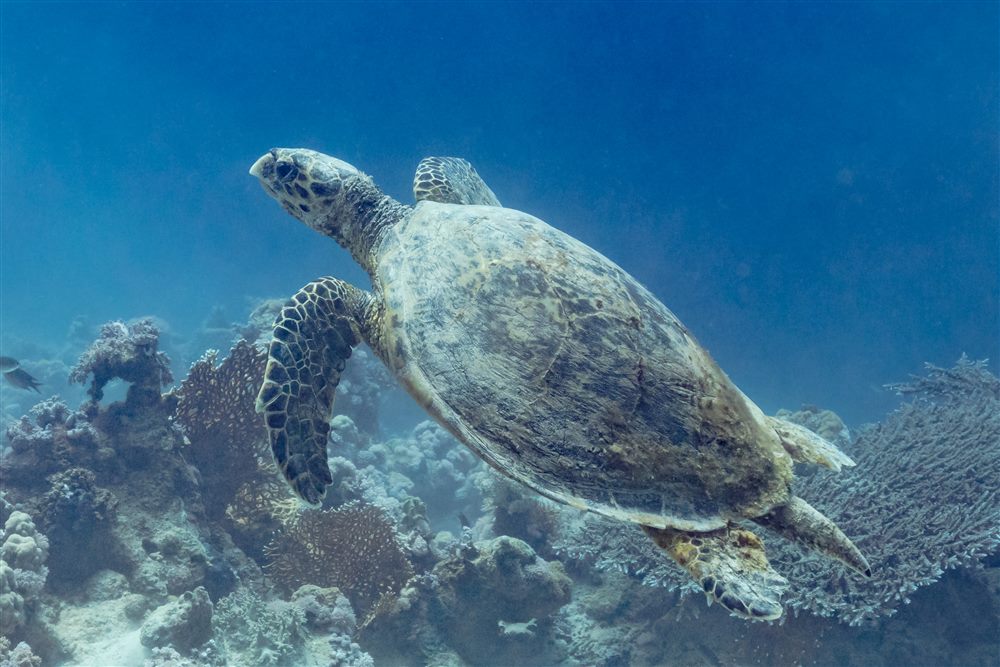
What if it disappeared?
Impact HighWithout the hawksbill turtle, the sponges it specifically targeted on the reef — including Chondrilla nucula, a fast-growing species known for invading available space — immediately stop facing this selective predation pressure.
DocumentedDetail
León, Y.M. & Bjorndal, K.A. (2002). Selective feeding in the hawksbill turtle, an important predator in coral reef ecosystems. Marine Ecology Progress Series, 245, 249-258.
The study documents the gut content and dietary preferences of hawksbill turtles in the Dominican Republic: the species doesn't consume reef sponges in proportion to their abundance, but preferentially targets certain fast-growing species — the same selectivity that, in its absence, would leave those sponges without their main specialized predator.
A decade later, those sponges likely advance onto the coral instead of being kept in check: an exclusion experiment shows that removing their predators from a reef plot lets sponges overgrow markedly more coral than elsewhere — a mechanism demonstrated mainly with angelfish, which share the hawksbill's main prey.
ExtrapolatedDetail
Hill, M.S. (1998). Spongivory on Caribbean reefs releases corals from competition with sponges. Oecologia, 117(1-2), 143-150 — mesuré chez le poisson-ange spongivore en Floride, extrapolé ici à la disparition de la tortue imbriquée qui partage sa proie principale.
The hawksbill turtle shares its main prey (Chondrilla nucula) with the spongivorous angelfish tested in this exclusion experiment, which makes a similar effect from its own disappearance plausible — but no exclusion cage has isolated the turtle's own specific effect, as it is too rare and too large for this kind of small-scale experimental setup.
What's missing to confirm it: A comparison of coral cover between reefs that have lost their hawksbill turtles and reefs where they remain present, at comparable angelfish density, would confirm the size of this effect on its own.
Over a century of absence, this sponge advance would likely settle into a new reef state where they dominate the space coral once occupied — a lasting shift rather than a temporary setback, the kind of tipping point a reef takes generations of coral growth to reverse once sponges have gained enough ground.
HypothesisOver a thousand years, even if the hawksbill turtle eventually returned, the reef it found would no longer be quite the same: the slow-growing coral colonies that build reef structure take decades to establish, and an already-established sponge mat resists their return — a permanently different underwater landscape, even after the turtle's own recovery.
HypothesisDocumentation
-
León & Bjorndal (2002) — Selective feeding in the hawksbill turtle, an important predator in coral reef ecosystems, Marine Ecology Progress Series
Accessed August 10, 2026
-
Hill (1998) — Spongivory on Caribbean reefs releases corals from competition with sponges, Oecologia
Accessed August 10, 2026
-
IUCN Red List — Eretmochelys imbricata, statut et estimation de population
Accessed August 10, 2026
Last verified: August 16, 2026