Species → Chinese Giant Salamander
Chinese Giant Salamander
Andrias davidianus
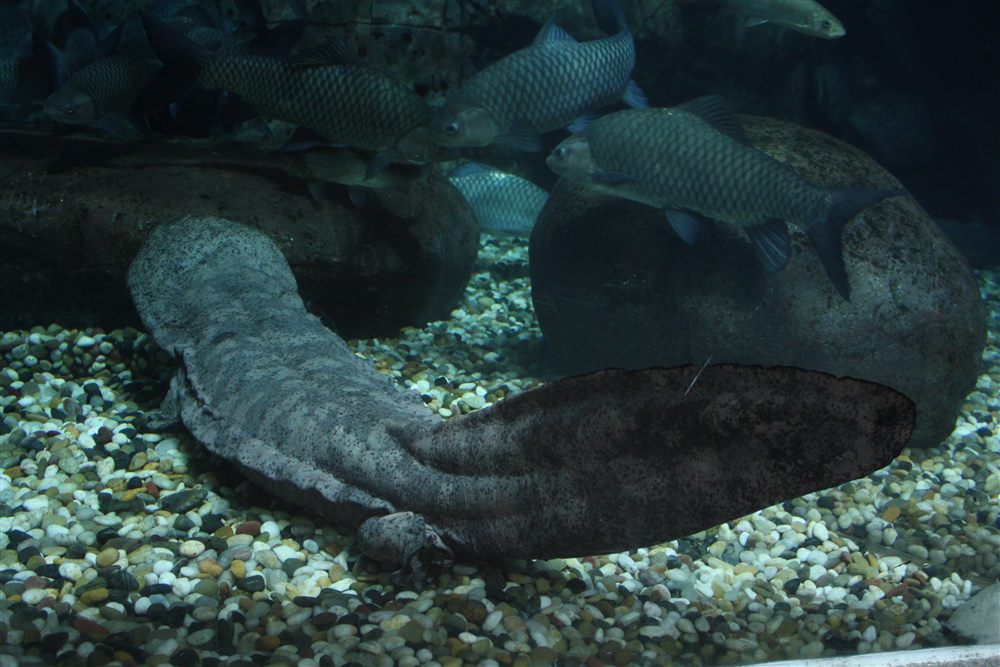
What if it disappeared?
Impact ModerateAs the world's largest living amphibian and a likely nocturnal ambush predator in its mountain streams, the Chinese giant salamander would almost immediately stop exerting hunting pressure on the fish and aquatic invertebrates that share its habitat, leaving them a margin it had until then kept in check.
HypothesisOver ten years, this reduced pressure would likely benefit some of the fish and invertebrate species it hunted, letting them grow in number and shift the balance among species in the deep pools of these mountain streams — probably at the expense of the species most vulnerable to that increased competition.
HypothesisAcross much of its range, these mountain streams have already been functioning without a confirmed wild salamander for several decades: the population collapsed by more than 80% between 1980 and 2000, and a recent survey covering 97 counties could not confirm a single genuinely wild individual. If its predator role holds, fish and invertebrates in these streams have in effect already been living without their historical regulator for several generations.
ExtrapolatedDetail
Extrapolation à partir de Turvey et al. (2018) : l'effondrement documenté de la population sauvage (80 % de perte entre 1980 et 2000, aucun individu confirmé sauvage lors du relevé de 97 comtés) est ici interprété comme une disparition fonctionnelle déjà en cours depuis plusieurs décennies dans une bonne partie de l'aire de répartition, sans qu'aucune étude ne mesure la réponse des poissons et invertébrés à cette absence.
The more than 80% collapse between 1980 and 2000 and the absence of any confirmed wild individual in the 2018 survey are directly measured facts. What remains an extrapolation is the link between this near-disappearance and the state of the fish and invertebrate communities in these streams, which has never been directly studied.
What's missing to confirm it: No study has compared the state of fish and invertebrate communities in streams where the salamander has been absent for decades to comparable streams where it would still be present — a comparison made difficult by the near-total absence of confirmed wild populations anywhere.
Over a thousand years, even a successful restoration would probably not bring back the same balance: mass releases from commercial farms have already mixed lineages that had evolved separately, basin by basin, over millions of years, and nothing guarantees that a future, genetically homogenized population would play exactly the same local regulatory role as the one that disappeared in each of these streams.
HypothesisDocumentation
-
IUCN Red List — Andrias davidianus, statut de conservation
Accessed August 14, 2026
-
Turvey et al. (2018) — Imminent extinction in the wild of the world's largest amphibian, Current Biology
Accessed August 14, 2026
-
Turvey et al. (2019) — Historical museum collections clarify the evolutionary history of cryptic species radiation in the world's largest amphibians, Ecology and Evolution
Accessed August 14, 2026
Last verified: August 16, 2026