Species → Stoplight parrotfish
Stoplight parrotfish
Sparisoma viride
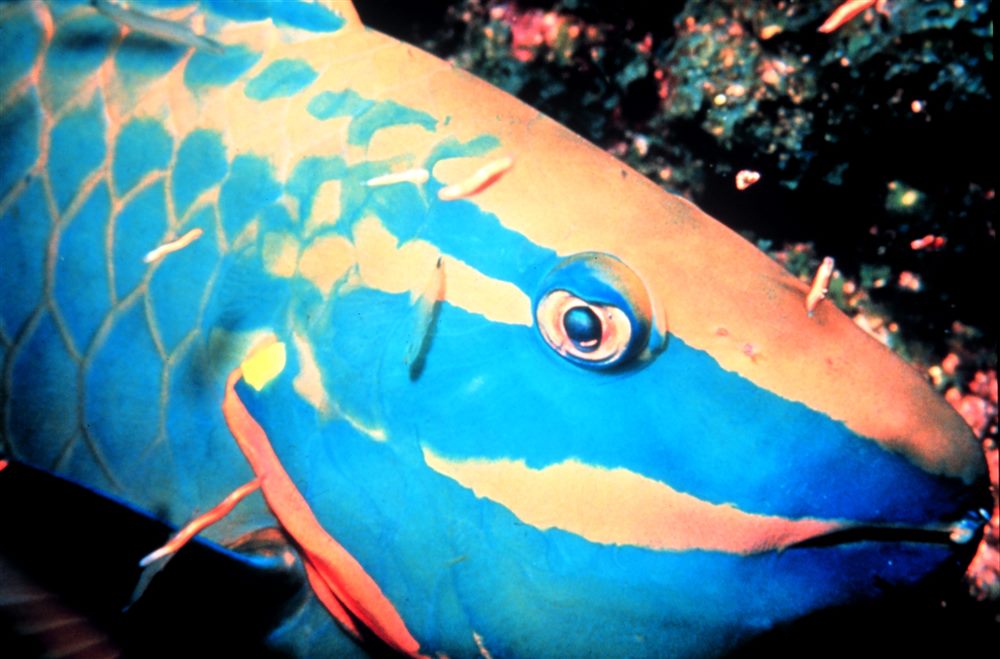
What if it disappeared?
Impact HighWithout parrotfish grazing on algae growing over dead coral, algae take over and start covering and smothering the living coral colonies.
DocumentedDetail
Mumby, P.J., Dahlgren, C.P., Harborne, A.R. et al. (2006). Fishing, trophic cascades, and the process of grazing on coral reefs. Science, 311(5757), 98–101.
The authors show that in the absence of parrotfish and other herbivores, coral shifts toward a state dominated by fleshy algae, a state change that is difficult to reverse once established. Overfishing of large predators that keep other competing herbivorous fish in check amplifies this effect further.
After about a decade without this grazing pressure, reefs become markedly less resilient to coral bleaching: those that lost their parrotfish recover far worse from a disturbance than those that kept them.
DocumentedDetail
Mumby, P.J. (2006). The impact of exploiting grazers (Scaridae) on the dynamics of Caribbean coral reefs. Ecological Applications, 16(2), 747–769.
By modeling the effect of different levels of parrotfish exploitation on Caribbean reef dynamics, the author shows that beyond a certain fishing threshold, the reef loses its ability to return to a coral-dominated state after a disturbance such as a bleaching event.
A century without parrotfish is no longer a one-off loss of resilience: the reef would have long since crossed the threshold beyond which, per Mumby's modeling, a coral reef flips into a state dominated by fleshy algae — a state change that is especially hard to reverse once established.
ExtrapolatedDetail
Extrapolation à partir de Mumby, P.J. et al. (2006) et Mumby, P.J. (2006), qui identifient un seuil d'exploitation au-delà duquel le récif bascule vers un état dominé par les algues, difficile à inverser — sans qu'aucun des deux articles ne suive un récif sur cent ans pour confirmer que cet état persiste aussi longtemps.
Both studies model and document the shift to an algae-dominated state beyond a certain exploitation level, and note how hard it is to reverse once established. Extending that finding across a century assumes nothing restores grazing in the meantime — a reasonable assumption given the lack of documented spontaneous recovery in either study, but still an extrapolation beyond the time window actually observed.
What's missing to confirm it: No century-long monitoring of a Caribbean reef without parrotfish exists to confirm that the algae-dominated state, once reached, actually persists that long without ever shifting back toward coral.
Over a thousand years, it wouldn't just be the reef's living cover that had changed, but its very framework: without live coral continually rebuilding the limestone skeleton that waves and burrowing organisms wear down without pause, the reef's three-dimensional structure would likely flatten into a plain of rubble and algae, far poorer in shelter for marine life — a transformation that a later return of parrotfish wouldn't be enough to quickly reverse.
HypothesisDocumentation
-
Sparisoma viride — The IUCN Red List of Threatened Species
Accessed August 10, 2026
-
Mumby et al. (2006) — Fishing, trophic cascades, and the process of grazing on coral reefs, Science
Accessed August 7, 2026
-
Mumby (2006) — The impact of exploiting grazers (Scaridae) on the dynamics of Caribbean coral reefs, Ecological Applications
Accessed August 7, 2026
Last verified: August 16, 2026