Species → Little Brown Bat
Little Brown Bat
Myotis lucifugus
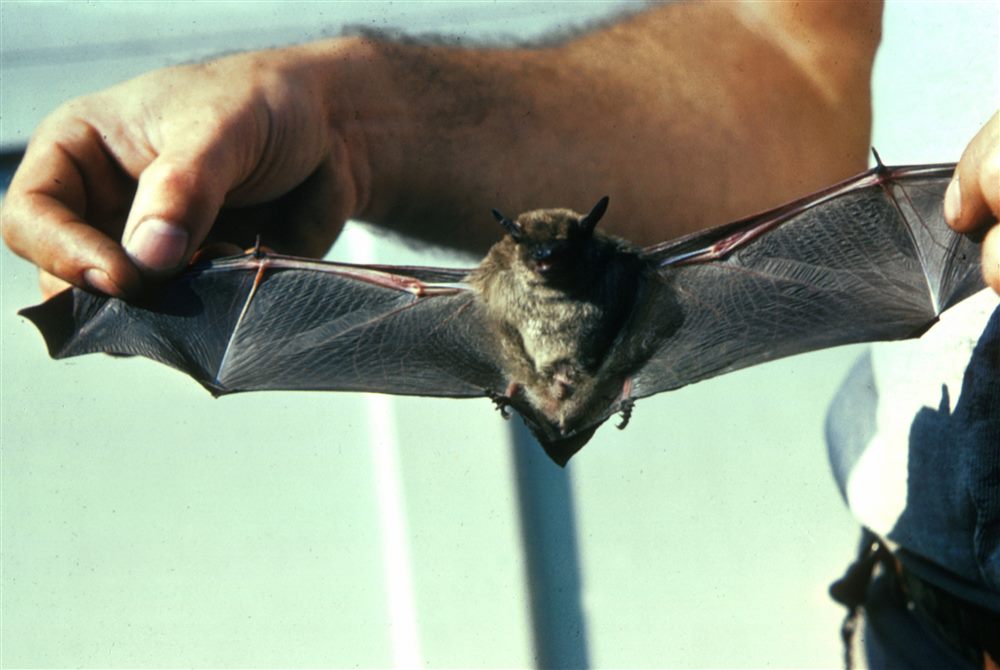
What if it disappeared?
Impact HighWhen white-nose syndrome hits a hibernation site, the little brown bat colony collapses almost immediately — sometimes by more than 90% in a single season. That drop instantly removes the predation pressure it exerted on the 160 agricultural pest and disease-vector species identified in its diet, within the vanished colony's hunting range.
ExtrapolatedDetail
Extrapolation à partir de Frick et al. (2010), qui documente la rapidité et l'ampleur des effondrements de colonies dus au syndrome du museau blanc, et de Maslo et al. (2022), qui identifie par ADN les 160 espèces de ravageurs et de vecteurs présentes dans le régime de l'espèce — aucune étude ne mesure directement le relâchement de la pression de prédation sur ces proies après l'effondrement d'une colonie.
Frick et al. (2010) show that hibernation colonies affected by the fungus collapse within a few seasons, with local declines exceeding 90%. Maslo et al. (2022) use DNA metabarcoding of guano to identify 653 distinct prey species, 160 of them known agricultural pests or disease vectors. Combining the two suggests a colony's disappearance almost immediately removes predation pressure on those specific prey, though no study has yet tracked that release in the field.
What's missing to confirm it: Monitoring of the 160 identified pest and vector species in the months following a colony collapse, to confirm the timing and scale of the release in predation pressure.
The disease has spread across all of eastern North America since it first appeared in 2006, collapsing entire colonies from one season to the next. It's no longer a single site losing its insect control, but whole swaths of the continent — to the point that the authors project complete regional extinction in several affected areas.
ExtrapolatedDetail
Extrapolation à partir de Frick et al. (2010), qui modélise la trajectoire régionale de l'espèce vers l'extinction dans les zones touchées, combiné à Maslo et al. (2022) pour la composition du régime — l'étendue exacte du service de régulation perdu à l'échelle régionale n'est pas mesurée directement.
Frick et al. (2010) combine decades of winter counts and demographic models to project a regional extinction trajectory in several areas hit by the syndrome, not just a one-off local decline. Extending the regulation role identified by Maslo et al. (2022) — 160 pests and vectors in the diet — to that scale suggests it's a service across a whole swath of the continent that's fading, not just that of one isolated hibernation site.
What's missing to confirm it: A regional, rather than site-by-site, measurement of residual predation pressure on the 160 identified pest and vector species as the disease progresses.
If the model's trajectory holds over a century, this regulation service would be gone for good in the affected regions. Other insectivorous bats would likely take over part of the role, but without targeting exactly the same 160 pest and vector species — a less precise form of control, whose real cost in crop losses or insect-borne disease no one has yet measured.
HypothesisOver a thousand years, another insectivore would likely occupy the general niche left empty, but probably not with the same prey selection revealed by the guano DNA — 653 distinct species, including those 160 well-identified pests and vectors. That precise fingerprint, shaped by the species' own history, would likely never be recreated exactly.
HypothesisDocumentation
-
Frick et al. (2010) — An emerging disease causes regional population collapse of a common North American bat species, Science
Accessed August 10, 2026
-
Maslo et al. (2022) — Bats provide a critical ecosystem service by consuming a large diversity of agricultural pest insects, Agriculture, Ecosystems & Environment
Accessed August 10, 2026
-
Boyles et al. (2011) — Economic importance of bats in agriculture, Science
Accessed August 10, 2026
Last verified: August 16, 2026