Species → Long-spined sea urchin
Long-spined sea urchin
Diadema antillarum
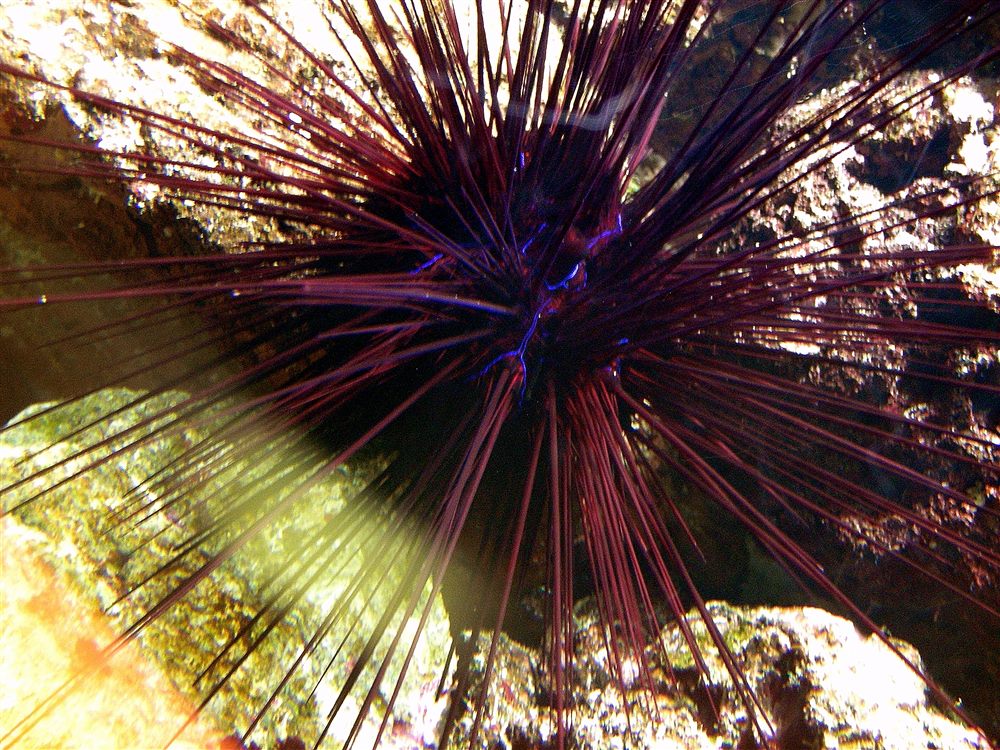
What if it disappeared?
Impact MajorWithin the first year after the long-spined sea urchin disappears, the fleshy algae its grazing had kept in check would likely begin overtaking the coral substrate, even before the drop in coral cover becomes fully visible.
ExtrapolatedDetail
Extrapolation à partir de Hughes (1994), qui documente l'état du récif de Discovery Bay plusieurs années après la mortalité de masse de 1983-1984, pas le rythme de la première année.
Hughes (1994) documents the reef's condition several years after the mass mortality, once the shift to algae was already underway — not how quickly algae began gaining ground in the first months. The reasoning starts from the fact that fleshy algae grow quickly once a major grazer disappears; the time before the drop in coral cover becomes measurable is, itself, documented only over several years.
What's missing to confirm it: No precise measurement of the Discovery Bay reef within the twelve months following the 1983-1984 mass mortality appears in the available sources — the documented monitoring begins later, once the shift was already underway.
Ten years after 95 to 99% of Caribbean long-spined sea urchins died in 1983-1984 — the last major algae grazer remaining after decades of herbivorous-fish overfishing — the Discovery Bay reef in Jamaica had gone from over 50% coral cover to less than 5%, while fleshy algae had invaded more than 90% of the substrate.
DocumentedDetail
Hughes, T.P. (1994). Catastrophes, phase shifts, and large-scale degradation of a Caribbean coral reef. Science, 265(5178), 1547–1551.
Long-term monitoring at Discovery Bay shows that the already long-standing overfishing of herbivorous fish had made the reef dependent on the urchin as its last line of grazing defense. Its sudden collapse, caused by a pathogen that spread from the Atlantic entrance of the Panama Canal, removed that last check — within a decade, the reef had flipped from a coral-dominated state to an algae-dominated one.
A century without the long-spined sea urchin would likely lock much of the Caribbean's reefs into an algae-dominated state rather than a coral-dominated one, compounded by warming-linked bleaching events — recovery since 1983 has been so slow and uneven, and was further set back by a second mass mortality in 2022, that a full century probably would not be enough to reverse it.
ExtrapolatedDetail
Extrapolation à partir des données de rétablissement sur 30 ans (Lessios 2016) et de la mortalité de masse de 2022 (Hylkema et al. 2023), prolongées au-delà de la période effectivement mesurée.
The urchin's recovery already varied widely from island to island by 2015 (about 12% of pre-1983 densities on average), and the new 2022 mass mortality again cut back a population that was already struggling to recover after nearly four decades. Extending this trajectory over a century assumes no rapid recovery occurs in the meantime, which remains an assumption beyond what the roughly 40 years observed so far can confirm with certainty.
What's missing to confirm it: A hundred-year projection assumes no rapid urchin recovery, and no other grazing species stepping in, changes the trajectory — a plausible but unverifiable assumption given that current data cover only about 40 years.
Over a thousand years, even if the long-spined sea urchin returned intermittently, reefs that had spent centuries dominated by algae would likely have lost much of their coral structure to plain erosion — the grazer's return alone would probably no longer be enough to rebuild what the reef took millennia to build.
HypothesisDocumentation
-
Hughes (1994) — Catastrophes, phase shifts, and large-scale degradation of a Caribbean coral reef, Science
Accessed August 7, 2026
-
Hylkema et al. (2023) — The 2022 Diadema antillarum die-off event, Frontiers in Marine Science
Accessed August 7, 2026
-
Lessios (2016) — The Great Diadema antillarum Die-Off: 30 Years Later, Annual Review of Marine Science
Accessed August 7, 2026
Last verified: August 16, 2026