Species → Common Brown Lemur
Common Brown Lemur
Eulemur fulvus
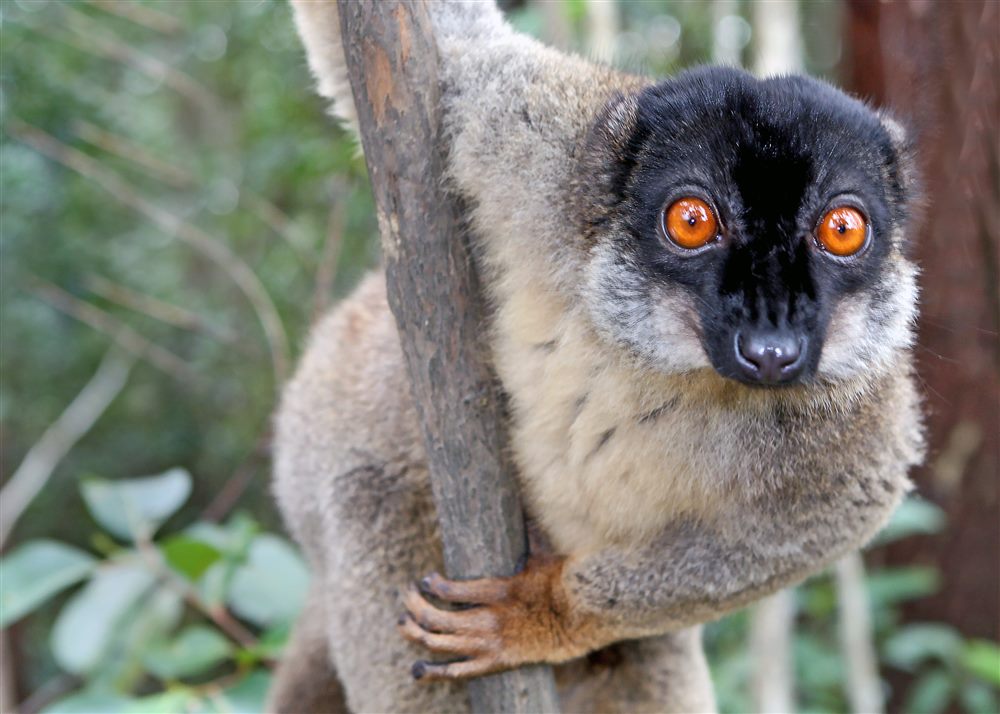
What if it disappeared?
Impact HighThe common brown lemur is the largest frugivore still present at its study site — on its own it removes up to 58.8% of the Astrotrichilia asterotricha fruit crop (dry season) and 26.0% of the Abrahamia deflexa crop (rainy season). Without it, that fruit would stay put, under the parent tree, instead of being carried off and dispersed elsewhere.
DocumentedDetail
Sato, H. (2022). Significance of seed dispersal by the largest frugivore for large-diaspore trees. Scientific Reports, 12, 19086.
The author directly measures the fruit removal rate by common brown lemurs for two species that fruit at different times of year (dry season for one, rainy season for the other) — the lemur's disappearance would therefore halt this function as soon as the next fruiting season, without delay.
Repeated across several fruiting seasons, this loss of dispersal would especially hit the 23 plant species that depend entirely on the common brown lemur — their seeds exceed 10 mm in diameter, too large for any other animal available at the site. Lacking anything to carry them off, their seedlings would pile up and stay clustered around the parent tree instead of colonizing new parts of the forest — exactly the pattern already observed in Madagascar forests where large frugivores have declined.
ExtrapolatedDetail
Extrapolation à partir de Sato, H. (2022). Significance of seed dispersal by the largest frugivore for large-diaspore trees. Scientific Reports, 12, 19086 — qui observe ce regroupement des semis autour de l'arbre parent dans des forêts où les grands frugivores ont déjà décliné, ici étendu à l'échelle temporelle d'une disparition complète et prolongée sur un site donné.
In forests where large frugivores have disappeared or declined, the author observes that seedlings and saplings of large-seeded species occur at much lower density and are clustered around the parent tree rather than dispersed — a sign of breaking forest regeneration. This finding, made in already-depleted forests, is here applied to what a decade of lemur loss would produce at a site that still has it today.
What's missing to confirm it: No measurement of the precise time lag between losing the disperser and the visible appearance of this seedling clustering was found in the sources gathered here.
A century on, the 23 plant species entirely dependent on the common brown lemur would still have no agent capable of dispersing their large seeds: their regeneration would stay confined to the immediate vicinity of parent trees, and their presence would likely give ground to small-seeded species — dispersed by wind or gravity — that are able to colonize new areas.
HypothesisOver a thousand years, several generations of large, large-seeded trees would have passed without ever regaining a suitable disperser: their share of the forest would decline for good, replaced by small-seeded species better served by wind or gravity. Even if a disperser of comparable size eventually filled that gap, it would find a forest whose proportion of large, large-seeded trees would probably never fully return to what it once was.
HypothesisDocumentation
-
IUCN Red List — Eulemur fulvus, statut de conservation
Accessed August 14, 2026
-
Sato (2022) — Significance of seed dispersal by the largest frugivore for large-diaspore trees, Scientific Reports
Accessed August 14, 2026
-
Tarnaud & Simmen (2002) — A major increase in the population of brown lemurs on Mayotte since the decline reported in 1987, Oryx
Accessed August 14, 2026
Last verified: August 16, 2026