Species → Fig wasp
Fig wasp
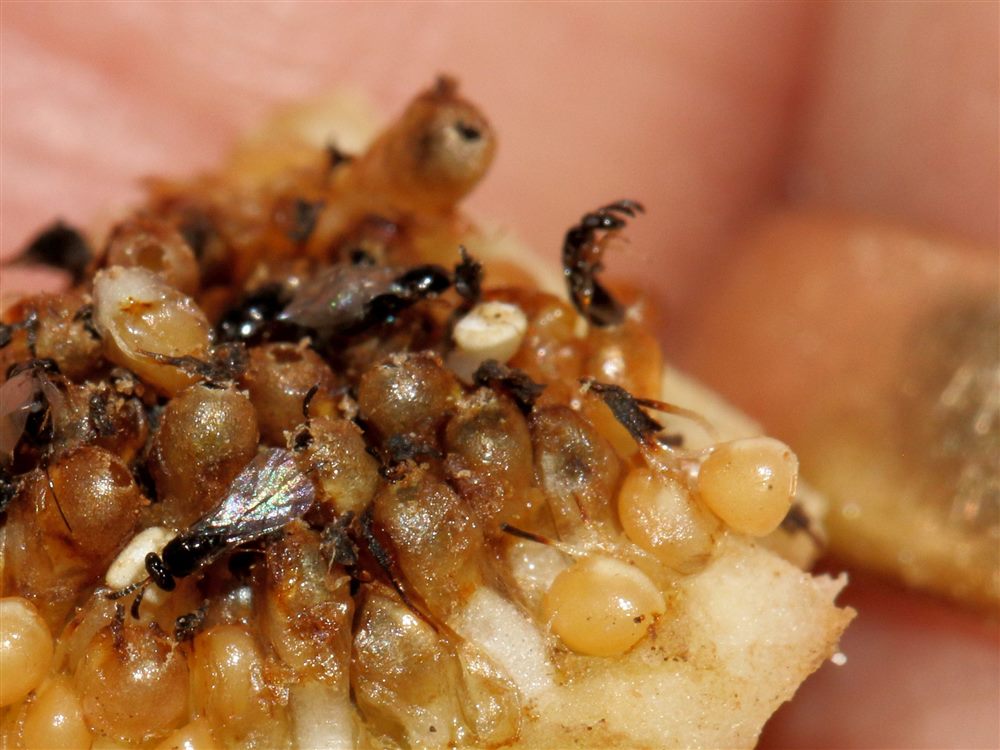
Ceratosolen spp. (famille Agaonidae)
What if it disappeared?
Impact HighWithout wasps to fertilize them, fig trees aborted their fruit en masse within the year after the 1997-1998 drought in Borneo — depriving the forest of one of its only reliable food sources during lean periods: radio-collared sun bears and Bornean bearded pigs were found emaciated or dying during the fruit shortage that followed.
DocumentedDetail
Harrison, R.D. (2000). Repercussions of El Niño: drought causes extinction and the breakdown of mutualism in Borneo. Proceedings of the Royal Society B, 267(1446), 911–915 ; Wong, S.T., Servheen, C., Ambu, L. et Norhayati, A. (2005). Impacts of fruit production cycles on Malayan sun bears and bearded pigs in lowland tropical forest of Sabah, Malaysian Borneo. Journal of Tropical Ecology, 21(6), 627–639.
The El Niño-related drought halted flowering in several dioecious fig species; with no receptive figs to lay eggs in, the wasps went locally extinct, and most had still not returned six months later. Unlike most tropical trees, which fruit in synchronized, spaced-out pulses, fig trees produce fruit almost continuously thanks to this mutualism — making them a crucial fallback resource during the long periods when other trees aren't fruiting. The removal of this resource coincides directly with the documented famine episodes among large frugivores in northern Borneo between 1999 and 2000.
If wasp populations hadn't reformed in the years following 1998 — the Borneo study only tracks six months without return — the affected sites would have faced not a single lean episode but repeated fruit shortages across several consecutive seasons, with cumulative stress on bears and pigs rather than an isolated shock they could recover from.
ExtrapolatedDetail
Extrapolation à partir de Harrison (2000), qui documente l'absence de retour des guêpes sur six mois seulement, sans suivi publié au-delà de cette fenêtre.
Harrison (2000) notes the possibility that some wasp species went fully extinct rather than just locally, given their high endemism and the extent of the drought — but no field follow-up published in the sources gathered here confirms if, where, and when recolonization actually occurred beyond the six months observed.
What's missing to confirm it: Multi-year field monitoring after 1998, to establish whether and when wasps recolonized the affected sites rather than having disappeared there for good.
Over a century of lasting loss rather than a one-off episode, animals that depend on figs as a fallback resource would have to do without it continuously: few other tropical trees fruit as steadily spread out over time, so nothing would truly fill that gap in the forest's food calendar.
HypothesisOver a thousand years without this fallback resource, populations of large frugivores like sun bears and Bornean bearded pigs would likely settle at lower, more unstable levels, shaped by recurring lean periods rather than the relatively steady supply figs once provided — a gradual narrowing of resilience across the whole food chain that depends on them, rather than a sudden collapse.
HypothesisDocumentation
-
Shanahan, So, Compton & Corlett (2001) — Fig-eating by vertebrate frugivores: a global review, Biological Reviews
Accessed August 7, 2026
-
Harrison (2000) — Repercussions of El Niño: drought causes extinction and the breakdown of mutualism in Borneo, Proceedings of the Royal Society B
Accessed August 7, 2026
-
Wong, Servheen, Ambu & Norhayati (2005) — Impacts of fruit production cycles on Malayan sun bears and bearded pigs, Journal of Tropical Ecology
Accessed August 7, 2026
Last verified: August 16, 2026