Species → Panamanian golden frog
Panamanian golden frog
Atelopus zeteki
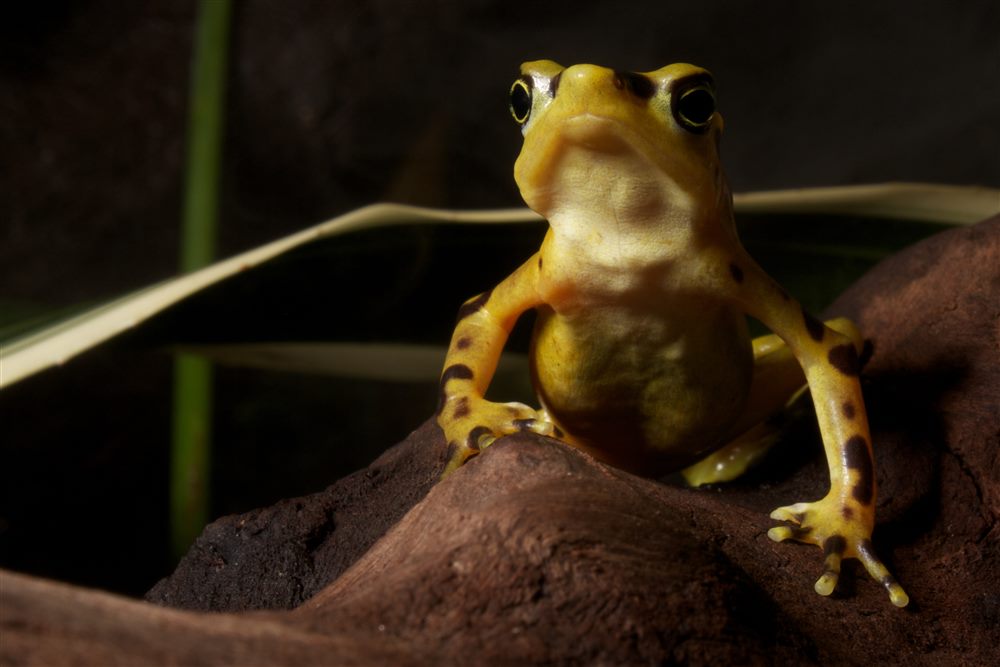
What if it disappeared?
Impact HighWhen the chytrid fungus wiped out nearly all of the stream's tadpoles at El Copé within about a year — including the golden frog's — the biomass of algae and fine detritus on the streambed more than doubled and the system's nitrogen uptake rate dropped by more than half: losing their grazing and stirring of the streambed immediately changed the stream's chemistry.
DocumentedDetail
Colón-Gaud, C. et al. (2010). Freshwater Biology, 55, 2077–2088 ; Whiles, M.R. et al. (2013). Disease-Driven Amphibian Declines Alter Ecosystem Processes in a Tropical Stream. Ecosystems, 16(1), 146–157.
Experimental electric-fence enclosures excluded tadpoles from certain zones of the stream, confirming that they directly consume algae and sediment and redistribute them through bioturbation. Researchers measured the stream before and after the sudden collapse of all the site's aquatically breeding frogs — the golden frog was among the most abundant members of this tadpole assemblage before the fungus arrived, though its individual role was not isolated from the rest.
Ten years on, nothing suggests the stream returned to its original state: the golden frog has not been seen in the wild anywhere in its range since 2009, and nothing has taken over its grazing role — the excess algae and detritus measured right after the collapse most likely persisted rather than receding.
ExtrapolatedDetail
Extrapolation à partir de l'absence documentée de toute observation de la grenouille dorée à l'état sauvage depuis 2009 (Panama Amphibian Rescue and Conservation Project), combinée à Whiles et al. (2013), qui mesurent l'état du cours d'eau juste après l'effondrement sans assurer un suivi sur dix ans.
The absence of any wild golden frog sighting since 2009 is a fact documented by the conservation program that monitors it. What that implies for the stream's condition ten years after the collapse measured by Whiles et al. (2013) remains an extrapolation: no newer El Copé sampling in the sources gathered here directly confirms that the algae excess and nitrogen deficit persisted rather than being taken over by another organism.
What's missing to confirm it: New sampling of the El Copé stream, years after the initial collapse, to confirm that the state measured then has persisted rather than receded.
Over a century, with no species stepping in to take over exactly the same grazing and streambed-stirring role, the stream would likely settle into a new, lasting equilibrium — more algae, less nitrogen recycled — rather than ever reverting to its pre-fungus state.
HypothesisOver a thousand years, the species surviving in captivity — more than 1,000 adults across more than 50 North American institutions — would do nothing for its home stream if the chytrid fungus persists there indefinitely: the golden frog would go on existing as a species without ever resuming its ecological role at El Copé, its survival and its function permanently split apart.
HypothesisDocumentation
-
Panama Amphibian Rescue and Conservation Project — Panamanian Golden Frog
Accessed August 7, 2026
-
Whiles et al. (2013) — Disease-Driven Amphibian Declines Alter Ecosystem Processes in a Tropical Stream, Ecosystems
Accessed August 7, 2026
-
Colón-Gaud et al. (2010) — étude complémentaire, Freshwater Biology
Accessed August 7, 2026
Last verified: August 16, 2026