Species → Blue Jay
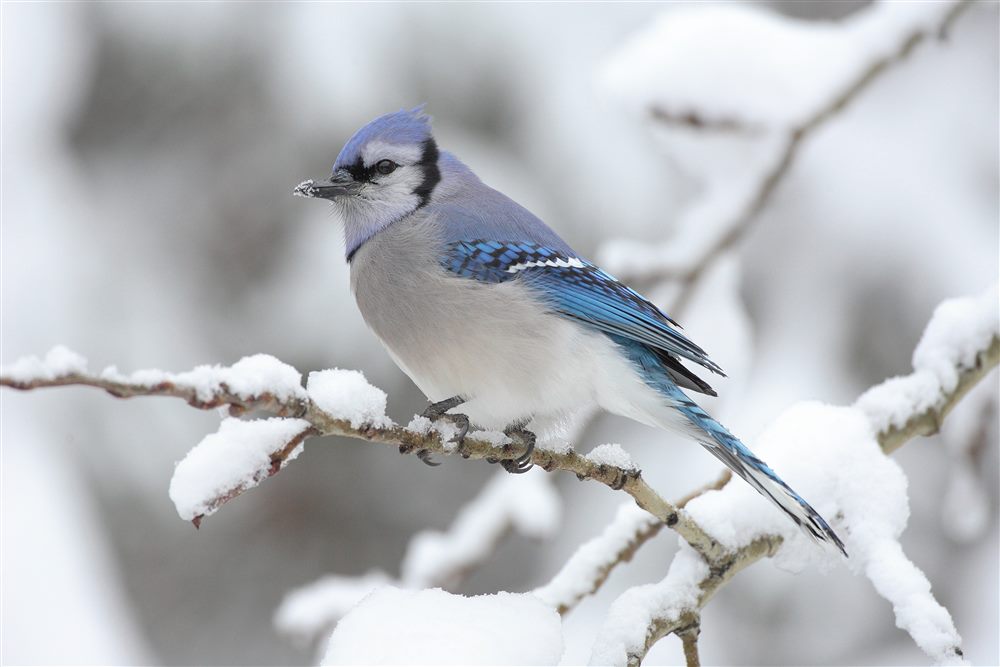
Blue Jay
Cyanocitta cristata
What if it disappeared?
Impact ModerateWithout blue jays to carry beechnuts and acorns several kilometers and bury them in caches, the forest would lose, from the very first mast season, a long-distance dispersal method no other agent (wind, gravity) reproduces at this scale for seeds this heavy.
DocumentedDetail
Johnson, W.C. et Adkisson, C.S. (1985). Dispersal of beech nuts by blue jays in fragmented landscapes. American Midland Naturalist, 113(2), 319–324.
Across hundreds of forest visits in autumn, the blue jays studied carried seeds up to several kilometers from the source tree and buried them at a depth ideal for germination. Without this service, beechnuts and acorns would only spread by gravity or wind — a few meters, not several kilometers.
Within a decade without jays, acorns and beechnuts would only be sown a few dozen meters by squirrels or gravity, instead of several kilometers: young oaks and beeches would stop colonizing clearings and open ground far from seed-bearing trees, staying confined to their immediate surroundings.
ExtrapolatedDetail
Extrapolation à partir de Johnson & Adkisson (1985), qui mesurent la distance de dispersion propre au geai, combinée au fait que les écureuils — l'autre disperseur mentionné dans la littérature — opèrent sur des distances bien plus courtes.
The dispersal distance measured for jays (several kilometers) contrasts with that of the other agents available once jays are gone: gravity (a few meters) and squirrels, which generally cache closer to the source tree. Over several years without jays, new oak and beech seedlings would concentrate around existing stands rather than colonizing open ground.
What's missing to confirm it: The exact share squirrels and gravity could compensate for, and the precise delay before a decline in clearing colonization becomes measurable in the field, remain to be quantified — this extrapolation combines two distinct facts (jay dispersal distances and available alternatives) rather than a direct measurement of the ten-year effect.
Over a century without jays, a forest tract would lose its ability to quickly recolonize a large clearing opened by fire or storm: oaks and beeches would return only along its edges, carried by wind or squirrels, while the clearing's center stayed dominated by other species for as long as the forest took to close back in.
HypothesisOver a thousand years without jays or related corvids, oaks and beeches would likely regain lost ground far more slowly than they did in the past: after the last glaciation, their rate of recolonization across North America outpaces what gravity or wind dispersal alone can explain, which already points to a key role for corvids at this timescale.
ExtrapolatedDetail
Extrapolation à partir de Johnson & Adkisson (1985) et de la littérature sur la vitesse de migration postglaciaire des chênes : le mécanisme de dispersion à courte échelle de temps appliqué à une question de paléoécologie sur des millénaires.
Models of post-glacial oak migration in North America show a rate of advance that's hard to explain by passive acorn dispersal alone. Corvids, capable of carrying heavy seeds several kilometers, are a plausible explanation put forward by several paleoecologists for this gap — the same mechanism would play out in reverse if jays disappeared today.
What's missing to confirm it: Disentangling the jays' contribution from that of other agents (squirrels, climate change itself) to the pace of historical recolonization remains hard to measure directly, since a millennia-old event can't be directly observed.
Documentation
-
Blue Jay Life History — Cornell Lab of Ornithology, All About Birds (citant Partners in Flight)
Accessed August 10, 2026
-
Johnson & Adkisson (1985) — Dispersal of beech nuts by blue jays in fragmented landscapes, American Midland Naturalist
Accessed August 7, 2026
Last verified: August 16, 2026