Species → Greater flamingo
Greater flamingo
Phoenicopterus roseus
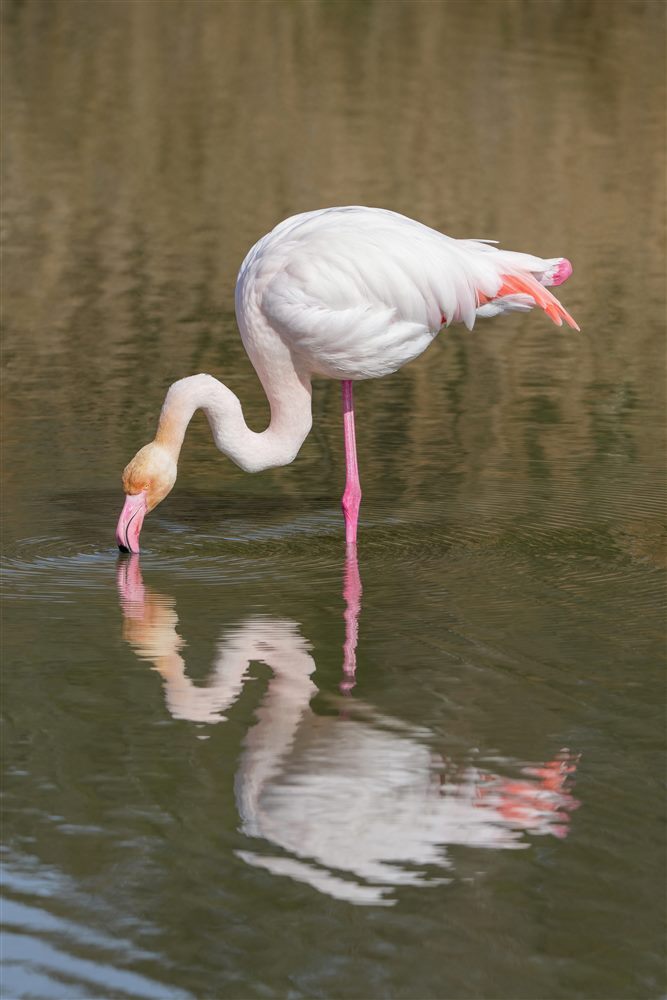
What if it disappeared?
Impact ModerateWithout greater flamingos in numbers, a saline lagoon almost immediately loses the nitrogen and phosphorus that their droppings and the sediment disturbance from their feet released into the water — an input that, measured at Fuente de Piedra, nearly doubles the growth rate of the bacteria that support the rest of the food chain.
DocumentedDetail
Batanero, G.L., León-Palmero, E., Li, L., Green, A.J., Rendón-Martos, M., Suttle, C.A. & Reche, I. (2017). Flamingos and drought as drivers of nutrients and microbial dynamics in a saline lake. Scientific Reports, 7, 12173.
During a wet year, more than 50,000 flamingos used the Fuente de Piedra lagoon (Málaga); during the following drought, the population crashed to 12,000 birds with no breeding. The authors show nitrogen and phosphorus inputs from droppings were markedly higher in the wet year, and that a laboratory guano addition nearly doubled the growth rate and carrying capacity of heterotrophic bacteria, via phosphorus assimilation.
That weakened bacterial production would, over the years, deprive zooplankton and aquatic invertebrates of part of their food base — the same resource that other waterbirds, like avocets and stilts, which share these saline lagoons with the flamingo, rely on.
ExtrapolatedDetail
Extrapolation à partir de Batanero et al. (2017) : l'effet mesuré sur la production bactérienne étendu aux niveaux trophiques supérieurs, pas un résultat publié pour ces niveaux.
The saline lagoons where flamingos nest also host avocets, stilts and plovers, which depend on the same aquatic invertebrates. If bird-driven nutrient enrichment genuinely benefits these levels, no monitoring yet directly links flamingo presence to zooplankton or fish abundance at these sites.
What's missing to confirm it: Monitoring comparing zooplankton, benthic invertebrates or fish between lagoons with high versus low flamingo attendance would confirm whether the nutrient effect measured at the bacterial level propagates up the food chain.
Over a hundred years without flamingos returning, a saline lagoon would plausibly stay locked into a poorer state: deprived of the regular input of droppings that sustains its bacterial base, the food chain that depends on it — zooplankton, invertebrates, fish, and the other waterbirds — would likely settle into a lastingly lower level of productivity, rather than recovering on its own.
HypothesisOver a thousand years, even if flamingos eventually returned, the community of microorganisms and invertebrates that had adapted in the meantime to this poorer nutrient regime would likely not become identical to what it once was — a new balance, different from the original, would have settled in.
HypothesisDocumentation
-
IUCN Red List / BirdLife DataZone — Phoenicopterus roseus (Greater Flamingo), statut et effectifs
Accessed August 10, 2026
-
Batanero et al. (2017) — Flamingos and drought as drivers of nutrients and microbial dynamics in a saline lake, Scientific Reports
Accessed August 10, 2026
-
Salvador et al. (2022) — Circular Bedforms Due to Pit Foraging of Greater Flamingo Phoenicopterus roseus in a Back-Barrier Intertidal Habitat, Diversity
Accessed August 10, 2026
Last verified: August 16, 2026