Species → Sunflower sea star
Sunflower sea star
Pycnopodia helianthoides
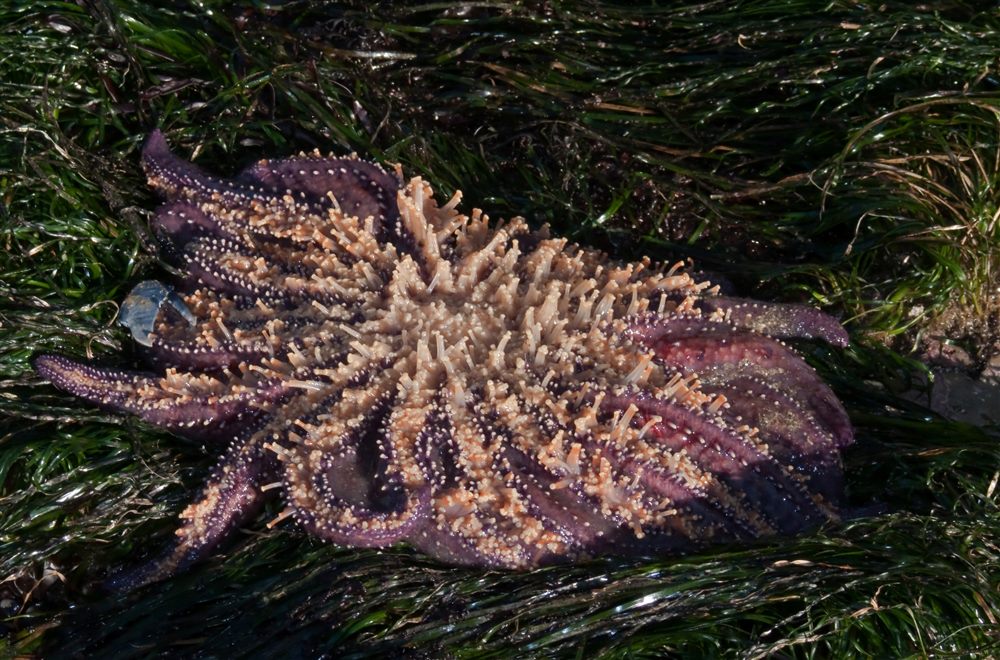
What if it disappeared?
Impact MajorWithout the sunflower star to keep them in check, purple sea urchins increased 60-fold in a single year in northern California, wiping out 95% of bull kelp canopy across more than 350 km of coastline.
DocumentedDetail
Rogers-Bennett, L. et Catton, C.A. (2019). Marine heat wave and multiple stressors tip bull kelp forest to sea urchin barrens. Scientific Reports, 9, 15050.
Purple urchin density rose from 0-1.7 per m² before 2014 to 8.2-12.9 per m² by 2015 — an explosion concentrated within a single season, immediately following the sunflower star's collapse in the region.
That urchin explosion was no isolated blip: the resulting red abalone mortality climbed to 96% the following year, and two fisheries worth nearly $47 million a year combined — recreational abalone, commercial red urchin — were forced to close.
DocumentedDetail
Rogers-Bennett, L. et Catton, C.A. (2019). Marine heat wave and multiple stressors tip bull kelp forest to sea urchin barrens. Scientific Reports, 9, 15050.
Red abalone mortality rose from 48 to 82% between 2016 and 2017, then up to 96% the following year, leading to the 2018 closure of the recreational abalone fishery ($44 million a year) and the collapse of the commercial red sea urchin fishery ($3 million a year) starting in 2015.
Over a century, if this coastline stayed without the sunflower star, this urchin-dominated state would likely persist rather than reverting to kelp forest on its own: once such an ecosystem has flipped, urchins can survive very long stretches without much food, which makes this kind of shift especially hard to reverse without intervention.
HypothesisOver a thousand years, the picture would likely be uneven: in fjords where glacial meltwater keeps the disease at bay, pockets of kelp sustained by a still-present sunflower star could have persisted, while elsewhere, across the thousands of kilometers of affected coastline, urchins would likely remain in control.
HypothesisDocumentation
-
IUCN Red List — Pycnopodia helianthoides, évaluation 2021 (Gravem et al.)
Accessed August 14, 2026
-
Harvell et al. (2019) — Disease epidemic and a marine heat wave are associated with the continental-scale collapse of a pivotal predator, Science Advances
Accessed August 14, 2026
-
Rogers-Bennett & Catton (2019) — Marine heat wave and multiple stressors tip bull kelp forest to sea urchin barrens, Scientific Reports
Accessed August 14, 2026
-
Gehman et al. (2025) — Fjord oceanographic dynamics provide refuge for critically endangered Pycnopodia helianthoides, Proceedings of the Royal Society B
Accessed August 14, 2026
Last verified: August 16, 2026