Species → African forest elephant
African forest elephant
Loxodonta cyclotis
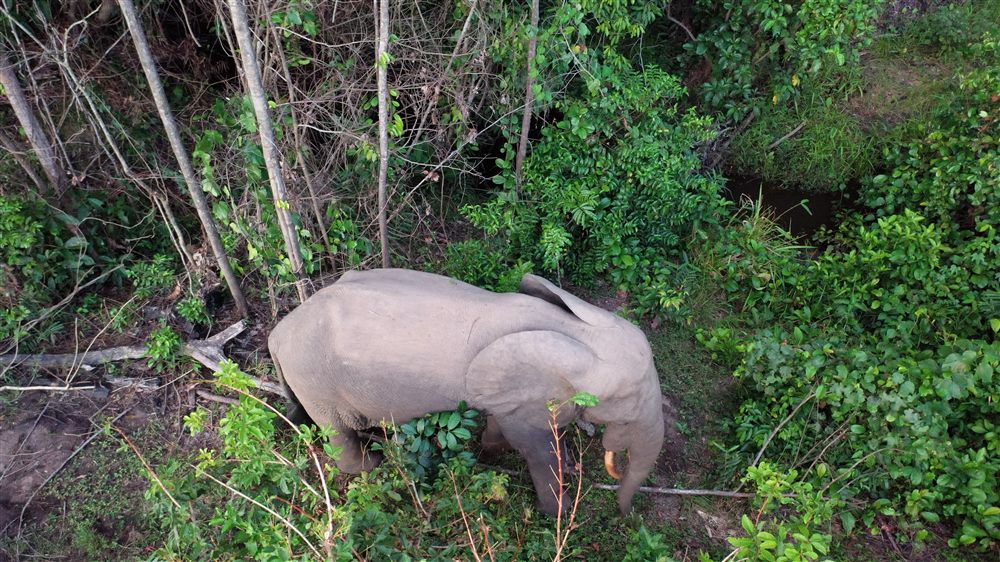
What if it disappeared?
Impact MajorWithout forest elephants to trample and browse the fast-growing saplings they normally keep from getting established, those soft-wood species would stop being held back from year one, growing unchecked in the clearings and trails elephants used to travel.
HypothesisOver a decade, those fast-growing young trees that elephants used to knock down or browse before they reached the canopy would start making their way up, at the expense of the dense-wood species that elephant presence had favored until then.
ExtrapolatedDetail
Extrapolation à partir de Berzaghi et al. (2019) : l'étude mesure un écart de composition forestière déjà établi, pas le rythme auquel il apparaît après la disparition de l'éléphant.
Berzaghi et al. (2019) compare forests with and without elephants without specifying how long the latter have been without them; this point assumes that an initial shift in forest composition, favoring fast-growing species, would already be noticeable after about a decade.
What's missing to confirm it: No decade-scale monitoring measuring how fast forest composition changes after elephants disappear was found in the sources gathered here — only the already-established gap between forests with and without elephants is measured.
In parts of the Congo Basin where forest elephants disappeared long ago due to hunting, the forest that grew back stores up to 60 tonnes less aboveground biomass per hectare today than comparable areas where elephants remained — field-measured proof that this loss lasts long after the disappearance itself.
DocumentedDetail
Berzaghi, F., Longo, M., Ciais, P. et al. (2019). Carbon stocks in central African forests enhanced by elephant disturbance. Nature Geoscience, 12(9), 725–729.
By comparing forests where elephants are present to comparable forests from which they were eliminated by hunting, the authors show that elephant disturbance favors dense-wood trees over fast-growing, soft-wood species — a gap that reflects decades of absence, not simply an unrelated difference between locations.
If this disappearance held at that time scale across the whole Congo Basin, simulations project a carbon release equivalent to several years of fossil emissions from many countries — a loss of storage capacity no longer confined to isolated patches but affecting the whole region, one that dense-wood trees taking centuries to regrow wouldn't fully recreate.
ExtrapolatedDetail
Extrapolation à partir de Berzaghi et al. (2019) : résultat d'une simulation par modèle de dynamique forestière, pas une mesure d'un relâchement de carbone déjà survenu.
The model projects what would happen to Congo Basin forest composition if the forest elephant's decline continued unchecked, across the whole region rather than a single plot. The result depends on the model's assumptions about the speed of forest recolonization and competition among tree species in the elephants' absence.
What's missing to confirm it: No field measurement, at the scale of the Congo Basin, yet confirms the carbon release the model projects should the decline continue.
Documentation
-
IUCN Red List — Loxodonta cyclotis, statut et population
Accessed August 7, 2026
-
Berzaghi et al. (2019) — Carbon stocks in central African forests enhanced by elephant disturbance, Nature Geoscience
Accessed August 7, 2026
Last verified: August 16, 2026