Species → Dugong
Dugong
Dugong dugon
What if it disappeared?
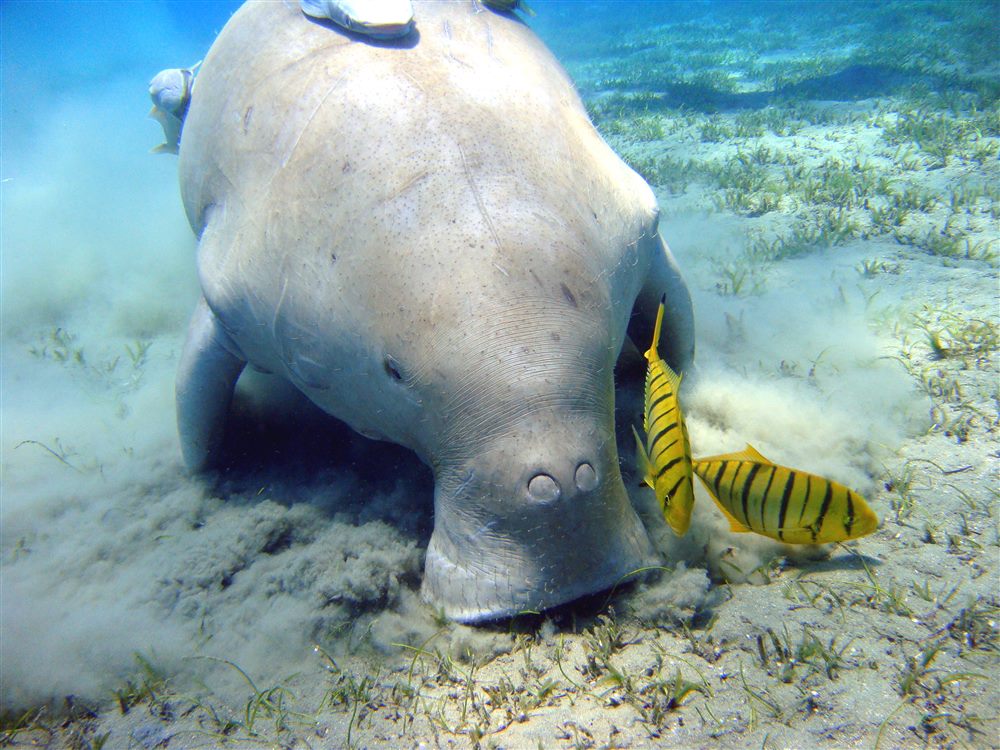
Impact ModerateWithout a dugong grazing a seagrass meadow hard, it no longer gets the push that makes it regrow richer in nitrogen: within the first year, the gap can reach 35% less than a meadow that stayed under active grazing.
DocumentedDetail
Aragones, L.V., Lawler, I.R., Foley, W.J. et Marsh, H. (2006). Dugong grazing and turtle cropping: grazing optimization in tropical seagrass systems? Oecologia, 149(4), 635–647.
By experimentally simulating light and intensive grazing on two tropical Queensland seagrass meadows, then measuring regrowth after 11 to 13 months, the authors show that the dugong's preferred species (Halophila ovalis and Halodule uninervis) that stay intensively grazed regrow with nitrogen concentrations 35% and 25% higher, respectively, than areas left ungrazed — the state a meadow would return to within the first year without dugongs. A gain tempered by lower starch and higher fiber content, and one that green turtle grazing partly reproduces (+30% nitrogen on Halophila ovalis).
That loss carries over into stored carbon: according to a model of a comparable meadow in Bahrain, a site left without dugongs for years would capture roughly two and a half times less carbon in its sediment than a meadow still grazed by a population of about 700 individuals.
ExtrapolatedDetail
Extrapolation à partir de Schmitz, O.J. et AlMealla, R.K. (2026). Integrating megafauna into blue carbon strategies: dugongs could enhance seagrass carbon storage. Frontiers in Marine Science, 13, 1816090 — un modèle, pas une mesure de terrain du stock de carbone avant et après broutage.
The model estimates that roughly 700 dugongs on a 145 km² meadow in Bahrain would multiply the ecosystem's net primary production and net carbon balance by 2.4 on average (range 1.1 to 4.2) and sediment carbon storage by 2.6 on average (range 1.1 to 7.6), representing about 79,000 additional tonnes of carbon captured each year. This is a numerical projection, not a repeated field measurement before and after an actual disappearance.
What's missing to confirm it: No direct field measurement, before and after an actual disappearance of dugongs on a comparable meadow, yet confirms the pace at which this gap in carbon storage would widen over a decade.
Along Queensland's urban coast, the dugong population fell from about 72,000 individuals in the early 1960s to about 4,220 in the mid-1990s, down to just 3.1% of its original level. If this near-disappearance held for a century, the seagrass meadows they once grazed would plausibly have lost, on a wide scale, the regrowth vigor and nitrogen richness that grazing sustained elsewhere.
HypothesisOver a thousand years, even if dugongs returned in force, the meadow likely would not simply spring back to its earlier form: the species that benefit least from grazing would have had plenty of time to dominate the seabed, and the carbon that failed to accumulate throughout that time would not be made up all at once.
HypothesisDocumentation
-
IUCN Red List — Dugong dugon, évaluation 2019 (Marsh & Sobtzick)
Accessed August 14, 2026
-
Aragones, Lawler, Foley & Marsh (2006) — Dugong grazing and turtle cropping: grazing optimization in tropical seagrass systems?, Oecologia
Accessed August 14, 2026
-
Marsh, De'ath, Gribble & Lane (2005) — Historical marine population estimates: Triggers or targets for conservation? The dugong case study, Ecological Applications
Accessed August 14, 2026
-
Schmitz & AlMealla (2026) — Integrating megafauna into blue carbon strategies: dugongs could enhance seagrass carbon storage, Frontiers in Marine Science
Accessed August 14, 2026
Last verified: August 16, 2026