Species → Common Bottlenose Dolphin
Common Bottlenose Dolphin
Tursiops truncatus
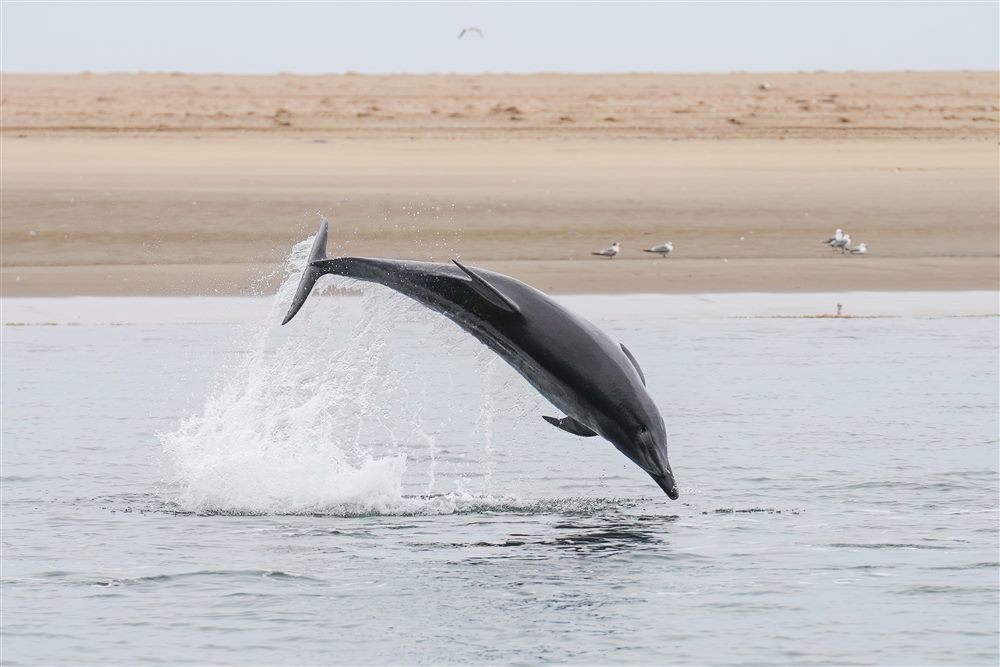
What if it disappeared?
Impact LowIn the first year, the fish a bottlenose dolphin used to catch every day — the equivalent of several kilograms per individual, according to a recent energetic study — stop being hunted by it: a real, quantifiable predation pressure vanishes overnight from the schools it once patrolled.
ExtrapolatedDetail
Extrapolation à partir de Rimbach et al. (2021), qui mesure la dépense énergétique du dauphin vivant — donc la quantité de poissons qu'il doit capturer — pas la conséquence de son retrait sur ces poissons.
Using the doubly labeled water method, the study measures the total energy expenditure of dolphins of different ages — the most direct measurement available for this species. It allows an estimate of how much fish an individual must catch each day to cover it, and therefore the predation pressure that disappears with it. It does not measure what that removal changes for those fish.
What's missing to confirm it: No study tracks prey fish abundance after the removal of a bottlenose dolphin population — the reasoning starts solely from the quantity an individual must consume each day.
Ten years on, that missing pressure would likely have gone unnoticed in coastal fish abundance: the bottlenose dolphin shares its prey with many other predators already present — sharks, other hunting fish, seabirds — able to absorb what it left behind.
HypothesisA century later, the structure of coastal fish populations would plausibly remain close to what it is today: the many other predators already hunting the same schools — sharks, tuna, seabirds — would have had ample time to fill in what the dolphin left behind.
HypothesisOver a thousand years, nothing suggests a lasting gap would have formed: unlike an ecosystem engineer such as the beaver, the bottlenose dolphin does not physically shape its habitat — its disappearance would remove one hunter among several, not a function no other species can fill.
HypothesisDocumentation
-
Rimbach et al. (2021) — Total energy expenditure of bottlenose dolphins of different ages, Journal of Experimental Biology
Accessed August 10, 2026
-
IUCN Red List — Tursiops truncatus, statut mondial
Accessed August 10, 2026
Last verified: August 16, 2026