Species → White-tailed Deer
White-tailed Deer
Odocoileus virginianus
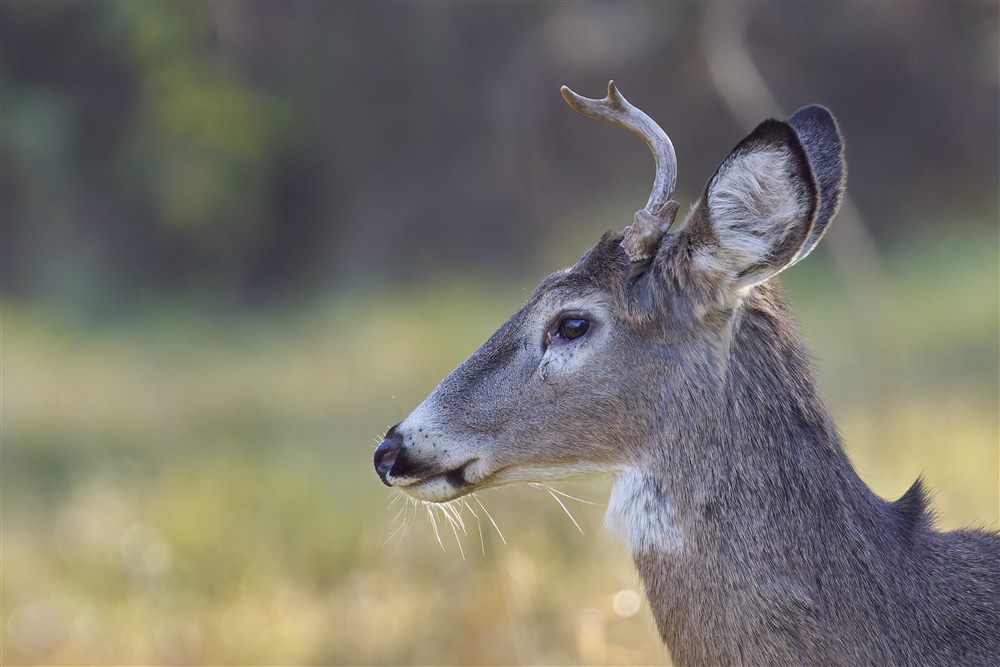
What if it disappeared?
Impact HighFreed from constant browsing, the most palatable herbaceous plants and young trees would start growing back within the very first year — the mirror image of what a landmark review documents under heavy deer pressure, where these are exactly the species that decline first.
ExtrapolatedDetail
Extrapolation inversée à partir de Rooney & Waller (2003), qui documentent le recul de ces mêmes plantes sous forte pression de broutage par le cerf, sans mesurer directement leur reprise après sa disparition.
Rooney & Waller synthesize decades of exclosure-fence studies showing that the higher and more prolonged deer density is, the more understory plant diversity declines. This point assumes the reverse — an immediate release from that pressure — though no study directly measures how fast recovery would begin within the first year after an actual deer disappearance.
What's missing to confirm it: A direct measurement of vegetation recovery within the year following an actual deer disappearance, rather than a simple inversion of the browsing mechanism documented while deer are present.
Ten years later, that rebound hasn't actually happened: a ten-year experiment fully excluding deer shows understory diversity, richness, and density remain unchanged despite a decade without browsing — locked in place by an invasive fern mat and a canopy already impoverished in tree diversity.
DocumentedDetail
Royo, A.A. & Carson, W.P. (2022). Stasis in forest regeneration following deer exclusion and understory gap creation: A 10-year experiment. Ecological Applications, 32(4), e2569.
Experiment conducted in Pennsylvania, crossing two treatments — deer exclusion and fern removal — to separate their effects. Only fern removal improves seedling establishment, and only in the first three years; deer exclusion alone changes neither richness nor diversity after ten years, a sign of a locked-in forest state rather than simple delayed recovery.
Nothing in those first ten years suggests a century would be enough to reverse the trend: the same lock-in — invasive ferns, tree species already missing from the canopy — that blocked recovery after ten years suggests that a hundred years without browsing wouldn't restore the original understory either.
ExtrapolatedDetail
Extrapolation au-delà de la durée réellement étudiée (dix ans) à partir de Royo & Carson (2022), qui ne mesurent pas l'état du sous-bois à cent ans.
A separate study on wolf density, browsing, and vegetation recovery (Brice et al., 2025) likewise finds weak, even reversed, effects when deer pressure is indirectly reduced by a predator's return — one more sign that the understory's lock-in doesn't simply undo itself by removing or reducing deer, even over a much longer timescale than ten years.
What's missing to confirm it: A genuinely long-term follow-up spanning several decades beyond the ten years studied, to know whether the observed lock-in persists or eventually gives way.
Over a thousand years, the forest would likely eventually regain a diverse understory — ferns don't dominate an unmanaged site forever — but probably not the same mix of plants as before: the slowest-dispersing species, lost locally during the decades of lock-in, would only return if a seed source still survives nearby.
HypothesisDocumentation
-
Rooney & Waller (2003) — Direct and indirect effects of white-tailed deer in forest ecosystems, Forest Ecology and Management
Accessed August 10, 2026
-
Royo & Carson (2022) — Stasis in forest regeneration following deer exclusion and understory gap creation, Ecological Applications
Accessed August 10, 2026
-
Brice et al. (2025) — Do wolves protect forests? Investigating the link between wolf density, deer browse, and plant recovery, Ecology and Evolution
Accessed August 10, 2026
Last verified: August 16, 2026