Species → Sperm Whale
Sperm Whale
Physeter macrocephalus
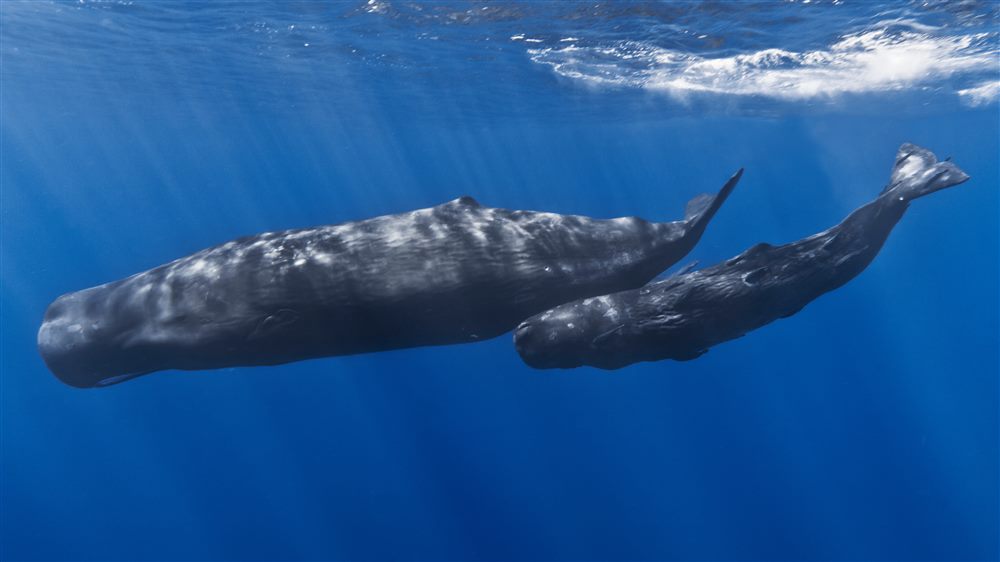
What if it disappeared?
Impact HighWithout sperm whales feeding at depth and then defecating near the surface, in the photic zone, the Southern Ocean immediately loses an annual input of about 50 tonnes of iron — a natural fertilizer that today fuels phytoplankton production and the net export of roughly 200,000 tonnes of carbon to the depths each year, more than these same whales emit by breathing.
DocumentedDetail
Lavery, T.J. et al. (2010). Iron defecation by sperm whales stimulates carbon export in the Southern Ocean. Proceedings of the Royal Society B, 277(1699), 3527–3531.
The mechanism differs from the one documented in the North Atlantic right whale (see that entry): where the general "whale pump" relies on nitrogen and nutrients brought up from all depths, this one specifically targets iron, a micronutrient that limits phytoplankton growth in the Southern Ocean. The authors' calculations, based on a population of about 12,000 sperm whales in that ocean, show that the iron input exceeds what would be needed to offset the carbon the whales themselves respire — a net negative carbon balance, making them a sink rather than a source.
After a decade without this iron fertilization, phytoplankton production would likely remain lower in the waters sperm whales once frequented, and the net export of carbon to the depths — around 200,000 tonnes a year today — would stay durably reduced, since nothing else in the Southern Ocean delivers that much iron to the surface this way.
ExtrapolatedDetail
Extrapolation à partir de Lavery et al. (2010), qui mesure l'apport actuel en fer et l'export de carbone associé, sans suivre ce qui se passerait sur dix ans si cet apport cessait.
The iron input measured by Lavery et al. (2010) exceeds what would be needed to offset the carbon the whales themselves respire — a net negative carbon balance, making them a sink rather than a source. Nothing in the study directly measures how long it would take, once that input disappeared, for phytoplankton production to fall and stay down; this is reasoning from the documented mechanism.
What's missing to confirm it: A multi-year study of phytoplankton production and carbon export in an area where sperm whales had actually disappeared would confirm the speed and persistence of this effect.
Most of the industrial hunting of sperm whales was concentrated in a bit over a century, from the rise of mechanized whaling to its gradual end after the 1980s, driving the global population down from about 2 million before exploitation to 840,000 today. If the Southern Ocean's carbon-sink capacity scales proportionally with the sperm whale population, that century of hunting likely cut this iron input and carbon export by more than half, though the exact scale of that drop has never been directly measured.
ExtrapolatedDetail
Extrapolation à partir de Lavery et al. (2010) et des estimations de population préindustrielle et actuelle du cachalot.
The inference assumes a proportional relationship between the number of sperm whales and the iron they defecate, plausible but not measured directly over so long a period. The most relevant figure would be the Southern Ocean's specific sperm whale population (about 12,000 individuals today) rather than the global population, and its own historical trajectory over the century of hunting is less well reconstructed than the world total.
What's missing to confirm it: A historical reconstruction of the sperm whale population specifically in the Southern Ocean over the century of industrial whaling would confirm the true scale of the loss and recovery of this particular carbon sink.
Over a thousand years without sperm whales, nothing in the Southern Ocean reproduces this exact mechanism — deep feeding followed by iron-rich defecation near the surface. Atmospheric dust and deep-water upwelling would likely supply part of the missing iron, but probably not enough to fully restore the phytoplankton production and carbon export sperm whales once provided, leaving this part of the ocean a durably weaker carbon sink.
HypothesisDocumentation
-
Lavery et al. (2010) — Iron defecation by sperm whales stimulates carbon export in the Southern Ocean, Proceedings of the Royal Society B
Accessed August 7, 2026
-
Current global population size, post-whaling trend and historical trajectory of sperm whales, Scientific Reports
Accessed August 7, 2026
-
IUCN — Red List Updates Published for Sperm Whales (2025)
Accessed August 7, 2026
Last verified: August 16, 2026