Species → North Atlantic right whale
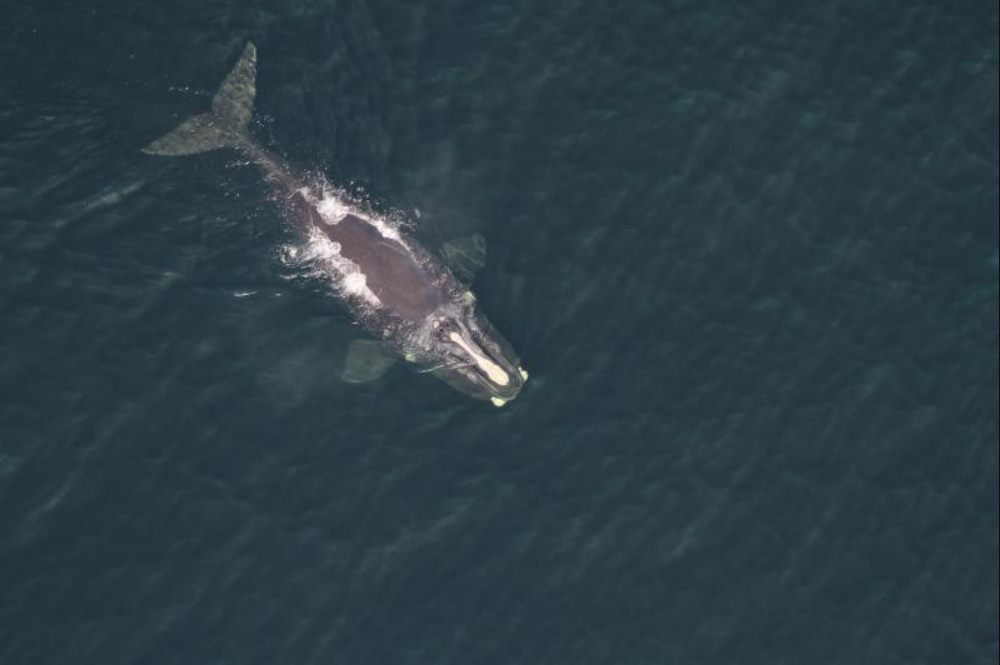
North Atlantic right whale
Eubalaena glacialis
What if it disappeared?
Impact ModerateWithout great whales to bring nutrients drawn from depth back up to the surface while feeding, phytoplankton production would lose an input — measured directly in the areas where whales are still present today — within the very first year.
DocumentedDetail
Roman, J. et McCarthy, J.J. (2010). The Whale Pump: Marine Mammals Enhance Primary Productivity in a Coastal Basin. PLoS ONE, 5(10), e13255.
Whales feed at depth, then surface to breathe and defecate near the surface, where their nitrogen- and iron-rich waste stimulates phytoplankton growth — the base of the entire marine food chain. The authors quantify this input for the Gulf of Maine and estimate that it once far exceeded river inputs, before commercial whaling reduced whale populations.
Over a decade, that same gap continues in a different form: the transport of carbon down to the ocean floor nearly stops, even though rebuilding great whale populations would export roughly 160,000 tonnes of carbon per year — compared with 9.1 million fewer tonnes already missing since commercial whaling began.
DocumentedDetail
Pershing, A.J., Christensen, L.B., Record, N.R., Sherwood, G.D. et Stetson, P.B. (2010). The Impact of Whaling on the Ocean Carbon Cycle: Why Bigger Was Better. PLoS ONE, 5(8), e12444.
A whale sinks to the ocean floor when it dies, durably exporting the carbon in its body. Great whales are more efficient at this than the smaller species that would occupy the same niche: removing a 92-tonne blue whale frees up enough food for seven minke whales, but their combined biomass amounts to only half that of the whale it replaced.
This isn't an abstract scenario: by the 1920s, no more than about a hundred North Atlantic right whales were left after decades of intense whaling, a low so severe that an international agreement banned hunting them starting in 1935. Through that century of crushed population, this carbon pump to the seafloor stayed minimal — a real but modest supplement next to total human emissions, never a climate lever on its own.
ExtrapolatedDetail
Extrapolation à partir du creux historique bien documenté de la population de baleines noires de l'Atlantique Nord dans les années 1920 (une centaine d'individus ou moins, avant la protection internationale de 1935), combiné à Pershing et al. (2010), qui chiffre le déficit de carbone séquestré depuis le début de la chasse commerciale sans le décomposer année par année pour cette espèce en particulier.
Even a full recovery of great whale populations would represent only a tiny fraction of human-caused carbon emissions — a real, measured ecological service, but one the authors themselves present as a supplement, never as a stand-alone climate solution. The right whale's near-disappearance in the 1920s, before its 1935 protection, illustrates how far this service likely slowed for most of the twentieth century.
What's missing to confirm it: More recent work notes that the recovery of great whales' carbon benefits is itself threatened by climate change, which is altering the availability of their food — the actual trajectory over this horizon remains uncertain, and no study quantifies this slowdown specifically for the right whale during the 1920s-1935 period.
Over a thousand years, it wouldn't just be a carbon flow that's missing but an entire seafloor habitat: every whale carcass that sinks feeds a community of specialized species for decades — including worms found nowhere else but on whale skeletons. Without a steady supply of new carcasses for a millennium, these seafloor communities would likely lose their footholds one by one — a quiet habitat that wouldn't come back the same even if whales returned.
HypothesisDocumentation
-
NOAA Fisheries — North Atlantic Right Whale, statut et effectif
Accessed August 7, 2026
-
Roman & McCarthy (2010) — The Whale Pump, PLOS ONE
Accessed August 7, 2026
-
Pershing et al. (2010) — The Impact of Whaling on the Ocean Carbon Cycle, PLOS ONE
Accessed August 7, 2026
Last verified: August 16, 2026