Species → American bison
American bison
Bison bison
What if it disappeared?
Impact ModerateWithout bison grazing and their patchy disturbance of the soil, a prairie would lose the mosaic of vegetation at different regrowth stages that currently increases its plant diversity compared with uniform grazing.
DocumentedDetail
Knapp, A.K., Blair, J.M., Briggs, J.M. et al. (1999). The Keystone Role of Bison in North American Tallgrass Prairie. BioScience, 49(1), 39–50.
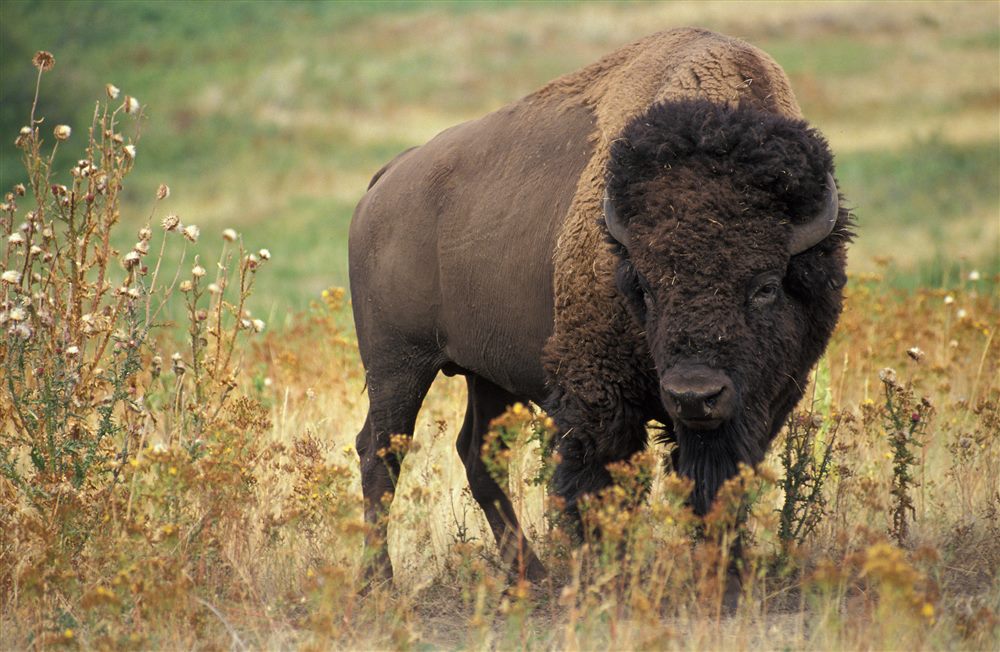
At Konza Prairie (Kansas), the authors show that bison graze some areas intensively while leaving others untouched, unlike the more uniform grazing pattern of cattle. This heterogeneity increases the diversity of habitats available for plants and the species that depend on them.
Recreating this heterogeneity across large restored prairies could restore some of the lost plant biodiversity — but no currently reconstituted population reaches the size and freedom of movement of the historical herd studied.
ExtrapolatedDetail
Extrapolation à partir de Knapp et al. (1999) : l'effet mesuré à Konza Prairie appliqué à l'échelle d'une restauration de grande prairie, pas un résultat publié pour cette échelle.
Nearly all bison today live in enclosures or managed herds at a much smaller scale than historical migrations. How much of that scale and freedom of movement is needed to reproduce the effect measured at Konza Prairie remains to be established elsewhere.
What's missing to confirm it: No study confirms at what herd size and area the heterogeneity effect measured at Konza Prairie holds up or fades.
Bison collapsed from tens of millions to just 1,091 individuals by 1889 — a near-total extinction across almost the entire Great Plains. More than a century later, only 20,000 to 30,000 bison still live in conservation herds with a real ecological function; the vast majority of the former range has therefore never regained the patchy grazing Knapp and colleagues measured at Konza Prairie, replaced instead by more uniform cattle grazing or by no large grazer at all.
ExtrapolatedDetail
Extrapolation à partir de Knapp et al. (1999) et des données de population déjà réunies dans cette fiche (creux de 1 091 individus en 1889 ; seulement 20 000 à 30 000 bisons actuels en troupeaux à fonction écologique) — aucune étude ne mesure directement l'état de la végétation sur l'ensemble des Grandes Plaines un siècle après l'effondrement de 1889.
Knapp et al. measure the bison's effect at the scale of a reserve where it has been maintained or reintroduced (Konza Prairie). The fact that almost the entire Great Plains has never regained ecologically functional bison since the 1889 collapse — replaced by cattle ranching or no large grazer at all — suggests that the uniform state Knapp et al. contrast with bison grazing is today the norm across most of the former range, rather than the exception. That's an inference from two already-sourced facts, not a direct measurement of vegetation at century scale.
What's missing to confirm it: No study measures vegetation across the entire Great Plains a century after the 1889 collapse — only the effect of the bison present at Konza Prairie and the overall population figures are documented.
Over a thousand years without free-ranging bison at scale, the prairie would likely have settled into a more uniform, deeply entrenched plant state, for lack of a grazer able to recreate the same mosaic at the same scale — even if today's conservation herds were to grow by then, the sheer scale of historic bison movement, spanning hundreds of kilometers, has no modern equivalent and would be hard to recreate.
HypothesisDocumentation
-
IUCN SSC Bison Specialist Group — Bison bison, statut et effectifs
Accessed August 7, 2026
-
Knapp et al. (1999) — The Keystone Role of Bison in North American Tallgrass Prairie, BioScience
Accessed August 7, 2026
Last verified: August 16, 2026