Species → American alligator
American alligator
Alligator mississippiensis
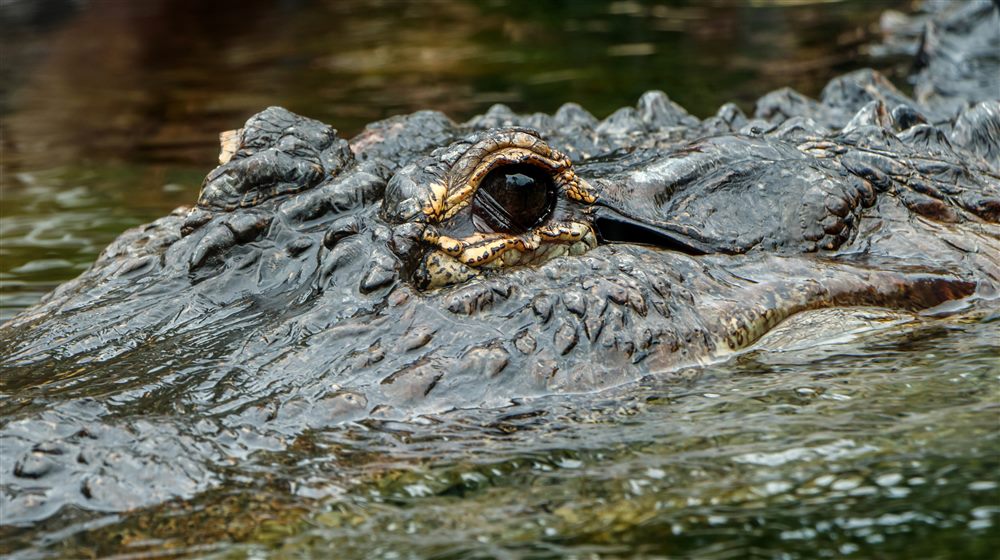
What if it disappeared?
Impact HighBy the first dry season after its disappearance — less than a year —, the Everglades would lose the landscape's last aquatic refuges: without alligators digging and maintaining ponds ("alligator holes") that stay flooded when the rest of the marsh dries out, fish, turtles, frogs, crayfish and aquatic insects would have nowhere left to concentrate to survive, nor a surviving population to repopulate the marsh the following wet season.
DocumentedDetail
Craighead, F.C. (1968), observation fondatrice des trous d'alligator comme refuges de saison sèche ; Palmer, M.L. & Mazzotti, F.J. (2004). Structure of Everglades alligator holes. Wetlands, 24(1), 115–122.
Alligator holes concentrate water, aquatic wildlife and nutrients in a marsh that, come the dry season, becomes largely walkable. Without this active maintenance — alligators regularly re-dig and clear their ponds — the holes would silt up and fill in quickly, a phenomenon already documented in abandoned holes.
Over the following decade, the few ponds still holding water would also lose their nutrient-enrichment function: it is the alligator's constant movement — snout, claws and tail redistributing sediment and organic matter — that keeps nutrient concentrations higher than in the surrounding marsh. Without it, bacterial and fungal mats would cover their bottoms, and the earthen mounds that give rise to the landscape's characteristic wooded islands would stop forming.
DocumentedDetail
Strickland, B.A. et al. (2023). An apex predator engineers wetland food-web heterogeneity through nutrient enrichment and habitat modification. Journal of Animal Ecology.
Ten active alligator ponds were monitored in two Everglades regions (Shark River Slough and Taylor Slough). The earthen mounds pushed up around the hole form a gradient of habitats — from open water to dry land — colonized by willows, wax myrtles and cypress, creating wooded islands that later serve as nesting sites for turtles and birds. A good portion of these islands are thought to originate from this alligator activity.
The alligator truly came close to commercial extinction across much of the southeastern United States, hunted for its hide from the late 19th century until populations hit their lowest point around the mid-20th century — nearly a century of pressure before federal protection arrived in 1967. Over such a long period, alligator ponds and the wooded islands they give rise to would likely have grown scarce across the whole landscape, not just around a few isolated holes.
ExtrapolatedDetail
Extrapolation à partir de l'histoire documentée de la chasse commerciale de l'alligator dans le sud-est des États-Unis, de la fin du XIXe siècle à la protection fédérale de 1967 (U.S. Fish & Wildlife Service), combinée aux études sur la fonction des trous d'alligator (Palmer & Mazzotti, 2004 ; Strickland et al., 2023), qui ne portent que sur des populations actuelles rétablies, pas sur l'état du paysage durant les décennies de déclin.
Commercial hunting for hides drove alligator populations down across much of their range starting in the late 19th century, with historical lows in several states by the mid-20th century, before the protections of the 1960s-1970s reversed the trend. No study from that period measured the state of ponds and wooded islands during this decline — only the function of ponds in today's recovered population has been documented.
What's missing to confirm it: No period measurement of the state of Everglades ponds and wooded islands during the alligator's decades of decline (late 19th to mid-20th century) has been found — only the function of ponds in today's population, recovered since 1967, is directly measured.
Over a thousand years without alligators, the marsh would likely permanently lose its mosaic of deep ponds and wooded islands, replaced by a more uniform expanse of shallow swamp. Species that nest or shelter specifically on these islands — herons and other colonial waterbirds in particular — would have nowhere left to settle away from ground predators, even as the rest of the marsh continued to exist more or less normally.
HypothesisDocumentation
-
Palmer & Mazzotti (2004) — Structure of Everglades alligator holes, Wetlands
Accessed August 7, 2026
-
Strickland et al. (2023) — An apex predator engineers wetland food-web heterogeneity, Journal of Animal Ecology
Accessed August 7, 2026
-
FIU News — Alligators are the engineers of the wetlands (2023)
Accessed August 7, 2026
-
U.S. Fish & Wildlife Service — American Alligator, statut et population
Accessed August 7, 2026
Last verified: August 16, 2026