Species → Saiga Antelope
Saiga Antelope
Saiga tatarica
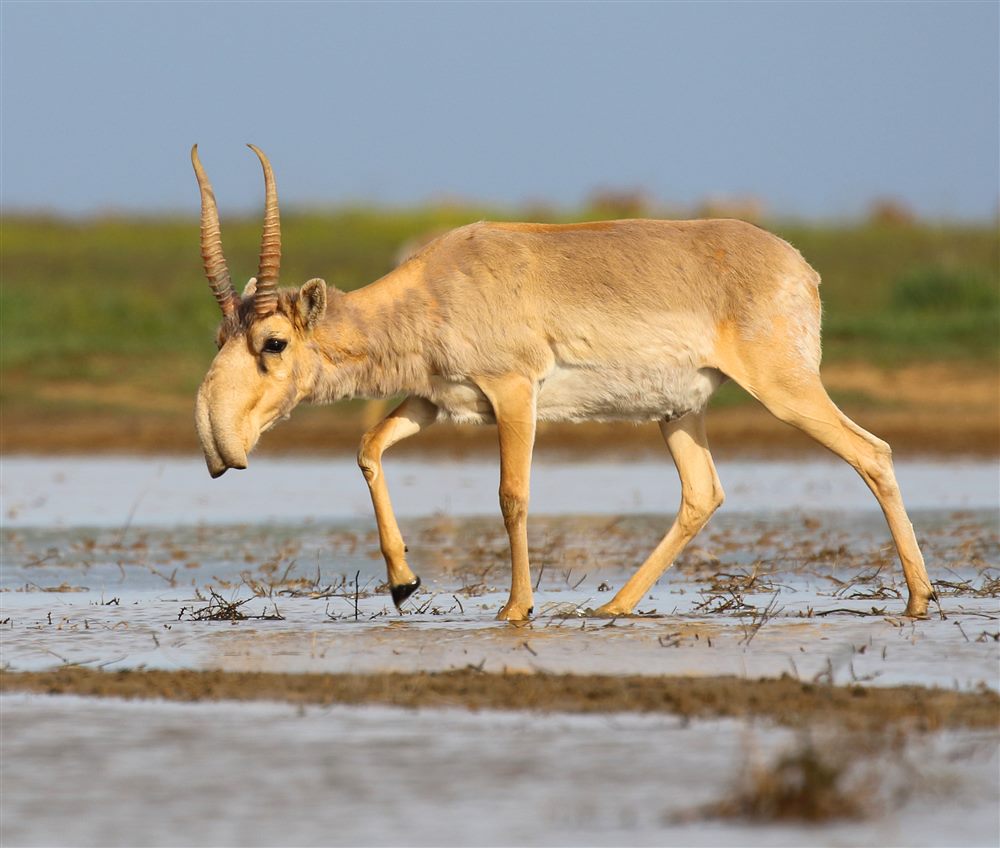
What if it disappeared?
Impact ModerateThe saiga's dramatic recovery is now causing growing damage to crops and grazing land in western Kazakhstan, to the point that the country is debating regulating the species — its disappearance would therefore almost immediately relieve that grazing and trampling pressure on farmland bordering the steppe, even though the exact scale of that damage has yet to be quantified.
ExtrapolatedDetail
Extrapolation, en sens inverse, à partir de The Astana Times (avril 2025), qui documente les dégâts agricoles liés à l'abondance actuelle du saïga sans mesurer ce qui se passerait en cas de disparition de l'espèce.
The population reached 4.1 million individuals in 2025, split between the Ural (2.3 million), Betpak-Dala (1.6 million), and Ustyurt (92,200) populations — more than 98% of the world population is now found in Kazakhstan. The debate pits experts favoring sustainable harvest against local officials who prefer non-lethal regulation methods. If that abundance is creating measurable damage to crops and grazing land today, its disappearance would logically remove the cause — a mirror-image argument from what the article documents, not a direct measurement of disappearance itself.
What's missing to confirm it: A quantified assessment of the actual scale of agricultural damage attributed to the saiga, which would allow precise measurement of what its disappearance would relieve.
Over roughly a decade without that large-scale grazing pressure, steppe grasses would grow denser and build up year after year, with no herds left to keep them short — a shift that would likely favor other, more sedentary grazers, none able on their own to range across such distances.
HypothesisOver a century, the buildup of ungrazed plant matter could permanently alter the steppe's own composition — more tall grasses, and fewer of the low-growing plants they would gradually crowd out, leaving a steppe landscape different from the one the saiga's heavy grazing had long shaped.
HypothesisOver a thousand years, the Central Asian steppe would have gone through its share of droughts and fires without saiga grazing to limit the buildup of dry vegetation between events — a more intense fire regime, in a landscape no longer roamed at the same scale by any large mobile grazer.
HypothesisDocumentation
-
IUCN Red List — Saiga tatarica, réévaluation 2023
Accessed August 14, 2026
-
Kock et al. (2018) — Saigas on the brink: Multidisciplinary analysis of the factors influencing mass mortality events, Science Advances
Accessed August 14, 2026
-
Fereidouni et al. (2019) — Mass die-off of saiga antelopes, Kazakhstan, 2015, Emerging Infectious Diseases
Accessed August 14, 2026
-
The Astana Times (avril 2025) — Kazakhstan's Saiga Population Reaches 4.1 Million as Debate Grows Over Regulation Measures
Accessed August 14, 2026
Last verified: August 16, 2026