Species → Rodrigues flying fox
Rodrigues flying fox
Pteropus rodricensis
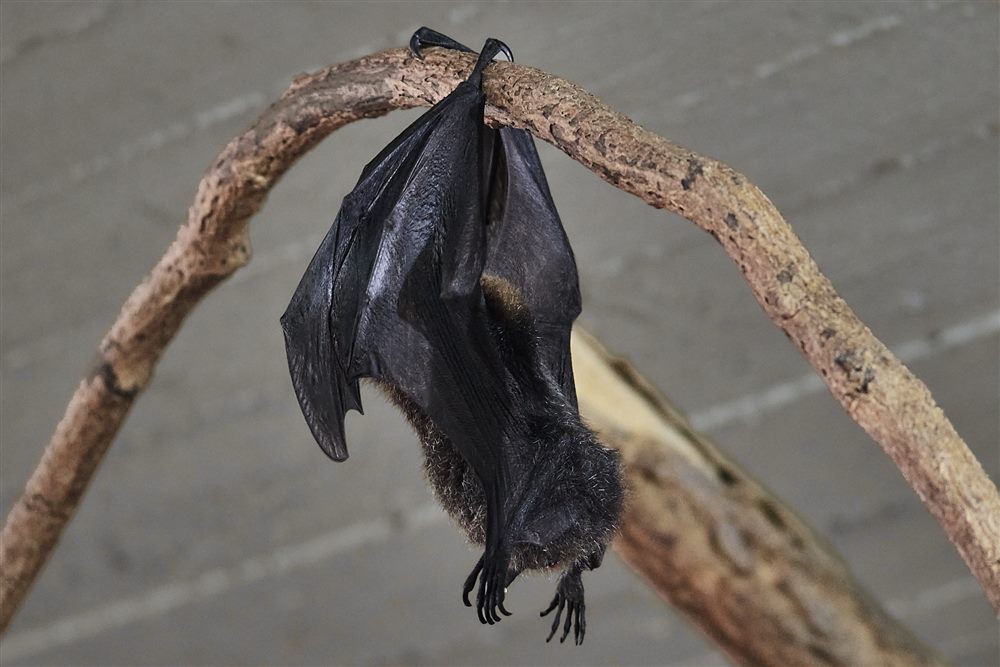
What if it disappeared?
Impact ModerateWithout the flying fox to press fruit against its palate and spit out seeds and fibre in pellets, the seeds of the plants it used to feed on would largely stay beneath the parent tree rather than being dispersed elsewhere — since the animal would then move on to feed or roost somewhere else.
DocumentedDetail
Comptes rendus naturalistes compilés par l'UICN et les programmes de conservation (Durrell Wildlife Conservation Trust, Mauritian Wildlife Foundation).
This feeding behaviour — pressing fruit and spitting out seeds and fibre — is documented across the genus Pteropus as a whole and confirmed for this species in particular by monitoring programmes carried out on Rodrigues. It mechanically makes the bat a long-distance dispersal agent, unlike seeds that simply fall beneath the parent tree.
After roughly a decade without the flying fox, large canopy trees would likely be hit hardest: in its close Mascarene relative, the Mauritian flying fox, seed dispersal by the species disproportionately benefits these trees — a plausible mechanism here too, though no dedicated quantitative study has been carried out on Rodrigues itself.
ExtrapolatedDetail
Nyhagen, D.F., Turnbull, S.D., Olesen, J.M. & Jones, C.G. (2005). An investigation into the role of the Mauritian flying fox, Pteropus niger, in forest regeneration. Biological Conservation, 122(3), 491–497 — étude sur l'espèce sœur Pteropus niger, pas directement sur P. rodricensis.
The Rodrigues flying fox fell to around 70 individuals after a cyclone in the 1970s, then recovered to around 20,000 by 2016 thanks to habitat restoration — but nothing in that recovery isolates the bat's specific effect on large trees. The study on its Mauritian sister species provides the most precise mechanism available: a disproportionate benefit for canopy trees, extrapolated here by analogy.
What's missing to confirm it: A dedicated field study of Pteropus rodricensis on Rodrigues island itself, directly measuring its effect on forest regeneration rather than inferring it from its close Mauritian relative, is still lacking.
Over a century without the flying fox, Rodrigues's forest would gradually lose the large trees that depend on it most as a disperser: without it, their seeds would stay clustered near the parent tree, more vulnerable to disease and competition, and would struggle more to recolonize ground after a disturbance such as a cyclone.
HypothesisOver a thousand years, this loss of dispersal could reshape the very composition of the island's forest: tree species most dependent on the flying fox would lose ground to those dispersed some other way, by wind or by other animals, and the original forest would never quite reassemble the way it was.
HypothesisDocumentation
-
IUCN Red List — Pteropus rodricensis, statut et population
Accessed August 7, 2026
-
Bat Conservation International — Where the Not-So-Wild Things Are (histoire de la population)
Accessed August 7, 2026
-
Nyhagen et al. (2005) — rôle de la roussette de Maurice (Pteropus niger) dans la régénération forestière, Biological Conservation
Accessed August 7, 2026
Last verified: August 16, 2026