Species → Giant Tube Worm
Giant Tube Worm
Riftia pachyptila
What if it disappeared?
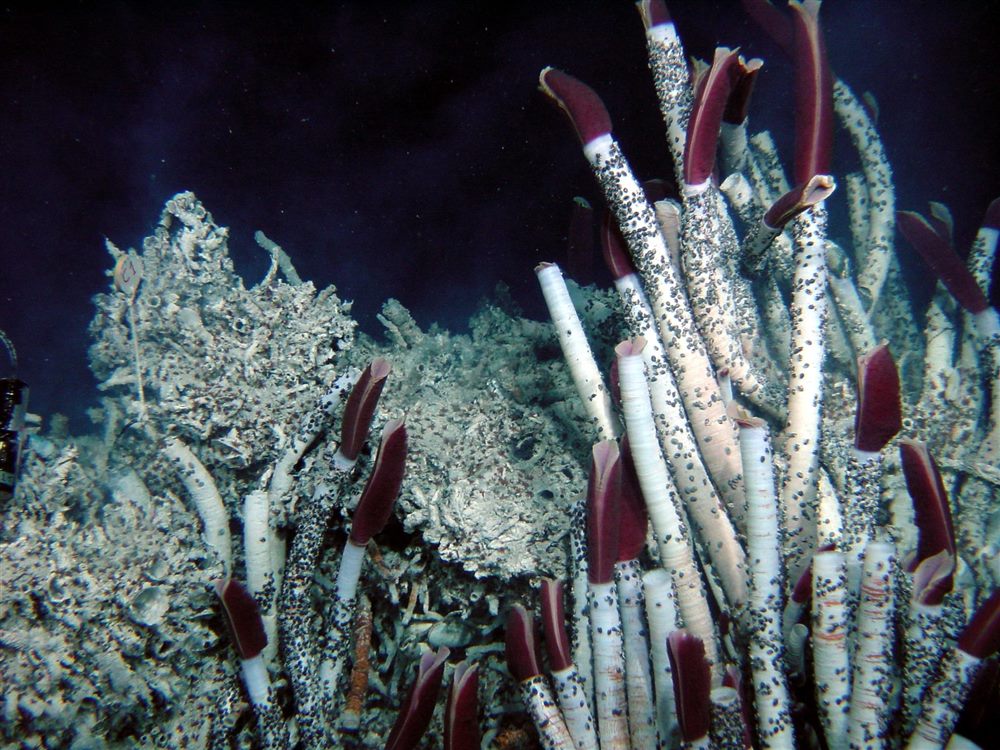
Impact ModerateThe giant tube worm forms dense clusters of tubes that cover the rock around a hydrothermal vent; without it, the shrimp, crabs, and other vent-specific invertebrates that shelter and feed within that mass of tubes would suddenly lose their main shelter at the site.
HypothesisAfter the 1991 eruption on the East Pacific Rise, tube worms colonized the new site, reaching 1.5 m and sexual maturity in under two years — the fastest growth ever measured in a marine invertebrate, likely necessary since a hydrothermal site can die out within just a few years. Without a tube worm able to move that fast, the vent's other species would have far less time to establish themselves before the site goes silent.
ExtrapolatedDetail
Extrapolation à partir de Lutz et al. (1994), qui mesure la vitesse de colonisation du ver tubicole sans documenter directement l'effet de son absence sur l'installation des autres espèces de l'évent.
The tube worm's extremely fast colonization rate reflects the inherent instability of the hydrothermal vent ecosystem: a site can appear or die out within a few years depending on local volcanic activity. That speed suggests the tube worm acts as an early builder that no other species measured to date matches — without it, the usable window for the rest of the community to establish on a new site could close before anything else has had time to settle in.
What's missing to confirm it: No study directly measures the colonization speed of the vent's other species in the tube worm's absence, or whether they could establish themselves there without it before the site's life ends.
Over a century, the question would no longer be about one particular site — most active vents are born and die out within a few decades anyway. It would instead become: without a tube worm to colonize each new vent quickly, would the community that settles there stay as rich? Lacking such a fast builder, it's plausible that fewer species would manage to establish themselves before the next site goes extinct in turn.
HypothesisOver a thousand years — dozens of cycles of vents being born and dying out — the tube worm's repeated absence as the first builder could leave hydrothermal vent communities permanently poorer, with no other known species recreating as quickly the same mass of tubes that shelters shrimp, crabs, and other vent-specific invertebrates.
HypothesisDocumentation
-
Cavanaugh, Gardiner, Jones, Jannasch & Waterbury (1981) — Prokaryotic Cells in the Hydrothermal Vent Tube Worm Riftia pachyptila Jones, Science
Accessed August 14, 2026
-
Lutz et al. (1994) — Rapid growth at deep-sea vents, Nature
Accessed August 14, 2026
-
Guinness World Records — Fastest growth rate for a marine invertebrate
Accessed August 14, 2026
Last verified: August 16, 2026