Species → Scalloped Hammerhead Shark
Scalloped Hammerhead Shark
Sphyrna lewini
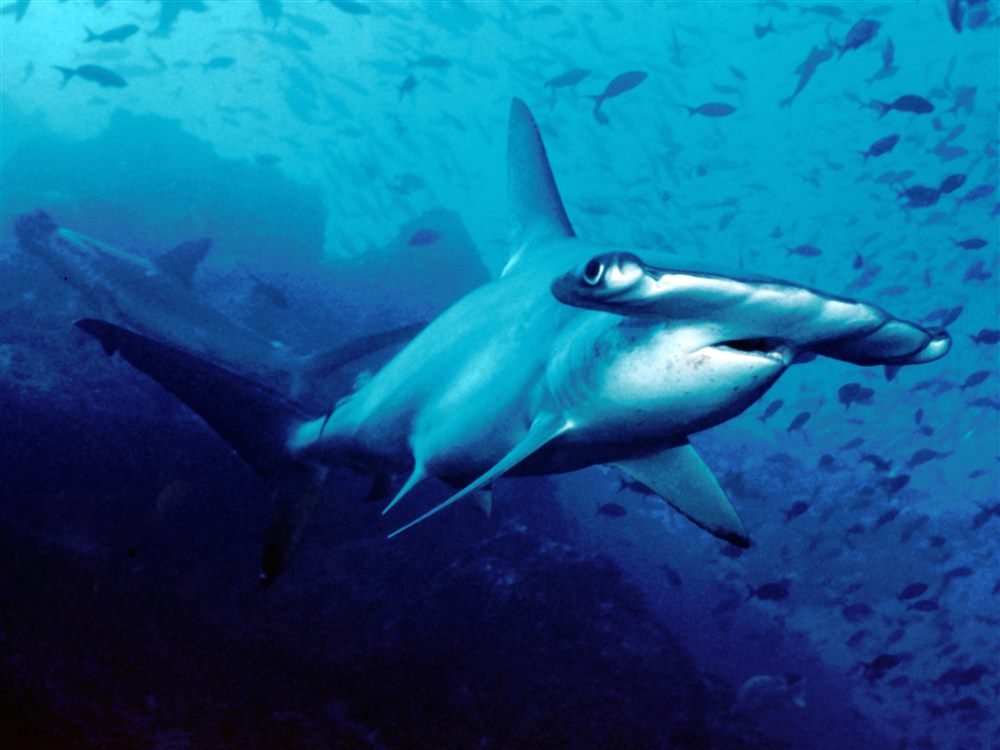
What if it disappeared?
Impact MajorAs soon as pressure from large sharks eases, cownose rays — one of their usual prey — lose that control and can start proliferating unchecked, with no other predator stepping in to fill the gap.
ExtrapolatedDetail
Extrapolation à partir de Myers, R.A., Baum, J.K., Shepherd, T.D., Powers, S.P. et Peterson, C.H. (2007). Cascading Effects of the Loss of Apex Predatory Sharks from a Coastal Ocean. Science, 315(5820), 1846–1850 — l'étude mesure le résultat cumulé sur plusieurs décennies, pas l'état après une seule année de déclin.
The easing of predation pressure on a mesopredator as soon as its predator disappears — a mechanism ecology calls mesopredator release — is the very principle behind the multi-decade cascade documented by Myers et al. (2007). What the study can't say is how quickly that release starts translating into measurable ray population growth.
What's missing to confirm it: No yearly data on the cownose ray population in the first year following the shark decline was found in the sources gathered here.
Within a few decades, the gradual disappearance of large predatory sharks along the U.S. East Coast coincided with an explosion of the cownose ray population, which then wiped out the scallop population it feeds on — closing a century-old fishery in North Carolina.
DocumentedDetail
Myers, R.A., Baum, J.K., Shepherd, T.D., Powers, S.P. et Peterson, C.H. (2007). Cascading Effects of the Loss of Apex Predatory Sharks from a Coastal Ocean. Science, 315(5820), 1846–1850.
Analyzing decades of fishing data along the U.S. East Coast, the authors show that the collapse of eleven large shark species (including the scalloped hammerhead) let mesopredators like the cownose ray proliferate unchecked. This ray began consuming enough scallops to shut down a fishery more than a century old in North Carolina.
The shark decline measured here dates back to the 1970s, and nothing suggests a reversal since the fishery closed in 2004: if the trend holds without large sharks recovering, a century without them would likely see this state — abundant rays, scarce scallops — settle in for good rather than resolve on its own.
ExtrapolatedDetail
Extrapolation à partir de Myers et al. (2007), qui documentent l'état de la cascade sur environ trois décennies (années 1970 à 2004), sans donnée directe sur son évolution au-delà de la période étudiée.
Myers et al. (2007) document a sustained trend over roughly thirty years, with no sign of shark population or scallop fishery recovery at the time of publication. Nothing in the sources gathered here confirms whether this state persisted, worsened, or reversed in the twenty years since the study — let alone over a full century.
What's missing to confirm it: No shark, ray, or scallop population monitoring after the 2007 study was found in the sources gathered here to confirm whether the documented state persists.
Over a thousand years, the ecosystem is unlikely to return to exactly its original composition even if large sharks eventually came back: a marine community durably dominated by rays and other mesopredators would have had time to reshape the coastal seabed in ways a simple return of predators likely wouldn't undo on its own.
HypothesisDocumentation
-
IUCN Red List — Sphyrna lewini, statut de conservation
Accessed August 7, 2026
-
Myers et al. (2007) — Cascading Effects of the Loss of Apex Predatory Sharks from a Coastal Ocean, Science
Accessed August 7, 2026
Last verified: August 16, 2026