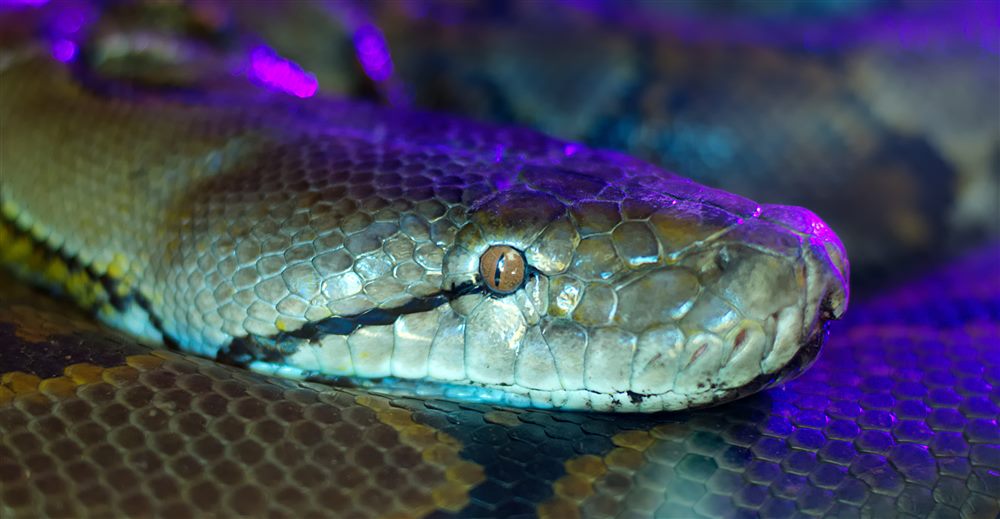
Species → Burmese Python
Burmese Python
Python bivittatus
What if it disappeared?
Impact HighWithout the Burmese python, the nighttime predation that drove raccoon sightings down 99.3%, opossum sightings down 98.9%, and bobcat sightings down 87.5%, and eliminated rabbits from road surveys altogether, stops in its tracks within the first year.
DocumentedDetail
Dorcas, M.E., Willson, J.D., Reed, R.N., Snow, R.W., Rochford, M.R., Miller, M.A., Meshaka, W.E. Jr., Andreadis, P.T., Mazzotti, F.J., Romagosa, C.M. & Hart, K.M. (2012). Severe mammal declines coincide with proliferation of invasive Burmese pythons in Everglades National Park. Proceedings of the National Academy of Sciences, 109(7), 2418-2422.
The study compares mammal sighting rates along park roads before and after python establishment, and across long-invaded, recently invaded, and still python-free zones. The geographic and temporal gradient is clear: the longer pythons have been present, the more severe the mammal decline — which rules out a climatic or seasonal cause common to the whole park, and confirms it is python predation itself, reversible the moment it disappears, that drives the decline.
This reduced predation first benefits sea turtles: raccoons and opossums, two nest predators reduced to almost nothing by the python, would likely regain sufficient numbers within a decade to start raiding nests again on beaches they had abandoned — reversing the temporary reprieve those nests enjoyed during the invasion.
ExtrapolatedDetail
Extrapolation à partir de Willson, J.D. (2017), qui mesure la réduction de la prédation des nids de tortues marines pendant que le python maintient les ratons laveurs et opossums à un niveau très bas — sans mesurer ce qui se passerait si ces prédateurs de nids retrouvaient leurs effectifs.
Willson (2017) shows a nest predation score of 1.5 (out of 5) where the python is long established, versus 4.6 where it is absent — an effect that operates entirely through the suppression of nest-predating mammals. If the python disappeared, nothing in the study rules out this mechanism reversing once mammals returned in sufficient numbers, but no site has yet made it possible to confirm this.
What's missing to confirm it: No site has undergone python removal that was both sufficient and monitored long enough to verify whether raccoons and opossums truly return within a decade, and whether turtle nest predation resumes at the same rate as before the invasion.
A century of Burmese python removal would likely not settle the question that matters most: the removal campaigns Florida has run for years remain tiny against an invasive population estimated in the tens of thousands, and no site has ever achieved a reduction large enough to test whether mammals return once the predator is gone — another century probably wouldn't change that as long as full removal stays out of reach.
HypothesisOver a thousand years, even a full and lasting python removal probably wouldn't recreate the Everglades as they were before its arrival: other introduced species, habitat loss, and changes to the wetlands themselves would have had ample time to reshape the ecosystem around a gap that the original raccoons and opossums would no longer fill in quite the same way.
HypothesisDocumentation
-
Dorcas et al. (2012) — Severe mammal declines coincide with proliferation of invasive Burmese pythons in Everglades National Park, PNAS
Accessed August 10, 2026
-
Willson (2017) — Indirect effects of invasive Burmese pythons on ecosystems in southern Florida, Journal of Applied Ecology
Accessed August 10, 2026
-
IUCN Red List — Python bivittatus, statut et tendance
Accessed August 10, 2026
Last verified: August 16, 2026