Species → Brown-throated Sloth
Brown-throated Sloth
Bradypus variegatus
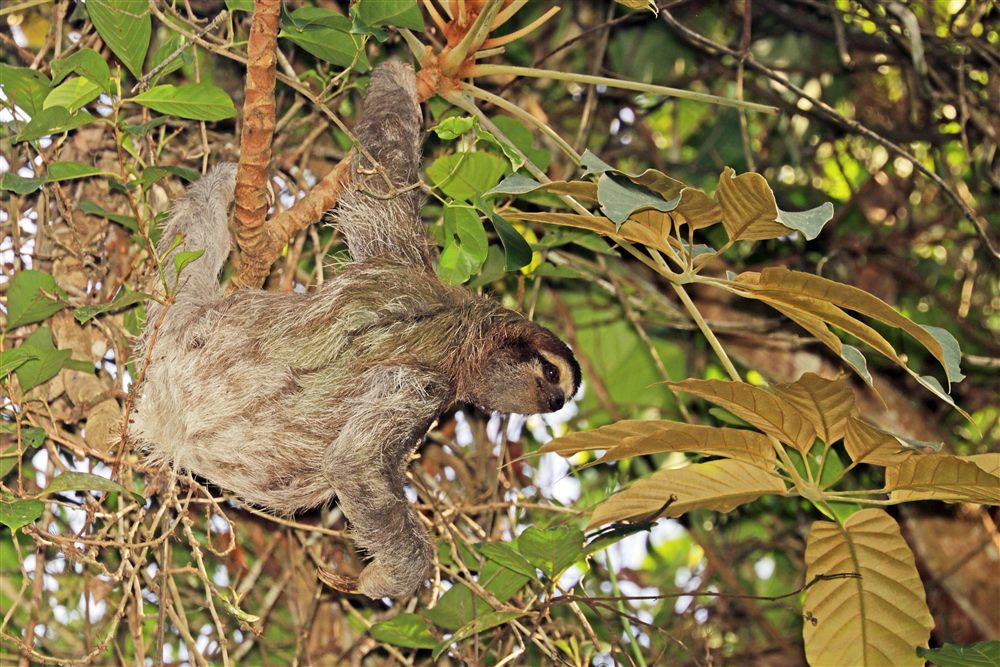
What if it disappeared?
Impact LowMoths live almost exclusively in the sloth's fur and rely on its weekly descent to the ground to lay their eggs there. Without it, these moths would instantly lose their only known egg-laying site — a habitat that doesn't exist anywhere else in the same way.
ExtrapolatedDetail
Extrapolation à partir de Pauli et al. (2014), qui documente la dépendance des papillons de fourrure du paresseux au comportement de descente au sol pour la ponte — l'étude ne mesure pas directement ce qui arrive aux papillons si le paresseux disparaît, seulement la corrélation chez des animaux vivants.
Pauli et al. (2014) establish a statistical correlation between the number of moths present in the fur and how often the sloth descends to the ground, in animals captured and released in Central America. Ground descent is presented as the key behavior that lets the moths lay their eggs. No study has followed a population of these moths after the disappearance of a host sloth.
What's missing to confirm it: Monitoring of fur-moth populations in an area where the sloth has disappeared, to confirm they actually lose their egg-laying site.
Over ten years, these sloth-fur-specific moths would likely decline to local disappearance, for lack of another known host able to replace this very particular niche — a case of cascading extinction limited to a handful of insect species, not the whole forest.
HypothesisA century later, this loss would likely remain confined to that handful of ultra-specialized insects. A critical re-evaluation of the original scenario showed that the sloth doesn't groom itself, that 83% of its digesta samples contain no trace of algae at all, and that ground predation risk is far lower than predicted — links to the rest of the forest too thin for a century of absence to measurably change the vegetation itself.
ExtrapolatedDetail
Extrapolation à partir de Monge-Nájera (2021), qui montre que le paresseux à gorge brune ne se toilette pas et que 83 % des échantillons de bol alimentaire analysés ne contiennent aucune algue — aucune étude ne mesure directement l'état de la forêt un siècle après la disparition de l'espèce.
Monge-Nájera (2021) raises several inconvenient facts against Pauli et al.'s (2014) three-species mutualism scenario: no grooming in the brown-throated sloth, no algae in 83% of analyzed digesta samples, and ground predation risk 5.5 times lower than the original model predicted. If the nutritive links between sloth, algae, and the rest of the forest are as thin as this re-evaluation suggests, the species wouldn't carry the ecological weight needed to change the vegetation at a century scale — only the fur-moth niche would remain affected.
What's missing to confirm it: A direct comparison of forest structure between an area that lost its sloths long ago and a comparable area that still hosts them.
Over a thousand years, this gap would likely remain permanent for the fur moths themselves: without another mammal as slow-moving and as thickly furred to recreate this very particular niche, this insect lineage would likely never return — even as the rest of the forest carried on largely unchanged.
HypothesisDocumentation
-
Pauli et al. (2014) — A syndrome of mutualism reinforces the lifestyle of a sloth, Proceedings of the Royal Society B
Accessed August 10, 2026
-
Garcés-Restrepo et al. (2019) — The demography of a resource specialist in the tropics: Cecropia trees and the fitness of three-toed sloths, Proceedings of the Royal Society B
Accessed August 10, 2026
-
Monge-Nájera (2021) — Why sloths defecate on the ground: rejection of the mutualistic model, Cuadernos de Investigación UNED
Accessed August 10, 2026
Last verified: August 16, 2026