Species → Arabian Oryx
Arabian Oryx
Oryx leucoryx
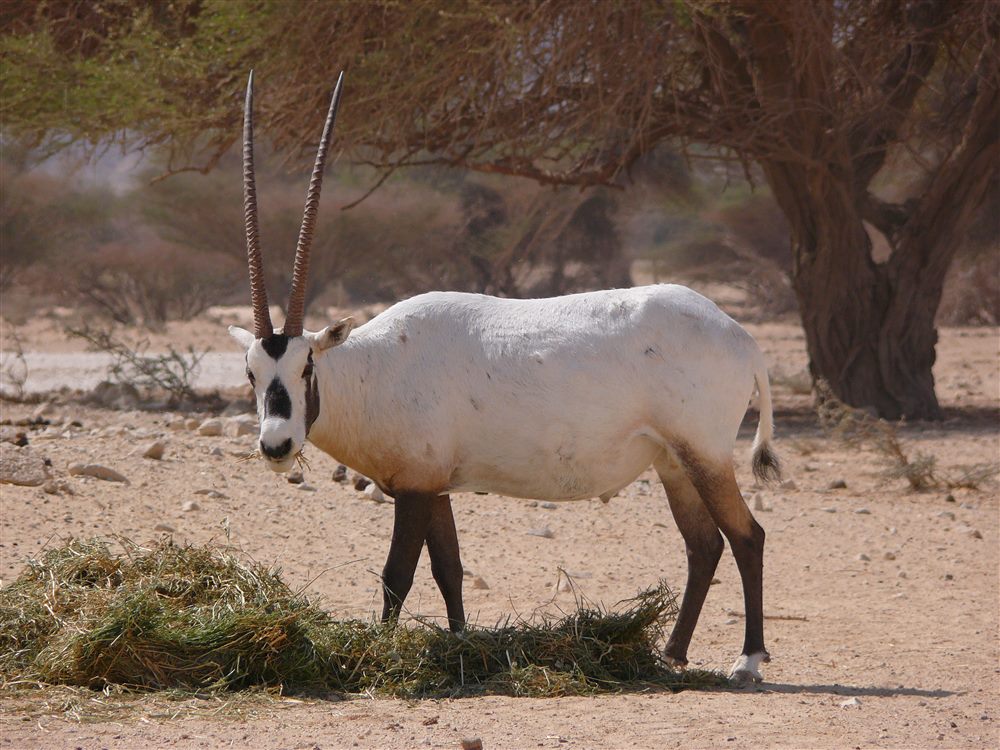
What if it disappeared?
Impact LowAs a large herbivore able to travel long distances between the desert's scarce water points, the Arabian oryx's disappearance would immediately remove a grazing pressure on the scattered shrubs and grass tufts it fed on along its route, which would grow a little more freely without it.
HypothesisOver a decade, the seeds the oryx carried in its coat and gut while moving between the desert's isolated patches of vegetation would stop traveling those distances; the patches would become more independent from one another, less connected by its movements.
HypothesisOver a century, without the regular passage of this large migratory herbivore, desert vegetation would likely become more fragmented and more locally uniform, each patch evolving more on its own instead of exchanging seeds with others through the oryx.
HypothesisOver a thousand years, even if other species partly filled this role, they would likely be smaller and more sedentary: the very-long-distance seed-dispersal networks built around the oryx's movements between distant water points would likely never quite be rebuilt the same way.
HypothesisDocumentation
-
IUCN Red List — Oryx leucoryx, évaluation 2017 (IUCN SSC Antelope Specialist Group)
Accessed August 14, 2026
-
Al Rawahi et al. (2022) — Rescued back from extinction in the wild: past, present and future of the genetics of the Arabian oryx in Oman, Royal Society Open Science
Accessed August 14, 2026
Last verified: August 16, 2026