Species → Bornean Orangutan
Bornean Orangutan
Pongo pygmaeus
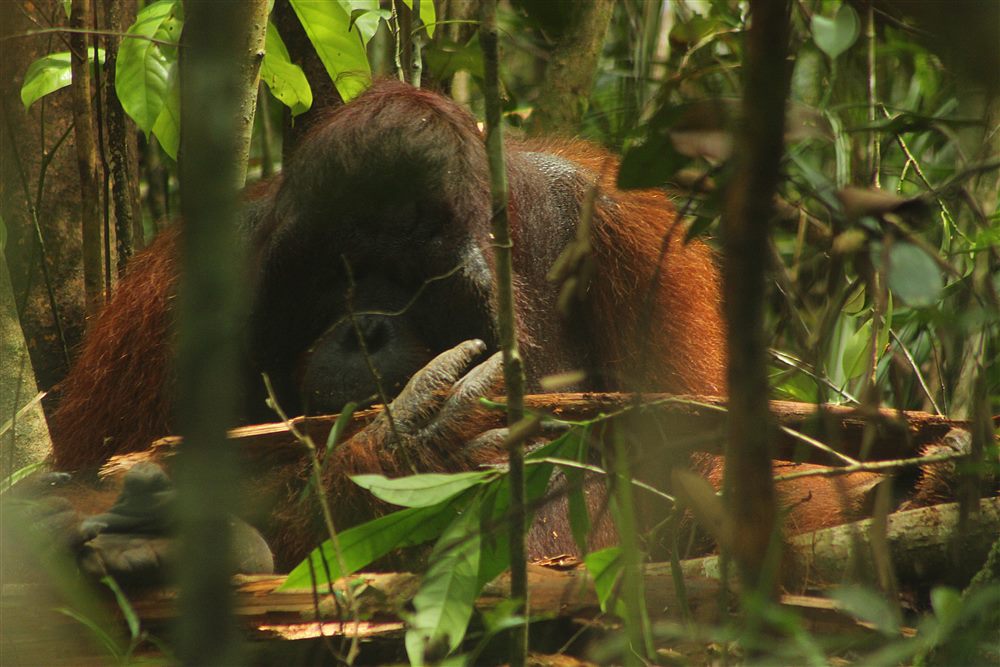
What if it disappeared?
Impact HighWithout the orangutan, the large seeds that it alone, on this island, swallows whole stop being carried away: three-quarters of its analyzed feces contained intact seeds from 24 different plant genera, moved an average of 500 to 600 meters from the parent tree.
DocumentedDetail
Blackburn, A., Susanto, T.W. & Knott, C.D. (2020). Orangutan seed dispersal in Gunung Palung National Park, Borneo, Indonesia: dispersal quantity, germination rates, gut transit times, and dispersal distances. 7th Frugivores and Seed Dispersal Symposium.
Study based on 549 fecal samples from 36 individuals at Gunung Palung National Park (Borneo). The orangutan is one of the only animals in Borneo large enough to swallow large-seeded fruit whole, on an island with neither elephants nor rhinoceroses to fill that role — which makes this transport hard to replace with another species the moment it stops.
From one fruiting season to the next, these seeds would now fall under their own parent tree instead of at a distance — and for five of the six genera tested, they would also germinate less well: seeds that passed through the orangutan's gut germinated significantly better than control seeds, an advantage that disappears along with it.
ExtrapolatedDetail
Extrapolation à partir de Blackburn, Susanto & Knott (2020), qui mesure la distance de dispersion et l'avantage de germination lié au passage digestif sur les orangs-outans actuellement présents, sans suivre ce qui arrive au recrutement des jeunes arbres une fois l'espèce disparue.
The study establishes two directly measured facts — seed transport distance and the germination boost from gut passage — but not their combined effect across multiple fruiting seasons. In tropical forest, seeds falling near the parent tree typically face higher mortality from predation and competition; combined with already weaker germination without gut passage, recruitment of the affected tree species would likely decline year after year.
What's missing to confirm it: No monitoring of actual tree seedling recruitment has been carried out across multiple seasons to confirm that the loss of dispersal and germination really does translate into fewer established saplings, rather than being offset by other dispersers.
In areas where the orangutan has been gone since the 1950s — nearly a century in some places already — regeneration of large-seeded tree species would likely be measurably slower than in forests where it still persists; but in a landscape so extensively converted to plantations, this effect would remain hard to separate from the far larger one of the forest itself disappearing.
HypothesisOver a thousand years, with no other animal on the island large enough to swallow these fruits whole, the tree species that depended on the orangutan would likely be permanently disadvantaged against those dispersed by other means — a lasting imbalance in forest composition that would probably never quite correct itself, even if the forest itself eventually regrew elsewhere.
HypothesisDocumentation
-
Blackburn, Susanto & Knott (2020) — Orangutan seed dispersal in Gunung Palung National Park, Borneo, 7th Frugivores and Seed Dispersal Symposium
Accessed August 10, 2026
-
Ardiantiono et al. (2024) — Selecting umbrella species as mammal biodiversity indicators in tropical forest, Biological Conservation
Accessed August 10, 2026
-
IUCN Red List — Pongo pygmaeus, statut et estimation de population
Accessed August 10, 2026
Last verified: August 16, 2026