Species → Freshwater Pearl Mussel
Freshwater Pearl Mussel
Margaritifera margaritifera
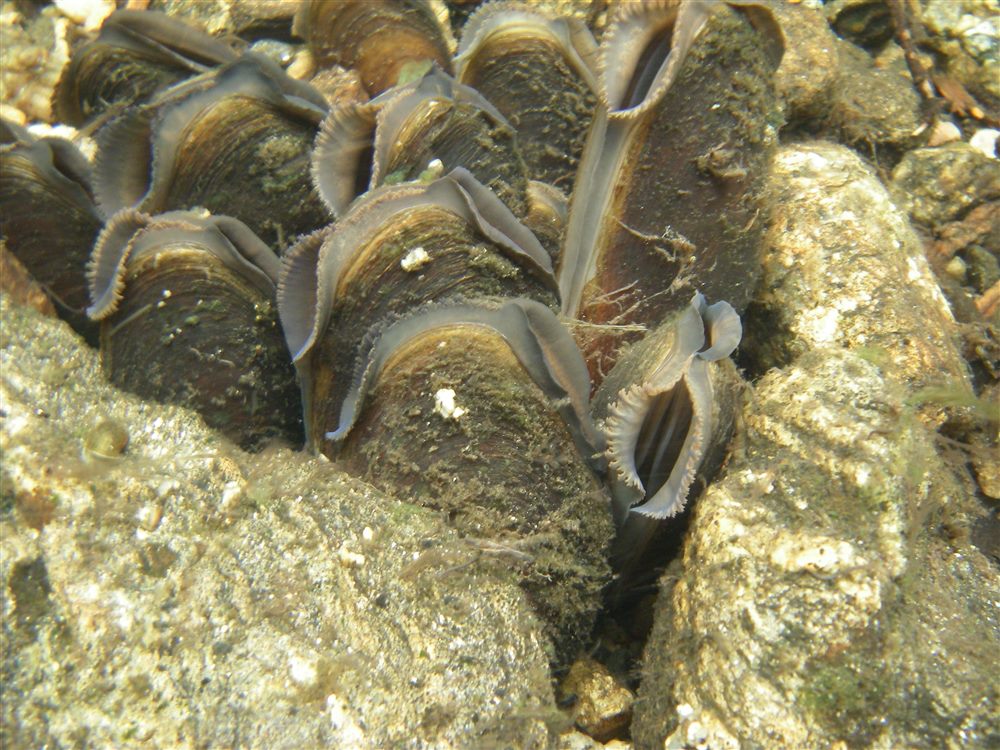
What if it disappeared?
Impact HighOne year after a pearl mussel bed disappears, young brown trout in the area would likely change how they behave around the current: a 2026 study shows the physical presence of a mussel bed shapes how they use it, an effect that would fade once the bed is gone.
ExtrapolatedDetail
Extrapolation à partir de l'étude 2026 sur l'ingénierie d'écosystème par la moule perlière (Freshwater Biology), qui compare des tronçons de rivière avec et sans lit de moules selon le débit, pas le même tronçon avant et après la disparition du lit.
The study establishes that the physical presence of a pearl mussel bed changes brown trout behavior depending on flow, suggesting the bed's structure creates shelter or resting zones the trout actively use. Nothing directly measures how long it would take, after a bed's actual disappearance, for that behavior to change — the reasoning assumes the effect fades about as quickly as it appears.
What's missing to confirm it: Monitoring the same river reach before and after a mussel bed's actual disappearance would confirm the real timeline of this behavioral change in trout.
Ten years after a pearl mussel bed disappears, the water in that stretch would stay more loaded with algae and suspended particles, and the streambed would receive fewer of the nutrients a dense bed once deposited there by filtering up to 50 liters of water a day per mussel.
ExtrapolatedDetail
Extrapolation à partir de la capacité de filtration documentée de la moule perlière (The Wildlife Trusts ; U.S. Fish & Wildlife Service) et du constat que cette fonction a déjà largement disparu là où la population a reculé de 90 à 98 %.
An adult pearl mussel filters up to 50 liters of water a day, removing algae, bacteria, and particles, and moving nutrients from the water column down to the streambed — a role documented in freshwater mussels generally and measured in this species. A bed gone for ten years would have stopped that transfer long enough for effects on water quality and the streambed community to show, but no study directly measures that exact timeline.
What's missing to confirm it: A comparison between comparable watersheds with and without the pearl mussel, measuring water quality and downstream benthic community structure, would confirm the real scale of this effect after ten years.
A century after vanishing from most of Europe's rivers — a decline of 81.5% over the past 90 years — the continent's low-calcium streams would, on a large scale, have lost the filtration and nutrient deposits their mussel beds once provided.
ExtrapolatedDetail
Extrapolation à partir du déclin de 81,5 % sur 90 ans mesuré en Europe (synthèse sur le « vortex d'extinction » de la moule perlière) — un chiffre de population, pas une mesure directe de la fonction filtrante perdue à cette échelle.
The synthesis on the pearl mussel's extinction vortex puts the European decline at 81.5% over the past 90 years, and 61.5% worldwide over the same period. A decline of this scale, sustained for roughly a century, implies the filtration and nutrient-deposit function has vanished from most of the streams that once benefited from it — but no study directly measures the current state of water quality or the streambed community in these rivers.
What's missing to confirm it: A direct measurement of water quality and streambed community in European rivers where the mussel has been gone for roughly a century would confirm the true scale of this lost function.
Over a thousand years without the pearl mussel, the nutrients it would have deposited on the streambed would instead stay suspended in the water — a new balance likely settled in for good, one that even the species' eventual return would not quickly reverse.
HypothesisDocumentation
-
The Wildlife Trusts — Freshwater pearl mussel
Accessed August 7, 2026
-
U.S. Fish & Wildlife Service — Mussels: The Muscles of a Healthy Waterway
Accessed August 7, 2026
-
Ecosystem Engineering by Mussels (Margaritifera margaritifera) Influences the Behaviour of Their Host Fish Brown Trout, Freshwater Biology (2026)
Accessed August 7, 2026
-
Human Pressure meets Climate Change: The Extinction Vortex of the Freshwater Pearl Mussel — synthèse du déclin (90-98 %)
Accessed August 7, 2026
Last verified: August 16, 2026