Species → Atlantic Horseshoe Crab
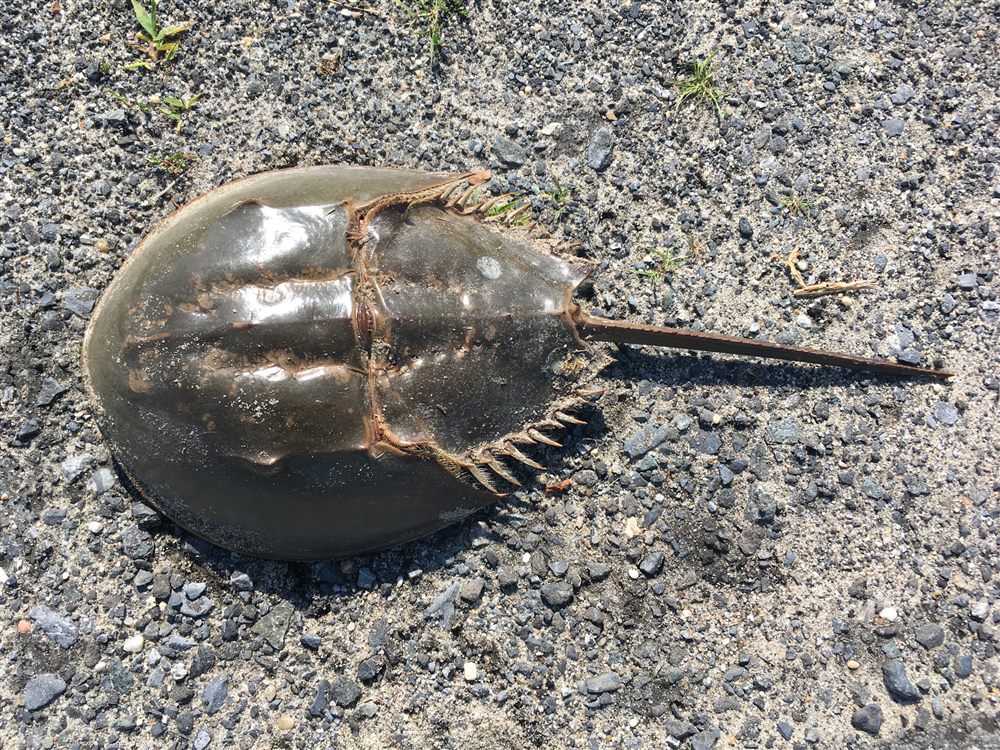
Atlantic Horseshoe Crab
Limulus polyphemus
What if it disappeared?
Impact HighAs soon as horseshoe crabs become scarce on a spawning beach, the millions of eggs they would have laid there each spring vanish almost immediately: that's what the surge in bait harvesting showed in the 1990s, a tenfold increase within just a few years, with egg availability on affected beaches collapsing quickly.
ExtrapolatedDetail
Extrapolation à partir de Niles et al. (2009), qui documente la hausse de récolte pour appât et la chute de plus de 90 % de la disponibilité des œufs sur l'ensemble de la décennie 1990, sans isoler le rythme exact de cette baisse dans les tout premiers mois suivant la raréfaction des limules sur une plage donnée.
The harvest of horseshoe crabs for fishing bait increased 10-fold during the 1990s, causing a more than 90% drop in egg availability on Delaware Bay's spawning beaches. The link between harvest and egg availability is direct and measured over the decade; the assumption that the drop began within the first spawning season after a local scarcity remains a plausible inference rather than a measurement isolated to that precise timescale.
What's missing to confirm it: A season-by-season measurement of egg availability during the 1990s harvest surge, to confirm whether the drop was as fast as the harvest increase itself.
That egg shortage directly starves the shorebirds that rely on it to complete their migration: over seventeen years, the red knot population that depends on Delaware Bay's beaches declined by more than 75%, a collapse measured alongside the more-than-90% drop in egg availability.
DocumentedDetail
Niles, L.J. et al. (2009). Effects of Horseshoe Crab Harvest in Delaware Bay on Red Knots: Are Harvest Restrictions Working? BioScience, 59(2), 153–164.
Horseshoe crab eggs, laid by the millions on Delaware Bay beaches each spring, are the concentrated food resource that lets several shorebird species rebuild fat reserves in just a few weeks before the final leg of their migration to the Arctic — a link so precisely timed and localized that these birds' survival depends directly on how the horseshoe crab fishery is managed.
Over a century without horseshoe crabs, Delaware Bay would likely lose its role as a migratory stopover for good: red knots and the other shorebirds that depend on it would have to find another concentrated food source along their route, or vanish from this particular migration flyway.
HypothesisOver a thousand years, the migration route running through Delaware Bay could vanish from the map entirely, with shorebirds redistributing to other stopovers elsewhere along the coast — a migratory network permanently redrawn, never quite rebuilt the same way even if horseshoe crabs eventually returned.
HypothesisDocumentation
-
IUCN Red List — Limulus polyphemus, statut de conservation
Accessed August 14, 2026
-
Maloney, Phelan & Simmons (2018) — Saving the horseshoe crab: A synthetic alternative to horseshoe crab blood for endotoxin detection, PLOS Biology
Accessed August 14, 2026
-
Niles et al. (2009) — Effects of Horseshoe Crab Harvest in Delaware Bay on Red Knots: Are Harvest Restrictions Working?, BioScience
Accessed August 14, 2026
Last verified: August 16, 2026